
The Context Window Trap
In my 25 years engineering systems at institutions like JPMorgan Chase and Morgan Stanley, I’ve seen every trend in software architecture come and go. But the current obsession with "larger context windows" is a dangerous band-aid for a fundamental architectural flaw. When you build agentic AI for enterprise workflows, you cannot rely on stuffing every past interaction into the prompt. It is expensive, slow, and technically unsound. The model does not "remember"; it merely sees more text. For true long-term agent memory architecture, we need systems that persist, retrieve, and reason over history without bloating the immediate context.
The industry is moving past the naive assumption that a 1M+ token window solves memory. It doesn’t. It solves latency problems temporarily while creating cost and accuracy nightmares. We need a shift from passive context to active memory retrieval. This is not just about storing chat logs; it is about structuring knowledge so an agent can answer, "What did I decide about the client's risk profile last Tuesday?" with precision, not hallucination.
From Stateful Sessions to Persistent Memory Stores
Enterprise agents operate in long-running loops. A fraud detection agent might run for hours, or a supply chain coordinator might operate across fiscal quarters. Standard session state is volatile. If the pod crashes, or if the conversation exceeds the window, the context is lost. To fix this, we must decouple the LLM’s immediate reasoning from the persistent store of truth.
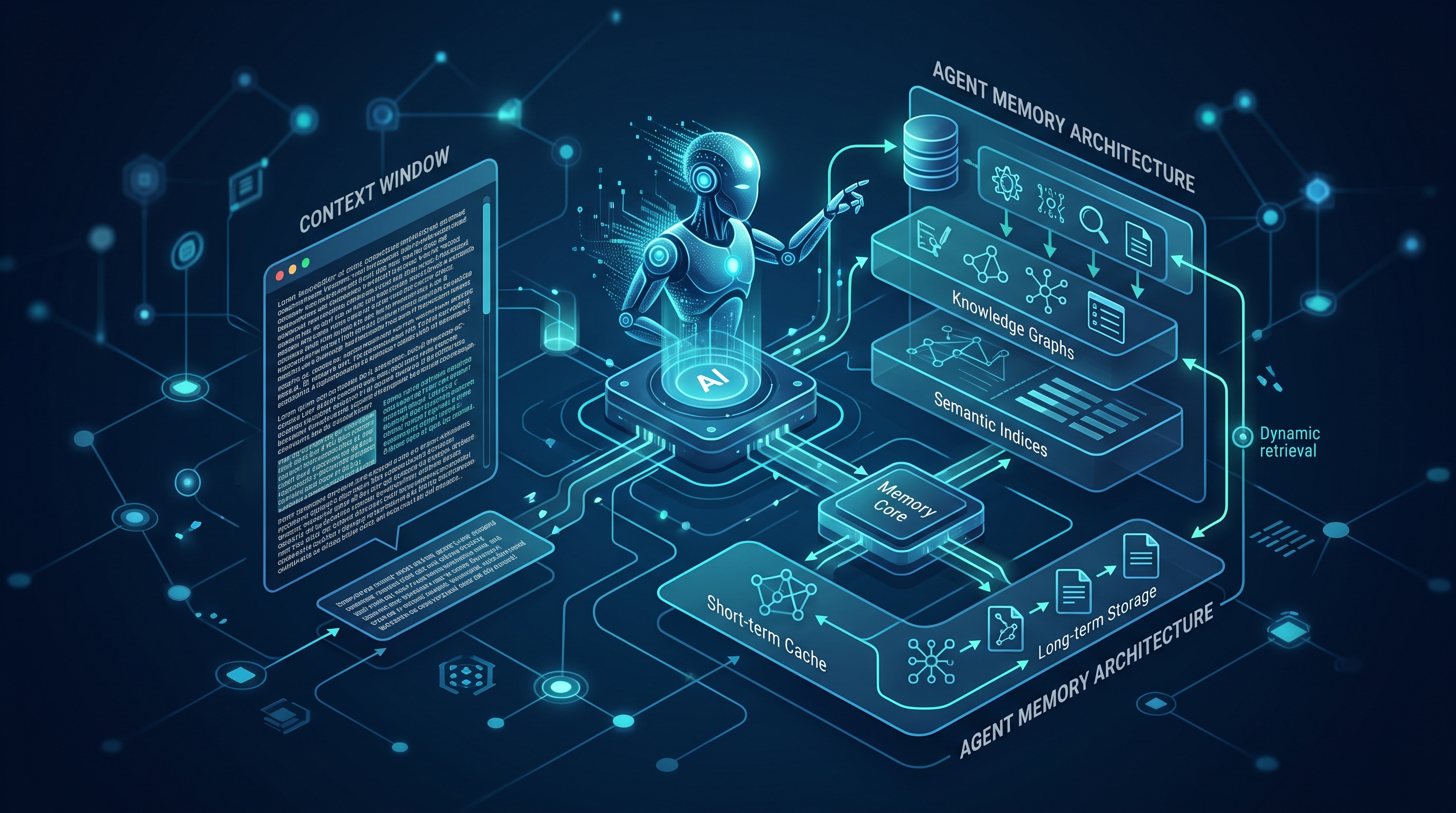
We are implementing a layered memory strategy that separates short-term working memory from long-term episodic and semantic memory. This approach mirrors how human cognition works and scales better for production workloads. Here is the breakdown of the components we are deploying in our 2026 infrastructure:
- Short-Term (Working) Memory: Held in the LLM context window. This includes the current task, immediate constraints, and the last 3-5 turns of conversation. It is high-cost and low-persistence.
- Episodic Memory: A timestamped log of specific events, decisions, and outcomes. Stored in a structured database (like PostgreSQL or DynamoDB) or a specialized vector store. This allows the agent to recall exact events, e.g., "On 2026-01-15, the user approved the vendor change."
- Semantic Memory: Aggregated knowledge, policies, and learned patterns. This is the "institutional knowledge" of the agent. It is updated via vector embeddings and allows the agent to reason based on general principles rather than specific past instances.
By separating these layers, we reduce the context window size by an estimated 60-70% during routine operations, significantly lowering token costs and improving inference speed. The agent only retrieves relevant snippets from long-term stores when necessary, rather than carrying the entire history.
Vector Embeddings and Semantic Retrieval
The engine of long-term memory is the vector database. In 2026, we no longer treat memory as simple text strings. We treat it as high-dimensional vectors that capture the semantic meaning of interactions. When an agent completes a task, the system doesn’t just save the transcript. It generates embeddings for the key insights, decisions, and outcomes.
We utilize hybrid search strategies, combining keyword search (for exact entity matches like account numbers or policy IDs) with vector search (for conceptual recall). For example, if a user asks, "Did we ever flag this transaction as suspicious?", the system searches for the semantic concept of "suspicious activity" rather than just the word "suspicious." This retrieval-augmented generation (RAG) pattern ensures that the agent’s responses are grounded in verified historical data.
The technical implementation involves a continuous embedding pipeline. As agents interact, new data is vectorized and indexed in real-time. We use libraries like LangChain or custom Python scripts to manage this flow, ensuring that the vector store remains consistent with the underlying transactional database. This dual-indexing approach is critical for enterprise-grade reliability. If you check out our deep dive on AI Agent Design Patterns for 2026, you will see how this fits into broader orchestration strategies.
Episodic Lifecycle and Pruning Strategies
Memory is not just about retention; it is about curation. An unmanaged memory store becomes a liability. It introduces noise, increases retrieval latency, and can lead to "catastrophic forgetting" or, more commonly, "context pollution" where outdated information interferes with current decisions. We implement strict lifecycle policies for episodic memory.
We categorize memory entries by relevance and recency. High-relevance events, such as security breaches or major financial transactions, are retained indefinitely. Low-relevance chitchat or temporary debugging logs are pruned after a defined window, such as 30 days. This pruning is not arbitrary; it is governed by business rules and compliance requirements. For instance, in a banking context, audit logs must be preserved for 7 years, while internal agent reasoning traces might only need to be kept for 90 days for performance tuning.
Furthermore, we implement periodic "memory consolidation" runs. During low-traffic periods, the system aggregates similar episodic memories. If an agent has handled 100 similar "password reset" requests, the system can summarize these into a single semantic pattern, reducing the vector store size while preserving the learned behavior. This consolidation step is crucial for maintaining the efficiency of the retrieval system as the volume of interactions grows into the millions.
Governance, Security, and Compliance in Memory
You cannot build an enterprise agent without rigorous governance. Memory is the most sensitive component of an AI system. It contains PII, PHI, and proprietary business logic. A breach in the memory store is a breach in the enterprise. We enforce strict access controls, encryption at rest and in transit, and comprehensive audit trails for every read and write operation to the memory store.
We also implement "memory leakage" prevention. Agents must not inadvertently store sensitive data in semantic memory if it violates regulatory guidelines. This requires a guardrail layer that scans outgoing data before it is committed to the long-term store. For more on this critical layer, see our guide on AI Agent Guardrails for Enterprise Production.
Compliance is not optional. We align our memory architecture with standards like SOC 2 and GDPR. This means the ability to delete specific data points upon request (the "right to be forgotten") must be technically feasible. Our vector stores support metadata filtering, allowing us to locate and remove specific records efficiently. This level of control is what distinguishes a hobby project from an enterprise-grade solution.
Frequently Asked Questions
What is the difference between episodic and semantic memory in AI agents?
Episodic memory refers to the specific, timestamped events and interactions an agent has experienced, similar to human autobiographical memory. Semantic memory, on the other hand, represents generalized knowledge, facts, and learned patterns that are abstracted from specific events. In practice, episodic memory is stored in structured logs or vector databases with temporal metadata, while semantic memory is often aggregated and updated through continuous learning processes.
How do I prevent context window bloat in long-running agents?
The key is to implement a retrieval-augmented generation (RAG) pattern where only relevant, retrieved snippets are added to the context window, rather than the entire conversation history. By offloading long-term storage to a vector database and using hybrid search to fetch only the most pertinent information, you can keep the context window small and focused, reducing costs and improving latency.
Is vector search sufficient for all enterprise memory needs?
No. Vector search excels at semantic similarity but struggles with exact matches, such as account numbers or specific transaction IDs. We recommend a hybrid approach that combines vector search with traditional relational or key-value stores. This ensures that you can retrieve both conceptual insights and precise data points accurately. See our article on Agent Sprawl and the Agentic Command Center for more on managing this complexity.
How often should memory be pruned or consolidated?
Pruning frequency depends on your data retention policies and computational resources. A common practice is to prune low-relevance data on a weekly or monthly basis, while consolidating similar episodes into semantic patterns during off-peak hours. Regular audits of the memory store’s size and retrieval accuracy are essential to determine the optimal schedule for your specific workload.