
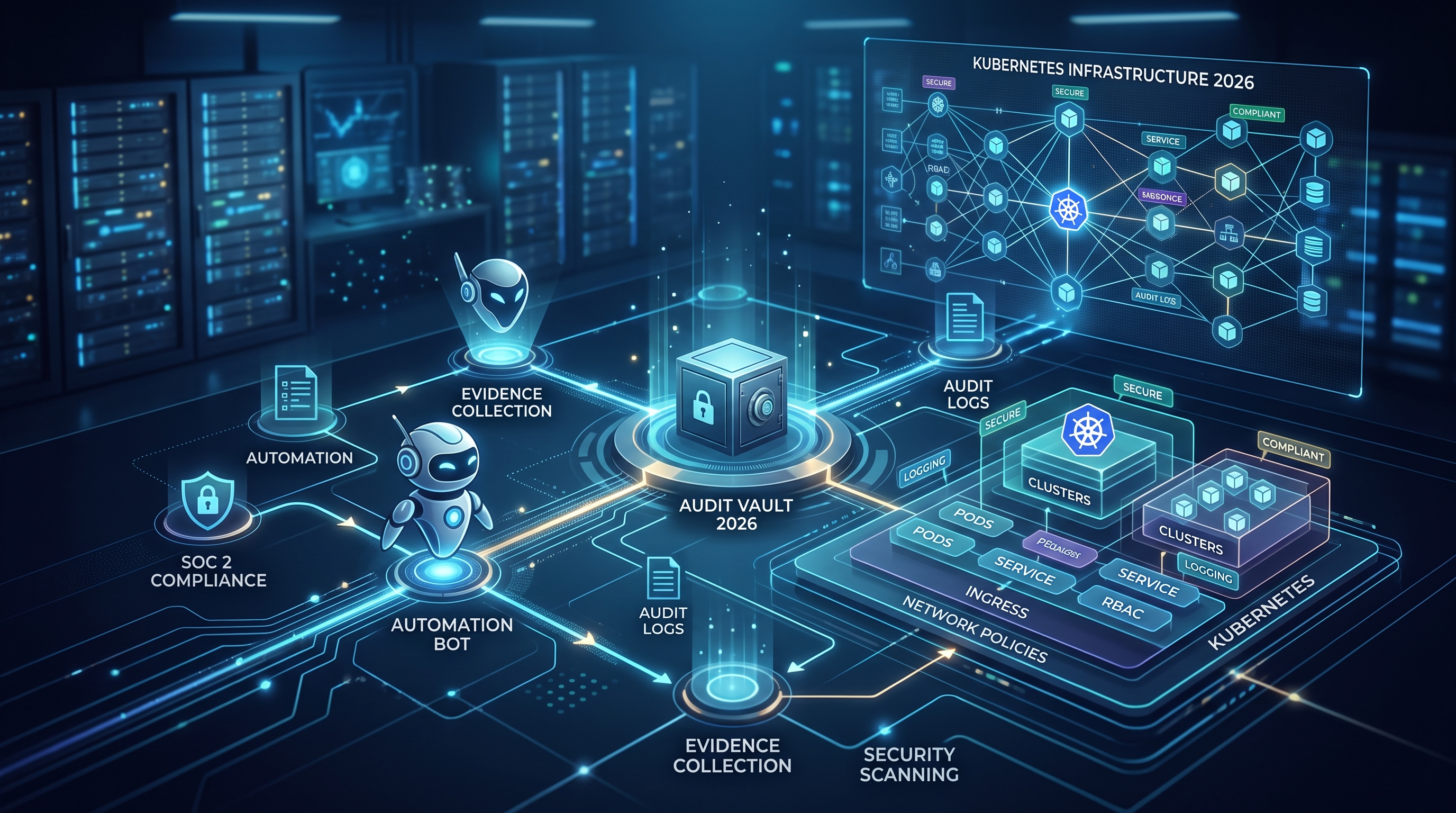
I spent 25 years in the trenches of enterprise banking, from JPMorgan Chase to Morgan Stanley. If there is one truth I have learned about compliance, it is this: SOC 2 audits are not about security; they are about evidence. And for too long, that evidence has been a chaotic mess of scattered logs, manual screenshots, and frantic Slack threads.
In 2026, the era of "audit readiness as a sprint" is over. We are moving to continuous compliance. The problem is that Kubernetes clusters are ephemeral. Pods die, nodes spin up and down, and configurations drift. If you are still manually collecting logs for your SOC 2 Type II report, you are failing. You need to automate the collection of evidence directly from the control plane and the data plane.
This is not about buying a black-box tool that promises to "fix" your compliance. It is about engineering a system where compliance is a property of the infrastructure, not an afterthought.
The Failure of Point-in-Time Auditing
Traditional compliance frameworks expect you to prove that your controls worked on a specific day, usually with a snapshot of data. In a Kubernetes environment, this is technically impossible to do accurately without significant overhead. By the time an auditor asks for the configuration of a specific pod, that pod has likely been replaced.
We need to shift from sampling to continuous verification. The goal is to have a persistent, tamper-evident log of every action that affects the security posture of your cluster. This includes admission control decisions, network policy changes, and secret rotations.
If you are looking to understand the broader shift in automation, read my analysis on agentic AI vs RPA automation ROI 2026. The distinction is critical: RPA mimics human clicks, while agentic AI understands intent and executes complex compliance workflows autonomously.
Declarative Policy as the Control Plane
The first step in automating SOC 2 evidence is to define your controls as code. We use tools like OPA (Open Policy Agent) or Kyverno to enforce rules at the admission controller level. When a developer tries to deploy a workload that violates a security policy—for example, running as root or exposing a port to the public internet—the request is denied immediately.
But here is the key: the denial itself is the evidence.
You must configure your admission controllers to emit structured logs for every decision. These logs should include:
- The timestamp of the request.
- The identity of the user or service account.
- The specific policy that was triggered.
- The outcome (allow/deny).
- A unique trace ID linking the event to the deployment pipeline.
This structured data becomes your primary source of truth. Instead of asking, "Did we block unauthorized changes?" you query the audit log. If the log shows 100% compliance over the audit period, the auditor accepts it. If there are gaps, you have a problem before the auditor does.
Continuous Monitoring and Log Aggregation
Evidence collection fails when logs are stored in silos. You need a centralized log aggregation pipeline that captures events from the Kubernetes API server, node agents, and sidecar containers. I recommend using a stack like Elasticsearch or Loki, but the tool matters less than the schema.
Your log schema must include non-repudiation fields. Every log entry must be signed by the system generating it. This prevents tampering. In a banking environment, I have seen teams use cryptographic hashing to link log batches. If a single byte in a log batch changes, the hash changes, and the integrity is broken.
Furthermore, you must automate the correlation of events. A SOC 2 auditor wants to see that access controls were enforced. If a user gains access to a sensitive database, you need to show:
- The authentication event.
- The authorization check.
- The subsequent query logs.
Automating this correlation requires advanced observability. We use AI agents for autonomous Kubernetes operations 2026 to detect anomalies and link them to compliance events. This reduces the noise and ensures that only relevant evidence is presented during an audit.
Agentic AI for Evidence Validation
This is where the 2026 landscape diverges from 2024. We no longer rely on static scripts to validate evidence. We use agentic AI to perform continuous control monitoring. These agents act as virtual auditors. They constantly review the state of the cluster against the SOC 2 criteria.
For example, an agent can:
- Scan all namespaces for unencrypted secrets.
- Verify that network policies are applied to all ingress traffic.
- Check that backup jobs have completed successfully.
- Generate a compliance report in the required format.
This is not about replacing human auditors. It is about providing them with a verified, real-time dashboard. The agent flags deviations immediately, allowing your team to remediate before the auditor ever sees them. This reduces the "audit fatigue" that plagues engineering teams.
I have also written about AI agent governance in enterprise compliance 2026 to discuss the risks of letting AI make compliance decisions. The key is human-in-the-loop validation for high-risk controls.
Automating the Audit Trail
The final piece of the puzzle is the audit trail itself. SOC 2 requires that you maintain records for a specific period, usually 7 years. Storing raw Kubernetes logs for 7 years is expensive and impractical. Instead, you need to create a compressed, immutable archive of compliance evidence.
This archive should include:
- Monthly snapshots of policy configurations.
- Quarterly reviews of access controls.
- Annual penetration test results.
- Continuous logs of critical security events.
You can automate this using a CI/CD pipeline. Every time a compliance report is generated, it is stored in an S3 bucket with WORM (Write Once, Read Many) protection. The pipeline also updates a dashboard that shows the current compliance posture. This makes the audit process a formality rather than a crisis.
Frequently Asked Questions
How do I handle private data in automated evidence collection?
You must implement data masking at the ingestion layer. Never store raw PII or secrets in your compliance logs. Use field-level encryption or tokenization before the data enters your aggregation pipeline. This ensures that even if the logs are compromised, the evidence is useless to an attacker.
Can I use open-source tools for SOC 2 compliance?
Absolutely. Most of the heavy lifting—policy enforcement, log aggregation, and alerting—can be done with open-source tools like OPA, Falco, and Prometheus. However, you need significant engineering effort to stitch them together into a coherent evidence pipeline. The cost is in labor, not licenses.
How often should I run compliance checks?
Continuous is the goal. However, for practical purposes, run deep scans weekly and lightweight checks every 15 minutes. The lightweight checks should focus on critical controls like authentication and network isolation. This balances performance with security.
What if an auditor asks for evidence I cannot provide?
If you cannot provide automated evidence, you must provide a compensating control. For example, if you cannot automate the review of access logs, you might have a manual process with documented sign-offs. However, this is a last resort. Automated evidence is always preferred and is easier to verify.