
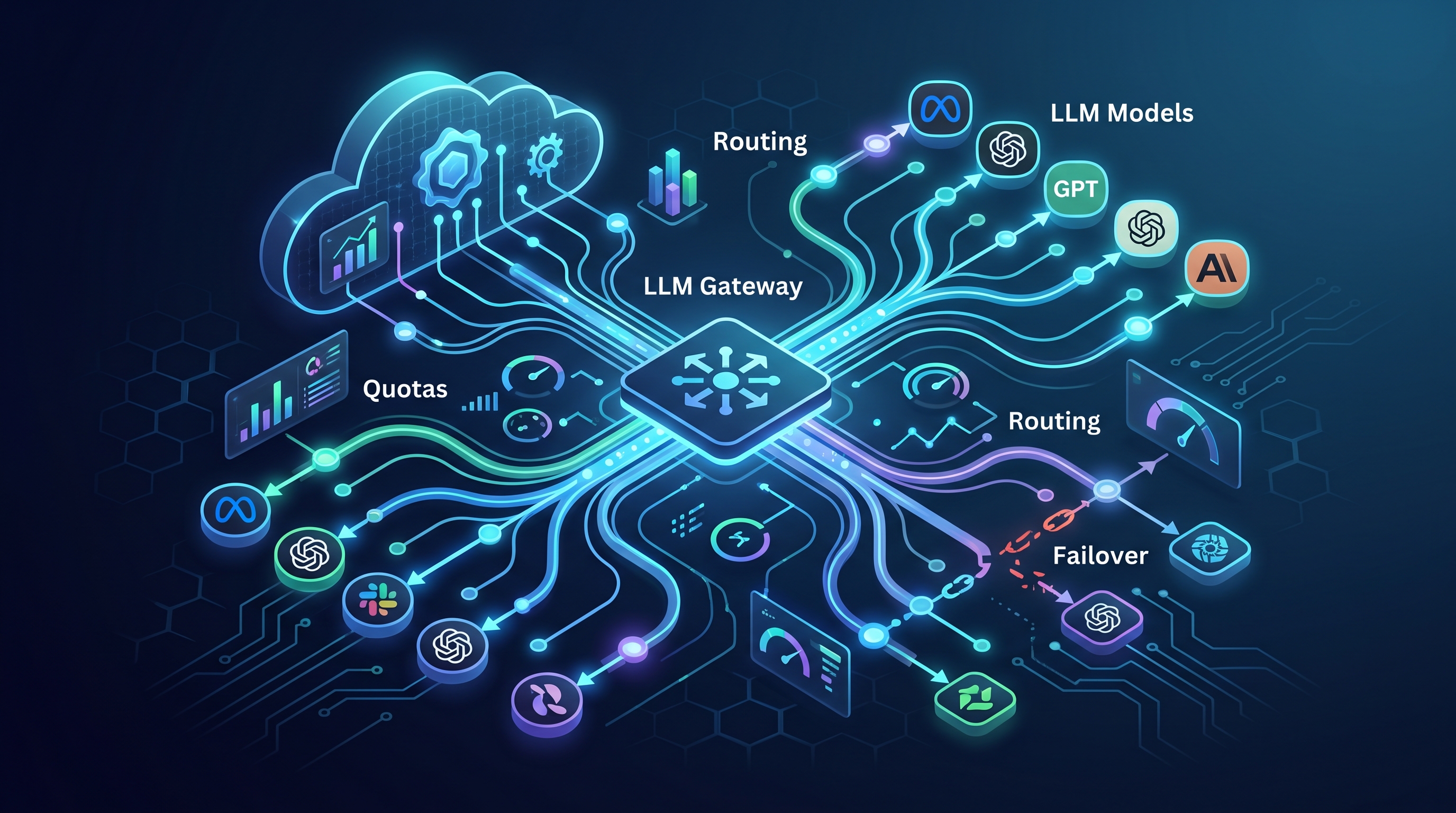
After twenty-five years navigating the infrastructure trenches at institutions like JPMorgan Chase and Morgan Stanley, I’ve seen every trend come and go. But the current shift toward agentic AI and embedded LLMs is different. It’s not just about deploying models; it’s about governing them. In 2026, the "LLM Gateway" has evolved from a simple reverse proxy into a sophisticated control plane. It is the single point of truth for routing, quota management, and failover.
If you are still letting your microservices call model APIs directly, you are bleeding money and risking availability. This post details the architecture of a production-grade LLM gateway, focusing on the triad of routing, quotas, and failover.
The Architecture of the Enterprise LLM Gateway
An enterprise LLM gateway sits between your application layer (or Agentic AI orchestrators) and the underlying model providers. It is not merely a load balancer; it is a policy engine. The core responsibilities include authentication, request transformation, routing decisions, rate limiting, and observability.
In a Kubernetes-native environment, this gateway typically runs as a high-availability service mesh sidecar or an ingress controller plugin. It must handle thousands of concurrent requests, parse structured outputs, and enforce security policies before the request ever hits a GPU cluster or a third-party API.
The complexity lies in the fact that modern AI workloads are non-deterministic and resource-heavy. A simple round-robin approach fails because different models have different latency profiles, cost structures, and accuracy levels. We need intelligence at the edge.
Intelligent Routing Strategies
Routing is the first line of defense and optimization. In 2026, routing is no longer static. It is dynamic, context-aware, and cost-sensitive. A robust gateway evaluates each incoming request against several criteria before deciding which model endpoint to target.
Consider the following routing logic:
- Cost-Based Routing: For simple data retrieval tasks, route to a smaller, cheaper model (e.g., a distilled 7B parameter model) rather than a flagship 70B+ model.
- Latency-Based Routing: For interactive chat interfaces, prioritize models with the lowest Time-to-First-Token (TTFT). If the primary low-latency model is congested, fallback to a slightly slower but more accurate model.
- Capability-Based Routing: Use a lightweight classifier to determine if the query requires complex reasoning. If yes, route to a high-performance reasoning model; otherwise, use a standard completion model.
- Geographic Routing: Route requests to the nearest data center to minimize network latency, especially for global enterprises.
This approach directly ties into llm cost optimization, as discussed in my previous analysis on enterprise inference strategies. By avoiding the overuse of expensive models for trivial tasks, organizations can reduce their AI spend by up to 40%.
Quota Management and Rate Limiting
Without quotas, an LLM gateway is a liability. Unchecked usage leads to budget overruns, service degradation, and potential denial-of-service scenarios. Quota management must operate at multiple levels: per-user, per-application, and per-model.
Hard quotas are non-negotiable. If a department has a monthly budget of $10,000 for API calls, the gateway must reject requests that would exceed this limit, returning a clear 429 Too Many Requests error with a retry-after header.
However, hard limits alone are insufficient. We need soft limits that trigger alerts and gradual throttling. The gateway should track usage in real-time using a distributed counter backed by Redis or a similar high-speed store.
Key quota features include:
- Token-Based Limits: Track input and output tokens separately. Different models may have different token pricing, so granularity matters.
- Request Rate Limits: Limit the number of requests per second (RPS) per user to prevent burst-induced congestion.
- Concurrent Connection Limits: Restrict the number of active in-flight requests to protect the gateway itself from being overwhelmed.
Implementing these quotas requires precise instrumentation. Ensure your gateway exports metrics to Prometheus, allowing you to set alerts for quota thresholds being approached.
Failover and Circuit Breaking
No model provider is 100% available. In 2026, we cannot afford to let a single vendor outage take down your entire AI capability. A robust LLM gateway must implement intelligent failover mechanisms.
Failover is not just about switching to a backup model; it is about maintaining the user experience. If a primary model returns an error or exceeds a latency threshold, the gateway should automatically retry the request on a secondary model.
Implement circuit breakers to prevent cascading failures. If a specific endpoint is failing, the gateway should stop sending traffic to it for a predetermined period, allowing the backend to recover.
The failover logic should consider:
- Health Checks: Continuous probing of model endpoints for availability and latency.
- Error Codes: Differentiate between transient errors (5xx) and permanent errors (4xx). Retry on transient, reject on permanent.
- Latency Thresholds: If the primary model’s latency exceeds the 95th percentile threshold, trigger a failover to a faster, albeit potentially less accurate, model.
This resilience pattern is crucial for maintaining SLAs. For more on maintaining high availability in AI infrastructure, review our guide on gpu optimized kubernetes llm inference.
Frequently Asked Questions
Q: Can I use an open-source LLM gateway for enterprise workloads?
A: Yes, but you must harden it. Open-source gateways like OpenLSS or custom-built proxies based on Envoy or Traefik are viable. However, you must add enterprise-grade authentication, audit logging, and quota management. Relying on the default configuration is a security risk.
Q: How do I handle model versioning in the gateway?
A: Treat model versions as distinct endpoints. The gateway should maintain a mapping of logical model names (e.g., "production-reasoning") to specific versioned endpoints (e.g., "v2.1-model"). This allows you to update the underlying model without changing the application code, provided the API contract remains stable.
Q: What is the impact of LLM gateways on latency?
A: A well-optimized LLM gateway adds negligible latency, typically less than 5-10 milliseconds, due to the efficiency of modern reverse proxy engines. The overhead is minimal compared to the hundreds of milliseconds or seconds involved in LLM inference. However, poor configuration, such as excessive logging or complex routing logic, can introduce significant delays.
Q: How do I monitor the effectiveness of my routing rules?
A: Monitor key metrics such as latency, error rates, cost per request, and user satisfaction scores. Use A/B testing to compare the performance of different routing strategies. Regularly review these metrics to adjust your routing policies and ensure they align with business goals.
Building an LLM gateway is not a one-time task; it is an ongoing process of optimization. As the landscape of AI models evolves, your gateway must adapt. By implementing intelligent routing, strict quotas, and robust failover mechanisms, you can build an AI infrastructure that is resilient, cost-effective, and secure.