
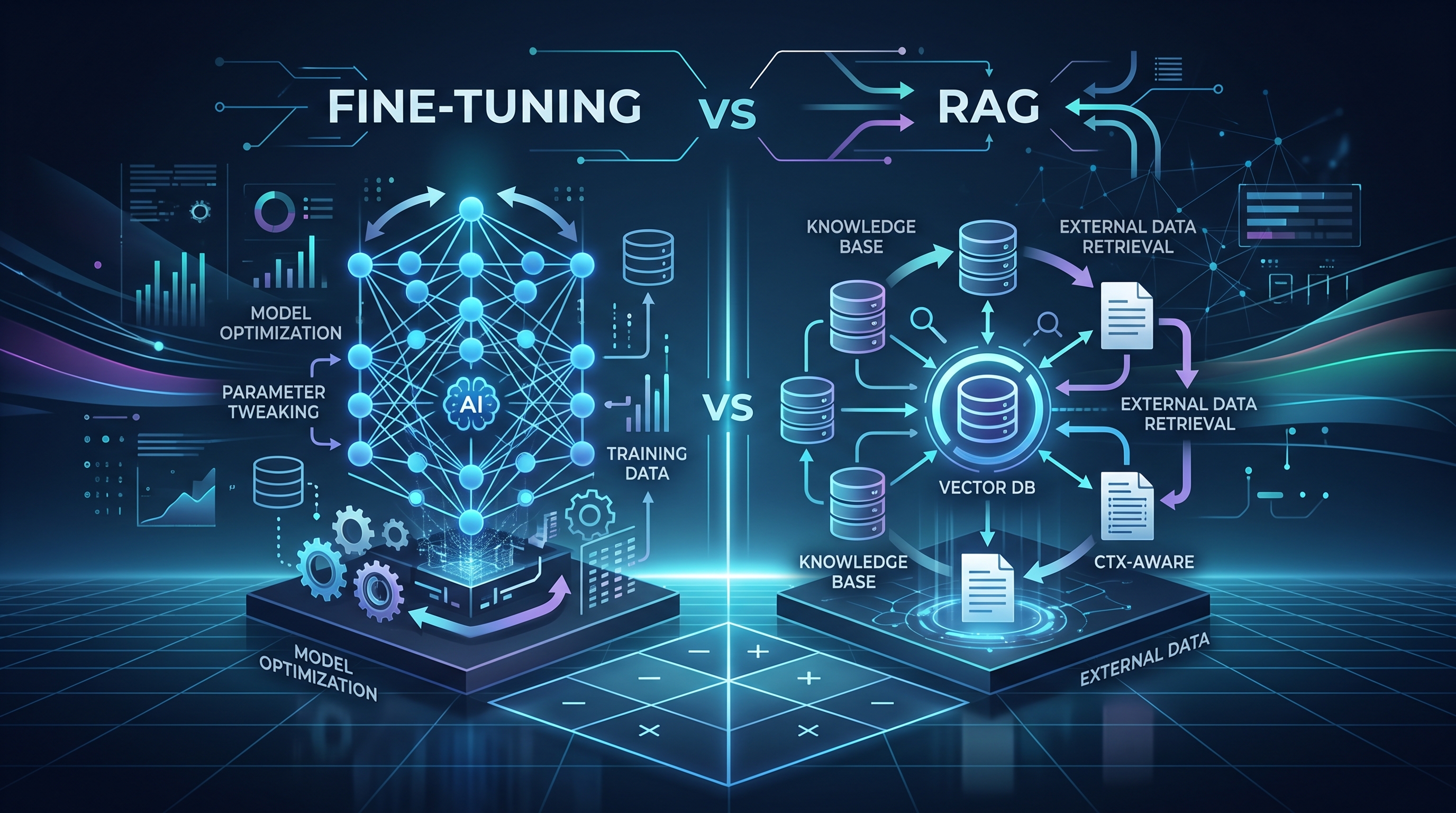
I have spent the last two decades watching hype cycles come and go. In 2017, it was microservices. In 2019, it was serverless. Today, it is Generative AI. But unlike the container revolution, where the tooling was standardized quickly, the debate around Large Language Model (LLM) integration is still muddy. I see teams paralyzed by the "fine-tuning versus rag decision 2026" because they are treating it as a binary choice. It is not. It is a spectrum of trade-offs.
After leading AI initiatives at JPMorgan Chase and Deutsche Bank, I can tell you that the "right" choice depends entirely on your data’s volatility, your latency constraints, and your compliance posture. Let’s cut through the noise and look at the engineering reality.
The Core Distinction: Knowledge vs. Behavior
Before writing a single line of code or spinning up a Kubernetes cluster, you must define what problem you are solving.
Retrieval-Augmented Generation (RAG) is fundamentally about knowledge grounding. You are not changing the model’s weights. You are providing it with external context at inference time. This is ideal when your data changes frequently, is proprietary, or requires strict factual accuracy. If you are building a customer support bot that needs to reference the latest product manual released yesterday, RAG is the only viable path. Fine-tuning a model on a daily-updating knowledge base is computationally absurd.
Fine-tuning, conversely, is about behavioral alignment. You are modifying the model’s internal weights to learn a specific pattern, style, or logical framework. This is best for tasks that require consistent formatting, domain-specific reasoning, or instruction following. For example, if you need an LLM to always output JSON in a specific schema for your legacy backend, fine-tuning is more efficient than crafting 50 pages of prompt engineering.
When to Choose RAG: The Data Freshness Argument
In enterprise environments, data is rarely static. If your use case involves querying internal documents, codebases, or customer records, RAG is usually the starting point.
The primary advantage of RAG is that it decouples knowledge from the model. You can update your vector database without retraining. However, this comes with engineering overhead. You need a robust ingestion pipeline. You need to chunk your data effectively. And you need to manage vector embeddings.
Consider the latency. A well-optimized RAG pipeline adds approximately 200-500 milliseconds of overhead for retrieval and chunking before the LLM even starts generating. If your SLA requires sub-200ms responses, you have a problem. But for most enterprise queries, this is acceptable.
Furthermore, RAG preserves the model’s general reasoning capabilities. You are not sacrificing breadth for depth. You are just adding a source of truth. If you are worried about hallucinations, RAG is your first line of defense. You can implement a "grounding check" where the system verifies if the answer exists in the retrieved context before presenting it to the user.
For those looking to scale this architecture, see my deep dive on [scaling-rag-pipeline-production-scaling-2026.html] for practical tips on handling millions of documents.
When to Choose Fine-Tuning: The Efficiency Argument
Fine-tuning is often misunderstood as a magic bullet. It is not. It is expensive and rigid. However, it shines in scenarios where you need the model to *behave* in a specific way.
- Instruction Following: If you need the model to consistently extract entities from unstructured text into a specific JSON structure, fine-tuning can achieve 95%+ accuracy where prompt engineering might only hit 85%.
- Token Efficiency: A fine-tuned model can often understand complex instructions with fewer tokens. If you are processing high-volume batch jobs, reducing the prompt length by 30% can significantly cut your inference costs.
- Domain Language: If your engineers use specific acronyms or jargon that the base model ignores, fine-tuning on internal documentation can teach the model to recognize these terms.
The downside? You lose the ability to "unlearn" bad behavior easily. If your fine-tuned model starts hallucinating, you have to retrain or adjust your dataset. You cannot just update a vector index. Also, the cost of fine-tuning a 7B parameter model can range from $500 to $2,000 depending on the compute resources and the duration of the training run.
The Hybrid Approach: The 2026 Standard
In my experience, the most robust enterprise systems use a hybrid approach. We use fine-tuning to teach the model *how* to reason and *how* to format output. Then, we use RAG to provide the *facts*.
For example, a legal compliance bot might be fine-tuned to recognize legal terminology and format responses in a specific regulatory style. Then, it retrieves relevant case laws from a RAG pipeline. This combines the structural integrity of fine-tuning with the factual accuracy of RAG.
If you are deploying these systems on Kubernetes, ensure you have the right resource quotas. Read our guide on [rag-systems-kubernetes-deployment-2026.html] to avoid common pitfalls in managing GPU resources for these combined workloads.
Cost and Operational Complexity
Let’s talk money. RAG is generally cheaper to maintain but more expensive to run per query due to the retrieval step. Fine-tuning has a high upfront cost but lower marginal cost per query if the model is smaller and faster.
| Feature | RAG | Fine-Tuning | | :--- | :--- | :--- | | Data Freshness | Instant | Requires Retraining | | Hallucination Risk | Low (with grounding) | Medium/High | | Initial Cost | Low | High | | Operational Overhead | High (ETL/Vector DB) | Medium (Training Pipeline) | | Best For | Factual Querying | Style/Format/Logic |
Frequently Asked Questions
Is RAG better than fine-tuning for customer support?
Generally, yes. Customer support queries require up-to-date information about products, policies, and troubleshooting steps. RAG allows you to update your knowledge base in real-time without retraining the model. Fine-tuning is useful for setting the tone and empathy of the response, but RAG handles the facts.
Can I use both RAG and fine-tuning together?
Absolutely. This is the recommended approach for complex enterprise applications. Use fine-tuning to align the model’s behavior and formatting, and use RAG to ground the content in your proprietary data. This hybrid model reduces hallucinations and improves consistency.
How do I measure the success of a fine-tuning job?
You need a held-out test set that reflects real-world usage. Evaluate not just on accuracy, but on format compliance and latency. A fine-tuned model that is 10% more accurate but 2x slower may not be worth the trade-off. Use metrics like BLEU, ROUGE, and human evaluation for nuanced tasks.
What is the typical latency impact of adding RAG?
Adding a RAG layer typically increases latency by 200-500 milliseconds due to the retrieval and chunking process. However, this is negligible for most user-facing applications. If you need sub-100ms responses, you may need to optimize your vector database or cache frequently accessed results.