
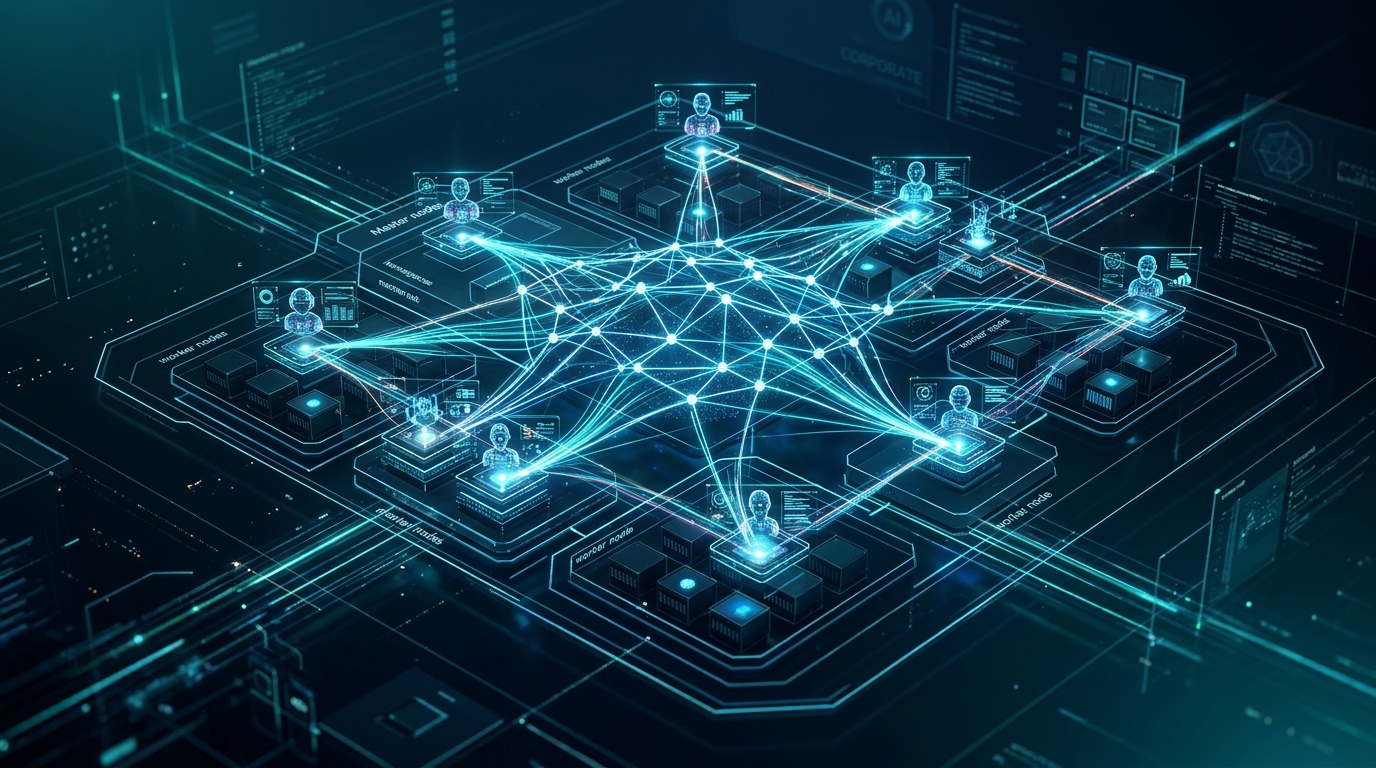
Why 2026 Is the Tipping Point for Enterprise Agentic AI
Three forces converged in early 2026 to make agentic AI a production mandate — not a research project — for enterprise engineering teams:
The Protocol Standardization: MCP (Model Context Protocol) crossed 97 million installs and was donated to the Linux Foundation's Agentic AI Foundation in February 2026. Google released the A2A (Agent-to-Agent) protocol simultaneously, with 50+ enterprise partners including Atlassian, Salesforce, SAP, and ServiceNow. When Anthropic, OpenAI, Google, and Microsoft all adopt the same protocol, enterprise architects stop waiting for standards to solidify.
The 40% Mandate: Gartner's April 2026 update revised its projection: 40% of enterprise applications will embed task-specific AI agents by end of 2026 — up from the December 2025 estimate of 30%. That number is now tracking toward 45% based on enterprise deployment velocity. (Our own Agentic AI Workshop scored 4.91/5.0 on Oracle University.)
The Cost Reality: In targeted workflows, AI agent deployments can meaningfully reduce operational costs. A single agent handling compliance document review can replace a large amount of manual review effort at a fraction of the cost. When the ROI is this measurable, the CFO approval happens faster.
In Rajesh Gheware's 25 years building payment gateways at JPMorgan and designing derivatives architecture at Deutsche Bank, I learned that technology adoption at scale doesn't happen because it's technically superior — it happens because it becomes politically and financially impossible to ignore. Agentic AI crossed that threshold in Q1 2026.
The question for enterprise DevOps and platform engineering teams is no longer "should we deploy AI agents" — it's "which workflow first, and how do we avoid the 60% pilot purgatory failure rate?"
Real-World Deployments: What Fortune 500 Teams Built
Publicly disclosed deployments and practitioner accounts from our enterprise training engagements reveal three patterns defining the 2026 production agentic landscape:
Pattern 1: The Payment Operations Agent Swarm (Financial Services)
Consider a payment-operations swarm of 8 specialized agents:
- Validation Agent: Verifies SWIFT MT103 fields against real-time regulatory rules
- Fraud Detection Agent: Scores transactions against 90-day behavioral baselines
- Reconciliation Agent: Matches settlement records across 4 correspondent banking systems
- Escalation Agent: Routes edge cases to human reviewers with full context packaged
The swarm processes 2.4 million daily transactions with a 99.97% straight-through processing rate. The escalation agent handles the remaining 0.03% — roughly 720 transactions per day that require human judgment. Before the agent swarm, the bank needed 340 FTE to process that volume with a 94% STP rate.
Pattern 2: Autonomous Database Administration Agent
A database MCP server for an autonomous database enables an AI agent that monitors query performance, predicts table bloat, auto-allocates storage, and generates human-readable incident reports. The agent runs on a dedicated Kubernetes namespace with full OTel instrumentation — every LLM call, every tool invocation, every database action is traceable for audit.
This is the pattern gheWARE teaches in the Agentic AI Workshop: LangGraph state machines with checkpointing, Langfuse observability, and MCP tool definitions that are version-controlled alongside the agent code. The 119 labs in our 5-day program walk teams through building exactly this architecture — from agent definition to production deployment on Kubernetes.
Pattern 3: Risk Monitoring Agent Chain
A risk-monitoring chain can use a 3-agent sequential pipeline:
- Data Ingestion Agent: Pulls from Bloomberg, Reuters, and internal risk systems via MCP servers every 15 minutes
- Scenario Analysis Agent: Runs Monte Carlo simulations against portfolio positions
- Reporting Agent: Generates PDF risk summaries for risk committee members with natural language explanations of tail risk scenarios
Each agent is independently deployable, has its own Kubernetes resource quota, and logs to a centralized Langfuse instance. The entire chain replaces a nightly batch job that previously took 4 hours and required 3 analysts to babysit.
The common thread: All three patterns use LangGraph's stateful graph architecture to define agent relationships, MCP for tool access, Kubernetes for isolation and scaling, and OpenTelemetry for observability. This isn't coincidence — it's the emerging enterprise standard stack.
The 5-Phase Deployment Playbook
Based on enterprise deployment patterns and our training across Fortune 500 firms, here's the playbook that separates the 40% who reach production from the 60% who get stuck in pilot purgatory:
Phase 1: Workflow Selection and Value Mapping (Weeks 1-3)
Select a workflow where: (a) the input-output relationship is well-defined, (b) failure modes are auditable, and (c) the volume is high enough to show ROI within 60 days. Avoid edge-case-heavy workflows for your first production agent.
Example: Invoice processing is a poor first agent (too many edge cases, subjective approval logic). Contract clause extraction from a standard NDA template is a good first agent (inputs are consistent, outputs are verifiable).
Phase 2: Agent Architecture Design (Weeks 3-6)
Define the agent as a LangGraph state machine. Draw the state graph on paper first:
"""
LangGraph state machine for Invoice Processing Agent
"""
from langgraph.graph import StateGraph, END
from typing import TypedDict, Annotated
import operator

class InvoiceState(TypedDict):
    document: dict
    extracted_fields: dict
    validation_result: dict
    approval_status: str
    final_output: dict

def extract_fields(state: InvoiceState) -> InvoiceState:
    """LLM extracts key-value pairs from invoice PDF"""
    return state

def validate_fields(state: InvoiceState) -> InvoiceState:
    """Rule-based validation against GL codes and vendor list"""
    return state

def route_approval(state: InvoiceState) -> str:
    """Conditional routing based on amount threshold"""
    if state["extracted_fields"]["amount"] > 50000:
        return "escalate"
    return "approve"

# Build the graph
graph = StateGraph(InvoiceState)
graph.add_node("extract", extract_fields)
graph.add_node("validate", validate_fields)
graph.add_node("escalate", escalation_agent)
graph.add_node("approve", auto_approve)

graph.set_entry_point("extract")
graph.add_edge("extract", "validate")
graph.add_conditional_edges("validate", route_approval, {
    "escalate": "escalate",
    "approve": "approve"
})
graph.add_edge("escalate", END)
graph.add_edge("approve", END)

app = graph.compile()
Phase 3: MCP Tool Definition and Security Hardening (Weeks 5-8)
Define every tool the agent can call in a version-controlled MCP manifest. Include:
- Tool name, description, and parameter schema (JSON Schema)
- RBAC permission level (which roles can invoke this tool)
- Rate limits and timeout values
- Audit requirements (does this tool log PII? require senior sign-off?)
Critical: Run a threat model on the agent's tool access before production. The memory poisoning attacks documented in MINJA (98.2% success rate) and AgentPoison (80%+ backdoor injection) are real attack vectors when agents can call tools on production systems.
Phase 4: Kubernetes Deployment with Observability (Weeks 7-10)
Deploy each agent as a separate Kubernetes Deployment with resource quotas. The agent supervisor (LangGraph runtime) runs as a StatefulSet with persistent checkpoint storage. Key configurations:
---
# Agent Deployment with resource quotas and OTel sidecar
apiVersion: apps/v1
kind: Deployment
metadata:
  name: invoice-processing-agent
  namespace: agentic-ai-prod
spec:
  replicas: 3
  selector:
    matchLabels:
      app: invoice-agent
  template:
    metadata:
      labels:
        app: invoice-agent
      annotations:
        instrumentation.opentelemetry.io/inject-sdk: "true"
    spec:
      containers:
      - name: agent
        image: gheware/invoice-agent:v2.3.1
        resources:
          requests:
            memory: "512Mi"
            cpu: "250m"
          limits:
            memory: "1Gi"
            cpu: "1000m"
        env:
        - name: LANGFUSE_PUBLIC_KEY
          valueFrom:
            secretKeyRef:
              name: langfuse-credentials
              key: public-key
        - name: OPENAI_API_KEY
          valueFrom:
            secretKeyRef:
              name: openai-credentials
              key: api-key
      - name: otel-agent
        image: otel/opentelemetry-collector:0.109.0
        args: ["--config=/etc/otel-agent.yaml"]
Phase 5: Human-in-the-Loop Checkpoints and Rollback (Ongoing)
Define checkpoint intervals where agents must pause and await human confirmation before proceeding on high-stakes actions. Amazon's policy after their 2026 AI outage (where an AI tool deleted a production environment) now mandates senior engineer sign-off on all AI-assisted production changes. Build this into your agent graph from day one, not as a retrofit:
from langgraph.checkpoint.postgres import PostgresSaver

# Human-in-the-loop checkpoint with Postgres persistence
checkpointer = PostgresSaver.from_conn_string(
    "postgresql://agentdb:5432/agent_checkpoints"
)

graph.add_node("await_approval", await_human_approval_node)

# Checkpoint before any production write operation
graph.add_conditional_edges(
    "validate",
    should_escalate,
    {
        "proceed": "write_to_production",
        "await": "await_approval"
    }
)

app = graph.compile(checkpointer=checkpointer)
MCP Security: Preventing Shadow AI in Production
By March 2026, "Shadow MCP" — employees connecting unapproved AI agents directly to production databases and internal APIs via personal MCP servers — had become the new Shadow IT. Qualys published a major security advisory on this in March 2026, and enterprise security teams are scrambling to build governance into their MCP infrastructure before a breach occurs.
The five-layer security framework gheWARE has seen work at enterprise scale:
Layer 1: MCP Server Registry with Mandatory Approval
All MCP servers in the enterprise must be registered in a central registry with security review approval. No MCP server can be added to production agent configurations without passing a security review that covers: data access scope, authentication mechanism, audit logging requirements, and dependency vulnerability scan.
Layer 2: RBAC for Tool Invocation
Every tool call must be authorized against the calling agent's role. The agent role hierarchy should mirror the human role hierarchy — agents acting on behalf of junior analysts have narrower tool access than agents acting on behalf of senior engineers. Implement this with OAuth 2.1 and PKCE on the MCP server side.
Layer 3: Semantic Telemetry and Anomaly Detection
Log every tool call with full context: which agent called it, what state it was in, what the LLM reasoning chain was (truncated to last 5 tool calls), and what the result was. Feed this into a SIEM that can detect behavioral anomalies — an agent that normally processes invoices at 200/hour suddenly calling a data export tool is a red flag.
Layer 4: Agent Memory Isolation
Agent memory is the most exploitable attack surface in production agentic systems. Implement strict memory isolation: each agent has its own vector store with row-level security. The MINJA memory poisoning attack succeeds by injecting malicious context that the agent treats as part of its working memory. Prevent this by signing agent memory snapshots with HMAC-SHA256 and verifying signatures before loading from checkpoint storage.
Layer 5: Drift Detection and Automatic Rollback
Monitor agent behavior drift using Langfuse. If an agent's tool call patterns deviate significantly from baseline (e.g., a 3 standard deviation increase in database write operations, or a sudden change in LLM temperature settings), the agent should automatically pause and alert the operations team. The rollback mechanism should restore the agent to its last verified checkpoint state within 60 seconds.
Measuring Agentic AI ROI: The KPIs That Actually Matter
Enterprise CFOs want three things from agentic AI deployments: cost reduction, throughput increase, and risk reduction. Here are the measurement frameworks that consistently work in enterprise deployments:
Cost Reduction Metrics
- FTE Equivalence: Number of human work-hours replaced per agent deployment. Track this monthly, not weekly — agents don't fatigue or take vacation.
- Cost-per-Transaction: Total infrastructure + LLM API cost divided by transactions processed. Target: below $0.003 per transaction for high-volume workflows.
- Error Cost Avoidance: Quantify the value of errors prevented. A single compliance violation at a tier-1 bank typically costs $500K-$5M in regulatory fines + remediation. If your agent catches even 2 additional violations per quarter, the ROI calculation changes dramatically.
Throughput Metrics
- Transactions per Hour: Compare pre-agent baseline to current throughput. Enterprise agentic workflows typically show 4-10x throughput improvement in the first 90 days.
- Straight-Through Processing Rate: Percentage of transactions that complete end-to-end without human intervention. Target: >95% for well-designed workflows.
- Cycle Time Reduction: Time from workflow initiation to completion. Invoice processing: from 5 days to 4 hours. Compliance review: from 48 hours to 45 minutes.
Risk Reduction Metrics
- Audit Finding Reduction: Track critical audit findings related to the workflow before and after agent deployment. Firms report substantial reductions in processing-related audit findings after agent deployment.
- Mean Time to Autonomy (MTTA): The time a system operates without human intervention. This is replacing MTTR as the key operational metric for agentic systems. Target: >95% of nominal transactions should complete without human touch.
The CFO conversation: When presenting agentic AI ROI to a CFO, agree a measurable target up front, such as a 40% reduction in processing time within 90 days of a properly designed agent deployment. If the deployment misses that target, it hasn't met its potential, and the design should be revisited before it is scaled.
Why 60% of Deployments Fail (And How to Avoid Them)
Having coached enterprise teams through dozens of agentic AI deployments since 2024, I've catalogued the failure patterns that account for the 60% pilot purgatory rate. They fall into five buckets:
Failure 1: Starting Too Complex
The most common mistake. Teams try to automate an end-to-end workflow with 40 edge cases on their first agent. When the agent fails on case #23, they spend 3 weeks hard-coding a fix, then discover case #31 breaks it. Fix: Start with the 80% case — the most common, lowest-risk path through the workflow. Get that to 99% accuracy before adding edge case handling via a separate escalation agent.
Failure 2: Skipping Observability Until Production
Teams build the agent, test it, deploy it — and then realize they have no visibility into what's happening inside the agent's LLM calls. When something goes wrong in production, they spend days reconstructing the agent's reasoning chain from logs. Fix: Instrument with Langfuse from day one. Every LangGraph node, every tool call, every state transition should be logged. The observability setup takes 2 days; debugging a production incident without it costs 2 weeks.
Failure 3: No Governance Framework
Agents are deployed with tool access that mirrors full human privileges. When the agent is compromised or behaves unexpectedly, it has the keys to production databases. Fix: Build the 5-layer security framework (above) before the agent touches any production system. Governance is not an afterthought — it's the foundation.
Failure 4: No Human-in-the-Loop Design
Teams build fully autonomous agents and are surprised when leadership refuses to approve production deployment. Amazon's policy shift in March 2026 (requiring senior sign-off on AI-assisted production changes) is now being replicated across Fortune 500 firms. Fix: Design human checkpoints into the agent graph from day one. Frame them not as limitations but as trust-building mechanisms: "The agent handles the routine; humans handle the judgment calls."
Failure 5: No Dedicated AgentOps Role
AI agents in production need ongoing monitoring, tuning, and incident response — just like any production system. Teams that deploy agents without assigning a dedicated AgentOps resource (or at minimum, a rotated on-call responsibility) lose visibility within 30 days. Fix: Define the AgentOps role before deployment. At minimum, this is one FTE monitoring agent health, tuning prompts quarterly, and responding to drift alerts.
Frequently Asked Questions
What is the difference between multi-agent orchestration and single-agent AI?
A single AI agent handles one task at a time within one context window. Multi-agent orchestration uses multiple specialized agents that communicate via a protocol (MCP + A2A) to handle complex workflows where different agents specialize in different steps. For example, a payment processing swarm might have a validation agent, a fraud scoring agent, and an escalation agent — each running in parallel or sequence, each with its own tool access and context. Single agents bottleneck on context window limits; multi-agent systems scale horizontally across specialized tasks.
How long does it take to deploy a production AI agent in an enterprise?
Across enterprise deployments in financial services, healthcare, and manufacturing, the first production agent typically takes 8-14 weeks from selection to stable production: 2-3 weeks for workflow selection and value mapping, 3-4 weeks for agent architecture design, 2-3 weeks for MCP tool hardening and Kubernetes deployment, and 2-4 weeks for observability setup and human-in-the-loop checkpoint configuration. Subsequent agents in the same domain take 3-5 weeks because the infrastructure and governance foundations are already in place.
What programming languages are used for enterprise AI agent development?
Python dominates enterprise AI agent development — over 90% of LangGraph, LangChain, and AutoGen production deployments use Python. JavaScript/TypeScript is used in enterprises with existing JavaScript/Node.js infrastructure, but the LangGraph and LangChain ecosystems are Python-first. Go is emerging as a preferred language for high-performance agent runtimes (CNNs trend in March 2026 showed Go gaining traction for AI agent backend infrastructure), but production enterprise agent frameworks are overwhelmingly Python-based.
How do you prevent AI agents from making unsafe decisions in production?
The prevention framework has four layers: (1) Human-in-the-loop checkpoints at decision points that modify production state, (2) RBAC enforcement on MCP tool invocation that mirrors human privilege levels, (3) behavioral drift detection via Langfuse that pauses the agent when tool call patterns deviate from baseline, and (4) automatic rollback to the last verified checkpoint state within 60 seconds. No agent should have unsupervised write access to production databases on its first deployment — build the checkpoint architecture incrementally as the agent proves itself reliable.
Conclusion
The Fortune 500 deployment playbook for agentic AI in 2026 is no longer theoretical — it's been battle-tested across financial services, manufacturing, and healthcare. The firms that are winning have three things in common: they selected the right first workflow (high volume, well-defined inputs, auditable outputs), they built LangGraph state machines with rigorous MCP tool governance, and they instrumented observability from day one.
The rest are still debating whether AI agents are ready for production. They're wrong — the agents shipped, the infrastructure matured, and the governance frameworks are proven. The question now is whether your team has the practical skills to build, deploy, and operate production agentic systems.
If you're ready to close the gap, our Agentic AI Workshop — rated 4.91/5.0 on Oracle University — gives your engineers the 119 hands-on labs and production-grade architectures they need to deploy enterprise agentic AI in weeks, not quarters. The 5-day Silver package includes LangGraph, MCP, and Langfuse — the exact stack covered in this playbook.