
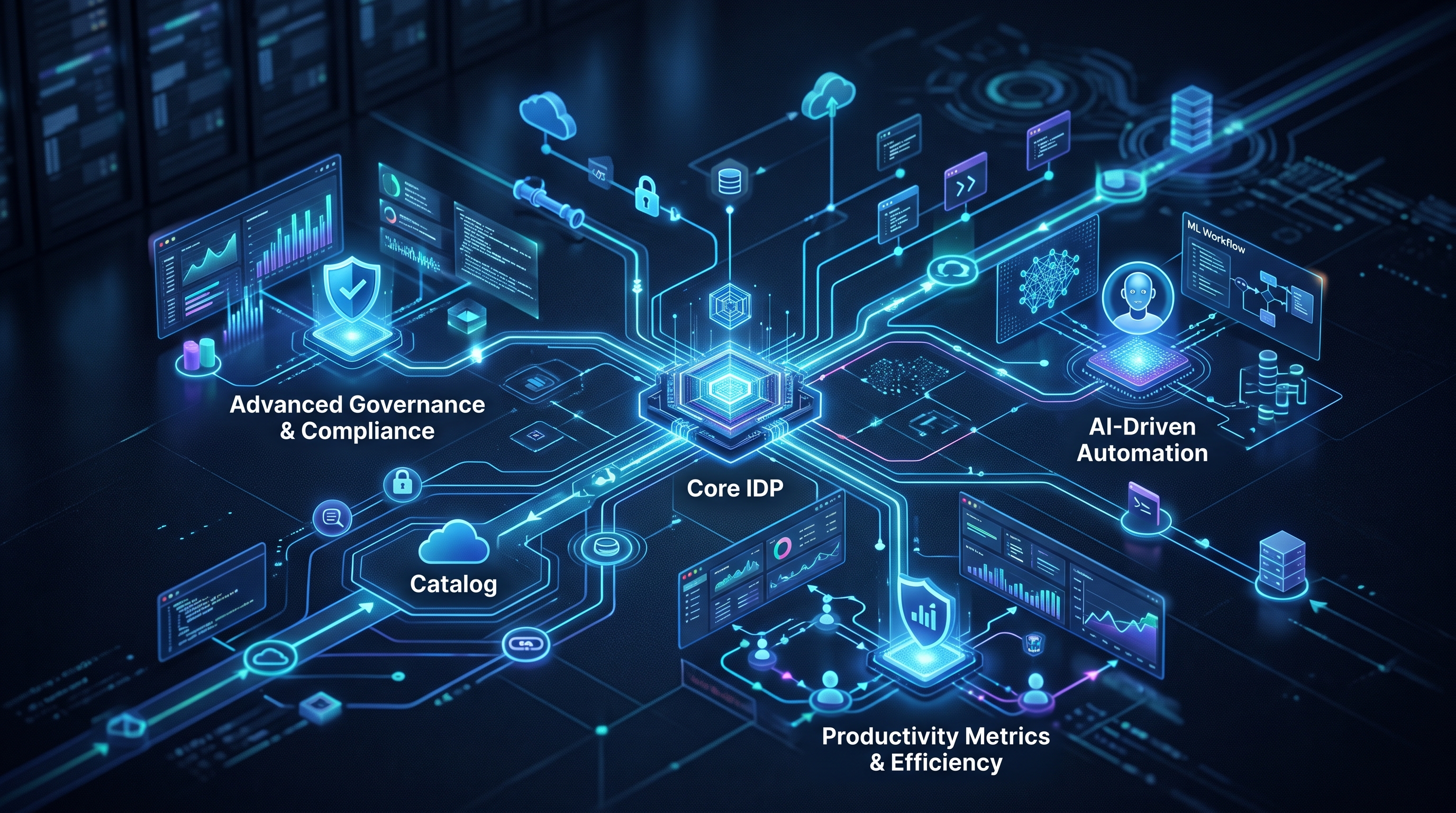
The Reality of Platform Engineering in 2026
After twenty-five years in enterprise finance, from JPMorgan Chase to Deutsche Bank, I have seen the cycle repeat: teams adopt a new tool, promise efficiency, and then drown in configuration. The "Internal Developer Platform" (IDP) is no different. In 2026, the hype around platform engineering has matured into a hard requirement. But most organizations are building the wrong thing. They are building catalogs for the sake of catalogs, not reducing cognitive load for the engineers who actually write code.
An internal developer platform must be invisible. If an engineer has to read a manual to deploy a service, the platform has failed. The goal is to reduce the time from commit to production by at least 40%, not by adding more gates, but by removing the friction of boilerplate, security scanning, and infrastructure provisioning. Backstage, originally from Spotify and now a CNCF project, remains the de facto standard for the user interface of these platforms, but it is not a silver bullet. It is a framework that requires serious engineering to make work.
Why Backstage is a Starting Point, Not a Destination
Many teams treat Backstage as the platform itself. This is a fundamental error. Backstage is the frontend and the orchestrator; the real value lies in the plugins, the custom components, and the integrations with your CI/CD pipelines. In 2026, a successful IDP integrates seamlessly with your existing toolchain rather than trying to replace it.
The core value proposition of Backstage is the Software Catalog. It provides a single source of truth for all software assets. However, a catalog is only as good as its data freshness. If the catalog is out of date, developers will ignore it. You must automate the ingestion of metadata from Git repositories, container registries, and deployment tools. This means integrating with tools like ArgoCD, Jenkins, or GitHub Actions to update entity status in real-time.
I have seen teams spend six months building a beautiful catalog that no one uses. The lesson is simple: build for the developer, not for the manager. The platform must solve immediate pain points, such as generating new microservices with pre-configured logging, tracing, and security policies. This is where the concept of "Golden Paths" comes in. By providing a curated set of templates that are correct by default, you guide developers toward best practices without forcing them to learn every underlying technology.
Implementing Golden Paths and Self-Service
Golden paths are not just templates; they are enforced standards. When a developer creates a new service using the Backstage template, they should get a Kubernetes namespace, a CI/CD pipeline, and a monitoring dashboard automatically. This reduces the setup time from days to minutes. In my experience, this automation can reduce onboarding time for new services by 70%.
The key to successful golden paths is flexibility. Developers must be able to deviate from the standard when necessary, but the default must be secure and compliant. This requires a robust plugin architecture. You need to build custom plugins that enforce security policies, such as ensuring all containers run as non-root or that secrets are managed through a vault. These plugins should be integrated into the workflow, not as a post-deployment check, but as a pre-commit or pre-deployment gate.
Consider the following critical components for a robust IDP:
- Service Templates: Pre-configured scaffolds for microservices with standard libraries and configurations.
- Infrastructure as Code (IaC) Generators: Tools that generate Terraform or Pulumi code for common infrastructure patterns.
- Security Scanners: Integrated tools that scan code and containers for vulnerabilities before deployment.
- Observability Dashboards: Automatic generation of Grafana or Datadog dashboards for new services.
By providing these components as part of the platform, you shift the burden of compliance and operations from the developer to the platform team. This allows developers to focus on business logic rather than infrastructure details. For a deeper look at how platform engineering differs from traditional DevOps, read my analysis on platform engineering vs devops in 2026.
Integrating AI and Agentic Workflows
The landscape of 2026 is defined by the integration of AI into the development workflow. An internal developer platform must leverage AI to assist developers, not replace them. This includes AI-driven code reviews, automated test generation, and intelligent incident response. Backstage can be extended with AI plugins that provide context-aware suggestions based on the codebase and historical data.
For example, an AI agent can analyze a pull request and suggest optimizations based on previous deployments. It can also predict potential failures based on infrastructure metrics. This requires a tight integration with your observability tools. If you are managing AI workloads, you need to understand the unique challenges of LLM ops and Kubernetes in 2026. The platform must support the specific resource requirements and latency constraints of AI models.
Moreover, security must be at the core of this integration. Zero-trust architecture is no longer optional. Every service, every API call, and every data access point must be verified. The platform should enforce zero-trust policies automatically, ensuring that services only communicate with authorized peers. This is critical for maintaining security in a microservices architecture. Read more about zero-trust DevOps implementation to understand how to secure your platform.
Measuring Success and Iterating
How do you know if your internal developer platform is working? You must measure outcomes, not outputs. Metrics such as deployment frequency, lead time for changes, and change failure rate are essential. However, these are lagging indicators. You also need leading indicators, such as the percentage of services using golden paths, the time spent on infrastructure tasks, and developer satisfaction scores.
I recommend conducting regular feedback sessions with developers. Ask them what frustrates them, what tools they bypass, and where they feel stuck. The platform is a product, and like any product, it requires continuous iteration. Do not build a platform that you think is right; build a platform that developers find useful. This might mean simplifying the interface, adding more automation, or removing features that add complexity without value.
Cost optimization is also a key metric. With the rise of cloud-native architectures, costs can spiral out of control. Ensure that your platform includes tools for monitoring and optimizing resource usage. Read my guide on kubernetes cost optimization for practical strategies to reduce waste.
Frequently Asked Questions
Is Backstage suitable for large enterprises?
Yes, but only if treated as a framework. Backstage is highly extensible and has been adopted by major financial institutions. However, it requires significant engineering effort to customize and integrate with existing systems. It is not a turnkey solution.
How do I measure the ROI of an internal developer platform?
Focus on developer productivity metrics. Track the reduction in time-to-production, the decrease in infrastructure-related tickets, and the increase in deployment frequency. Also, survey developers to gauge satisfaction and perceived efficiency gains.
Can Backstage replace our existing CI/CD tools?
No. Backstage is an orchestrator and a catalog. It should integrate with your existing CI/CD tools like Jenkins, GitLab CI, or GitHub Actions. Trying to replace these tools often leads to unnecessary complexity and loss of functionality.
What is the biggest mistake teams make with Backstage?
The biggest mistake is focusing on the catalog rather than the developer experience. A beautiful catalog is useless if it does not help developers ship code faster and more securely. Always prioritize usability and automation over aesthetics.