
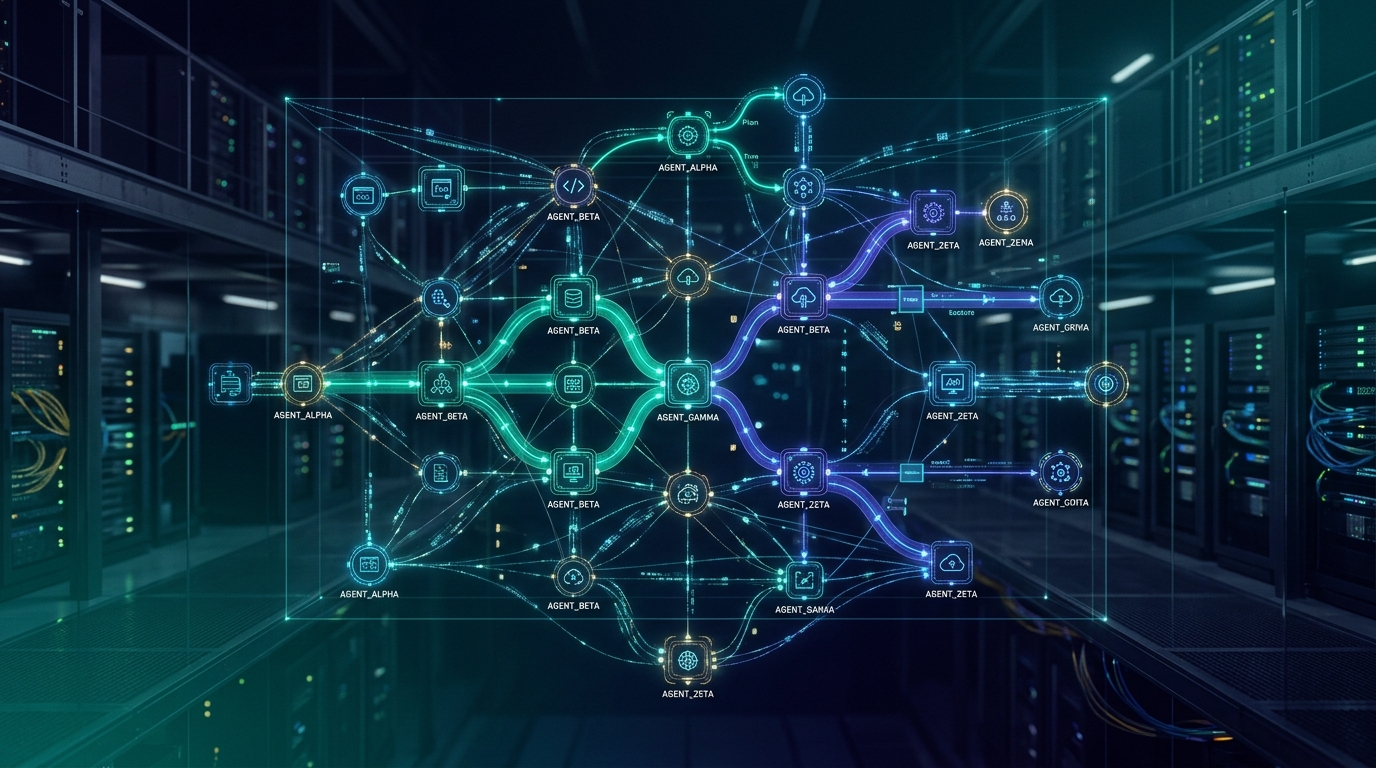
Why Multi-Agent Orchestration Dominates 2026
Gartner named multi-agent systems one of the most impactful emerging technologies for 2026. The reasoning is straightforward: single-agent AI systems hit a ceiling when confronted with enterprise-scale workflows. A chatbot that answers policy questions is useful. A system where a triage agent, a document verification agent, a risk-scoring agent, and an approval agent work together to process an insurance claim in 90 seconds — that is transformative.
The shift is visible across every vertical. In financial services, where Rajesh Gheware spent 25 years architecting payment and derivatives platforms, the pressure is particularly acute. Regulatory reporting alone involves fetching data from multiple systems, validating against compliance rules, generating audit trails, and routing to the correct regulatory body — a workflow that no single LLM call sequence can reliably automate.
Multi-agent orchestration solves this by assigning each cognitive task to a specialized agent with a defined role, knowledge scope, and action boundary. The agents communicate through structured message passing, enabling parallel execution, conditional branching, and human-in-the-loop checkpoints at critical decision points.
Three market forces are accelerating adoption in 2026:
- Governance mandates: As AI agents make consequential decisions, regulators in the EU, US, and India require explainability and audit trails — which multi-agent graphs provide by design
- Legacy integration: Enterprises cannot replace core banking or ERP systems; multi-agent architectures act as an intelligent middleware layer that orchestrates across existing systems without requiring rip-and-replace
- Agentic AI workforce readiness: The emergence of "agent ops" teams means enterprises need frameworks that human agents can monitor, intervene in, and optimize — LangGraph's checkpointing and streaming make this operationally viable
LangGraph's Graph-Based Architecture: How It Actually Works
LangGraph models multi-agent workflows as directed graphs. Each node represents either a computational step (an LLM call, a tool invocation, a routing decision) or an agent. Each edge represents the flow of information and control between nodes. The critical innovation is that LangGraph graphs are stateful — a central state object persists across graph steps, carrying accumulated context, agent outputs, and workflow metadata from one node to the next.
This differs fundamentally from LangChain's linear chain model. LangChain chains are acyclic and stateless — each step sees only the output of the previous step. LangGraph supports cycles, which means an agent can revisit a previous step based on new information. This is essential for workflows that require iteration: a compliance agent might reject a transaction and route back to a document collection agent for additional information.
LangGraph's architecture has five core components that make it enterprise-grade:
1. State and Checkpointing
Every graph execution maintains a state dictionary. LangGraph's checkpointing mechanism snapshots state at each step, enabling durable execution. If a Kubernetes pod crashes mid-workflow, the graph resumes from the last checkpoint rather than restarting from scratch. This is non-negotiable for long-running enterprise workflows that span hours or days (e.g., a KYC process that waits for document uploads).
2. Nodes as Agent Functions
Nodes are Python functions that receive the current state and return state updates. A multi-agent graph typically has a router node (which decides which specialized agent to invoke), several specialist agent nodes, and a supervisor or reducer node (which merges multi-agent outputs back into a coherent state).
Here is a simplified Python example of a LangGraph multi-agent architecture for an incident management workflow:
from langgraph.graph import StateGraph, END
from langgraph.checkpoint.memory import MemorySaver
from typing import TypedDict, Annotated
import operator

class IncidentState(TypedDict):
    alert_id: str
    alert_type: str
    triage_result: str | None
    assigned_agent: str | None
    resolution: str | None
    escalation_required: bool
    messages: list

def router_node(state: IncidentState) -> IncidentState:
    """Routes alert to the appropriate specialist agent."""
    alert_type = state["alert_type"]
    if "payment" in alert_type.lower():
        return {"assigned_agent": "payment_specialist"}
    elif "auth" in alert_type.lower():
        return {"assigned_agent": "auth_specialist"}
    else:
        return {"assigned_agent": "generalist_agent"}

def triage_node(state: IncidentState) -> IncidentState:
    """Performs initial triage and determines urgency."""
    alert = state["alert_id"]
    # Triage logic here — calls LLM or rule engine
    severity = classify_alert(alert)
    return {
        "triage_result": severity,
        "escalation_required": severity == "critical"
    }

def build_incident_graph():
    workflow = StateGraph(IncidentState)

    workflow.add_node("router", router_node)
    workflow.add_node("triage", triage_node)
    workflow.add_node("payment_specialist", payment_specialist_node)
    workflow.add_node("auth_specialist", auth_specialist_node)
    workflow.add_node("generalist_agent", generalist_node)
    workflow.add_node("supervisor", supervisor_node)

    # Define edges
    workflow.set_entry_point("router")
    workflow.add_edge("router", "triage")
    workflow.add_edge("triage", "payment_specialist", condition=lambda s: s.get("assigned_agent") == "payment_specialist")
    workflow.add_edge("triage", "auth_specialist", condition=lambda s: s.get("assigned_agent") == "auth_specialist")
    workflow.add_edge("triage", "generalist_agent", condition=lambda s: s.get("assigned_agent") == "generalist_agent")
    workflow.add_edge("payment_specialist", "supervisor")
    workflow.add_edge("auth_specialist", "supervisor")
    workflow.add_edge("generalist_agent", "supervisor")
    workflow.add_edge("supervisor", END)

    checkpointer = MemorySaver()  # Redis/Postgres in production
    return workflow.compile(checkpointer=checkpointer)
3. Conditional Edges and Routing
LangGraph's conditional edges are where multi-agent intelligence lives. The router node doesn't just pass work to the next step — it evaluates the current state and selects which agent or branch to invoke. This enables true parallel agent dispatch and conditional escalation paths.
4. Streaming and Human-in-the-Loop
LangGraph supports token-level streaming, which means users see agent outputs as they are generated — critical for UX in customer-facing agent systems. More importantly, LangGraph supports interrupt mechanisms that pause graph execution pending human approval. For a financial services workflow where an agent wants to approve a wire transfer exceeding a threshold, the graph can halt, surface the transaction details to a human reviewer, and resume only upon approval or rejection.
5. Error Handling and Recovery
Enterprise workflows must handle partial failures gracefully. LangGraph supports retry policies on individual nodes and the ability to define fallback paths. If the payment specialist agent times out, the graph can route to the generalist agent while logging the failure for post-incident review.
4 Enterprise Use Cases That Prove ROI
In Rajesh Gheware's 25 years building systems at JPMorgan Chase, Deutsche Bank, and Morgan Stanley, the pattern emerges across every enterprise transformation: the ROI case is made not with pilots, but with production workloads that replace manual processes. Here are four multi-agent LangGraph deployments that have demonstrated clear business value in 2026.
1. Automated Incident Management (IT Operations)
A global bank's IT operations team deployed a LangGraph multi-agent system where a triage agent ingests alerts from Splunk, Datadog, and PagerDuty, classifies them by type and severity, routes critical alerts to on-call specialists, and generates a first-response incident report. The system handles approximately 2,000 alerts per day, with the triage agent achieving 94% accuracy in routing — freeing senior engineers from 70% of their initial alert review workload. Time-to-acknowledgment dropped from 18 minutes to under 3 minutes for critical incidents.
2. KYC/AML Workflow Automation (Banking)
Know Your Customer and Anti-Money Laundering compliance is notoriously manual. A European private bank automated their KYC review process using a LangGraph graph with four specialized agents: a document extraction agent (pulls data from passports, utility bills, and corporate registry documents), a sanctions screening agent (cross-references against OFAC, EU, and UN sanctions lists), a risk scoring agent (assigns a risk tier based on transaction patterns and PEP database matches), and a compliance review agent (generates the final recommendation with supporting evidence). The multi-agent system processes 340 customer onboardings per day at 4.2x the throughput of the manual process, with a 0.3% error rate compared to 2.1% for human reviewers.
3. Insurance Claims Processing
An Indian general insurer reduced their motor claims processing time from 72 hours to 4 hours using a LangGraph multi-agent chain. The claims intake agent validates policy coverage, the damage assessment agent interfaces with computer vision models that analyze vehicle photos, the coverage determination agent applies the policy rules, and a fraud detection agent runs a risk score before final approval. Claims under INR 50,000 are auto-approved; higher-value claims route to a human adjuster with a pre-populated recommendation report. The system handles 1,200 claims per day across 14 regional offices.
4. Enterprise Customer Support Escalation
A B2B SaaS company handling enterprise support tickets deployed a LangGraph graph that routes inbound tickets through a classification agent (identifies product area, urgency, and contract tier), a knowledge retrieval agent (fetches relevant documentation and prior tickets), and a resolution agent (generates a draft response using the retrieved context). Tickets classified as "critical" by the triage agent route directly to a senior support engineer with a pre-composed escalation summary. First response time dropped 61%, and customer satisfaction scores increased from 3.8 to 4.4 out of 5.
Kubernetes Deployment: Production Patterns That Scale
LangGraph multi-agent systems are not monoliths. A production deployment with 5 to 12 specialized agents requires a microservices architecture on Kubernetes where each agent runs as an independent, horizontally scalable service. Here is the reference architecture that gheWARE uses in its Agentic AI workshop labs.
Architecture Overview
The system has four layers: an API gateway (handles authentication, rate limiting, and request routing), the LangGraph orchestration layer (runs the state machine graph), individual agent services (stateless Docker containers that receive state from the graph and return updates), and a state store (Redis for streaming checkpoints, PostgreSQL for durable state persistence).
# Kubernetes Deployment for a LangGraph Agent Service
apiVersion: apps/v1
kind: Deployment
metadata:
  name: payment-specialist-agent
  namespace: agentic-ai
spec:
  replicas: 3
  selector:
    matchLabels:
      app: payment-specialist-agent
  template:
    metadata:
      labels:
        app: payment-specialist-agent
    spec:
      containers:
      - name: agent
        image: gheware/payment-specialist-agent:v2.4.1
        ports:
        - containerPort: 8000
        env:
        - name: REDIS_URL
          valueFrom:
            secretKeyRef:
              name: langgraph-secrets
              key: redis-url
        - name: LLM_PROVIDER
          value: "openai"
        - name: OPENAI_API_KEY
          valueFrom:
            secretKeyRef:
              name: llm-secrets
              key: openai-api-key
        resources:
          requests:
            memory: "512Mi"
            cpu: "250m"
          limits:
            memory: "2Gi"
            cpu: "1000m"
        livenessProbe:
          httpGet:
            path: /health
            port: 8000
          initialDelaySeconds: 15
          periodSeconds: 20
        readinessProbe:
          httpGet:
            path: /ready
            port: 8000
          initialDelaySeconds: 5
          periodSeconds: 10
---
apiVersion: autoscaling/v2
kind: HorizontalPodAutoscaler
metadata:
  name: payment-specialist-agent-hpa
  namespace: agentic-ai
spec:
  scaleTargetRef:
    apiVersion: apps/v1
    kind: Deployment
    name: payment-specialist-agent
  minReplicas: 3
  maxReplicas: 20
  metrics:
  - type: Resource
    resource:
      name: cpu
      target:
        type: Utilization
        averageUtilization: 70
  - type: Pods
    pods:
      metric:
        name: agent_queue_depth
      target:
        type: AverageValue
        averageValue: "50"
LangGraph Checkpointing in Production
The checkpointing layer is the most critical production component. The MemorySaver used in development is insufficient for multi-day workflows or multi-replica deployments. Production deployments use Redis (for low-latency streaming checkpoints during active workflows) backed by PostgreSQL (for durable long-term state persistence). LangGraph's SqliteSaver and RedisSaver integrators handle the serialization and retrieval of graph state across pod restarts.
from langgraph.checkpoint.postgres import PostgresSaver
from langgraph.checkpoint.redis import RedisSaver
from langgraph.graph.state import CompiledStateGraph

# Production checkpointer with Redis streaming + Postgres durability
checkpointer = PostgresSaver.from_conn_string(DATABASE_URL)
checkpointer.setup()  # Creates required tables

# For sub-minute checkpoint latency during active workflows
redis_checkpointer = RedisSaver.from_url(REDIS_URL)

# The graph compiles with the production checkpointer
incident_graph = build_incident_graph().compile(
    checkpointer=checkpointer
)
API Gateway and Service Mesh
In a multi-agent system where 8 agents might be invoked in a single user request, latency management is critical. The API gateway should implement circuit breakers per agent service, retries with exponential backoff, and a timeout budget that fails gracefully if the overall graph execution exceeds an SLA threshold. Istio or Linkerd service mesh provides mTLS between agent services and traffic policies that prevent a single misbehaving agent from overwhelming the system.
Governance and Security for Multi-Agent Systems
Multi-agent systems introduce governance challenges that single-agent deployments do not. When five agents collaborate to approve a loan, who is accountable for the decision? When an agent escalates to a human reviewer, what information must be surfaced? When a prompt injection attack targets one agent, how does it propagate through the graph?
These are not theoretical concerns. In Rajesh Gheware's experience leading architecture reviews at Deutsche Bank and Morgan Stanley, the institutions that deployed AI earliest are now grappling with audit requirements that their systems were not designed to satisfy. The organizations deploying multi-agent AI in 2026 have the opportunity to build governance in from day one.
Permission Boundaries Per Agent
Each agent should operate within a strictly defined permission scope. The document extraction agent should be able to read customer documents from the document store but should not have write access to the transaction database. The risk scoring agent can read transaction history but cannot initiate wire transfers. Implement these boundaries using Kubernetes NetworkPolicies (which agents can communicate with which services) and IAM roles for cloud-native deployments. LangGraph's architecture makes this straightforward: since each agent is a discrete function in the graph, permission scoping can be implemented at the agent function level.
Decision Audit Logs
Every node in a LangGraph graph should emit structured log entries capturing: the input state at node entry, the agent's reasoning (if using structured outputs), the output state at node exit, and the execution duration. These logs must be immutable and queryable by compliance teams. gheWARE recommends storing agent decision logs in a SIEM-compatible format (JSON Lines to stdout, collected by Fluent Bit or Datadog agents) with a 7-year retention policy for financial services.
Human-in-the-Loop Checkpoints
For high-stakes decisions — credit approvals, large transactions, compliance exceptions — the graph must halt and require human sign-off. LangGraph's interrupt mechanism handles this at the graph level. In practice, the implementation surfaces a structured summary of the decision context to the human reviewer, shows the relevant regulatory checks that passed or failed, and provides approve/reject/return-for-revision buttons through a simple web UI.
# LangGraph human-in-the-loop interrupt
from langgraph.types import interrupt

def payment_approval_node(state: IncidentState) -> IncidentState:
    amount = state.get("transaction_amount", 0)

    # Interrupt for amounts above $10,000
    if amount > 10000:
        # Graph pauses here; external system handles approval
        user_action = interrupt({
            "action": "approve_payment",
            "transaction_id": state["transaction_id"],
            "amount": amount,
            "beneficiary": state["beneficiary"],
            "risk_score": state.get("risk_score"),
            "requires": "senior_compliance_officer"
        })
        if user_action == "rejected":
            return {"resolution": "rejected", "escalation_required": True}

    return {"resolution": "auto_approved", "escalation_required": False}
Prompt Injection Defense
Multi-agent systems are more resilient to prompt injection than single-agent systems — but only if designed correctly. The key principle is input validation at every agent boundary. If an external user message flows through five agents, each agent should validate that its input conforms to expected schemas before processing. Any agent that receives an unexpected payload structure should halt and log the anomaly, not attempt to process it. Additionally, avoid concatenating untrusted user input directly into LLM prompts — use structured tool-calling interfaces instead, where the LLM invokes named tools with typed arguments rather than interpreting free-text instructions.
Frequently Asked Questions
What is LangGraph and how does it differ from LangChain?
LangGraph is a framework built on top of LangChain that models AI workflows as directed graphs with stateful, cyclic computation. While LangChain excels at chaining LLM calls, LangGraph adds durable execution, checkpointing, human-in-the-loop approval points, and explicit control flow — making it production-ready for complex multi-agent scenarios that LangChain alone cannot handle.
What are the main enterprise use cases for multi-agent orchestration with LangGraph?
The highest-value enterprise use cases include: automated incident management (where a triage agent routes alerts to specialized resolution agents), KYC/AML workflows in banking (where document verification, sanctions screening, and risk scoring are handled by different agents), insurance claims processing (multi-step assessment with routing logic), and customer service escalation chains.
How do you deploy LangGraph multi-agent systems on Kubernetes?
Production LangGraph deployments on Kubernetes use a microservices architecture: each agent runs as an independent service (Docker container), LangGraph's state store uses Redis or PostgreSQL for checkpointing, the graph orchestration layer runs as a stateful service, and FastAPI exposes agent endpoints. Ingress controllers route requests, and Horizontal Pod Autoscalers handle burst workloads from multi-agent parallel execution.
What governance and security controls should enterprises implement for multi-agent AI?
Enterprise multi-agent governance requires: role-based permission boundaries per agent (least privilege), decision audit logs for every agent action, human-in-the-loop checkpoints for high-stakes decisions (e.g., approving a wire transfer), input/output validation to prevent prompt injection, and network segmentation so agent services cannot reach unauthorized internal systems. The governance framework should be baked into the graph architecture, not bolted on afterward.
Conclusion
LangGraph multi-agent orchestration is not a research project for 2026. It is a production-grade architecture already handling thousands of daily transactions in banks, insurers, and enterprise IT organizations worldwide. The framework has crossed the chasm from experimental to operational — which means the enterprises that master it now will have a structural advantage as agentic AI becomes the default way of automating complex workflows.
The technical fundamentals are accessible to any team with solid Python experience and a working knowledge of Kubernetes. The hard parts — governance design, audit trail completeness, graceful failure modes, human-in-the-loop UX — require the kind of enterprise architecture discipline that comes from experience. Rajesh Gheware's 25 years building systems for JPMorgan Chase, Deutsche Bank, and Morgan Stanley are embedded directly into gheWARE's approach to multi-agent design: every production system must be explainable, auditable, and recoverable.
gheWARE's Agentic AI Workshop covers LangGraph multi-agent orchestration with 119 hands-on labs. The curriculum ranges from building your first multi-agent graph to deploying a production-grade multi-agent system on Kubernetes with Redis checkpointing, Istio service mesh, and a full governance audit log. Rated 4.91 out of 5.0 by engineers at Oracle, the workshop is designed for AI engineers, platform architects, and technical leads who need to move from conceptual understanding to production-ready implementation.
If your team is evaluating multi-agent orchestration for enterprise workflows — whether in financial services, insurance, IT operations, or compliance — the time to build the foundational skills is now. The competitive window in agentic AI is measured in quarters, not years.