
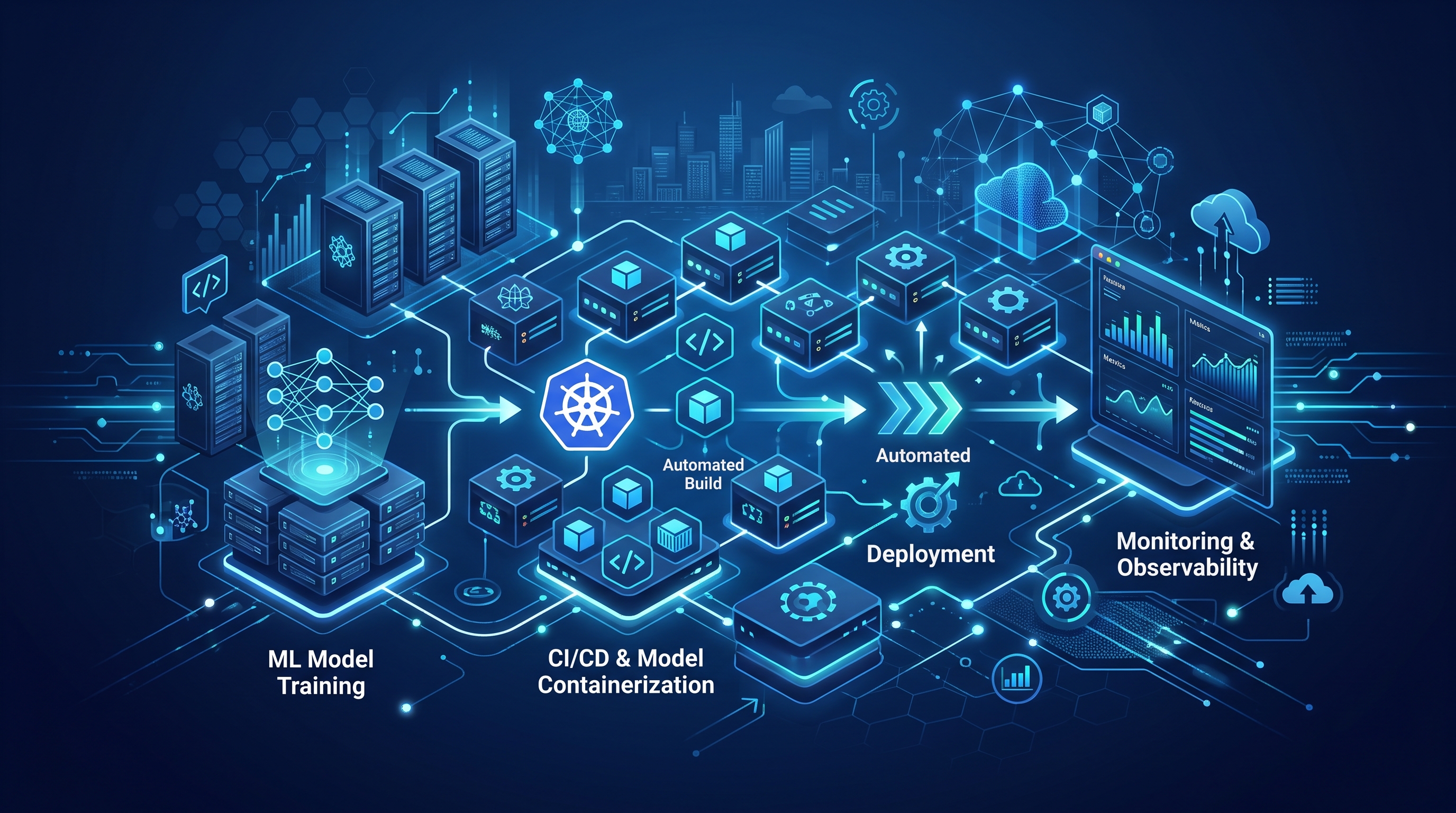
I spent the first two decades of my career building monolithic Java applications. Today, I build agentic AI systems and large-scale model serving infrastructure. The transition wasn’t just about learning Python; it was about unlearning the idea that code is static. In 2026, deploying an ML model is not a one-time event; it is a continuous lifecycle of training, validation, deployment, and retraining. If you are still trying to stuff your entire ML pipeline into a single Kubernetes pod, you are already behind.
The gap between a Jupyter notebook and a production endpoint is where most MLOps initiatives fail. It is not a technology gap; it is an engineering discipline gap. After managing infrastructure for global financial institutions, I have learned that reliability beats novelty every time. We need deterministic deployment patterns for non-deterministic models. Here is how we actually do it in production.
The Architecture: Decoupling Compute from State
In my early days at Deutsche Bank, we treated models as dependencies. Today, they are first-class citizens. The fundamental shift in 2026 is treating model artifacts as immutable objects, separate from the application code.
You must decouple the training environment from the serving environment. Training requires massive GPU clusters, ephemeral storage, and heavy I/O. Serving requires low latency, high availability, and consistent CPU/GPU ratios. Mixing these concerns in a single deployment manifest is a recipe for disaster.
Instead, adopt a layered architecture:
- Inference Layer: Stateless pods running the model server (e.g., Triton Inference Server, TorchServe, or Seldon Core). These pods scale horizontally based on request volume.
- Feature Store Layer: A dedicated service that provides low-latency feature retrieval. This decouples feature engineering from model inference.
- Control Plane: An orchestrator (like KServe or Kubeflow) that manages the lifecycle of model versions, handling canary deployments and traffic splitting.
This separation allows you to scale inference independently of training. If your model requires a heavy retraining job, it does not impact the latency of your live API.
Containerizing the Model: Beyond the Dockerfile
Writing a Dockerfile for a model is simple. Writing one that survives production is hard. The biggest mistake I see is including the entire training environment in the inference container. This bloats images, increases startup times, and expands the attack surface.
In 2026, we use multi-stage builds to create lean, secure inference images. The build stage installs heavy dependencies like PyTorch or TensorFlow. The final stage copies only the necessary binaries and the serialized model artifact.
Here is a pattern I use to ensure fast startup times, which is critical for autoscaling:
FROM nvidia/cuda:12.2-runtime-ubuntu22.04 AS base
WORKDIR /app
COPY --from=builder /app/model.bin /app/model.bin
COPY --from=builder /app/server.py /app/server.py
CMD ["python", "server.py"]
Notice that we are not installing drivers in the final stage. The host node provides the GPU runtime. This reduces image size by over 60%, leading to faster pulls and lower storage costs. For teams struggling with cloud costs, this simple optimization pays for itself. You can read more about optimizing your cloud infrastructure in my AWS EKS High Availability Guide.
Serving Strategies: Canary, Shadow, and A/B Testing
Deploying a new model version is a risk. In financial services, a 1% increase in latency or a 0.1% drop in accuracy can cost millions. Therefore, we never do "big bang" deployments. We use progressive delivery.
Kubernetes makes this easier with Ingress controllers and service meshes, but you need explicit strategies.
- Shadow Deployment: Traffic is mirrored to the new model. The new model processes the request, but the response sent to the client comes from the old model. This allows you to validate performance without impacting users.
- Canary Deployment: A small percentage of traffic (e.g., 5%) is routed to the new model. If error rates remain low, the traffic share increases gradually.
- A/B Testing: Users are bucketed into groups. Group A sees the old model, Group B sees the new one. You compare business metrics, not just technical ones.
Tools like KServe automate this by managing the Knative services and Istio virtual services required for traffic splitting. This reduces the manual configuration time by approximately 40% compared to managing these resources manually.
Monitoring: Observability for Non-Statistical Metrics
Monitoring a web server is easy: CPU, memory, and request count. Monitoring a model is harder. You need to track model-specific metrics. If you are not monitoring for data drift, you are flying blind.
Data drift occurs when the input data distribution changes over time. For example, if you trained a fraud detection model on pre-pandemic data, the patterns might shift dramatically. You need to monitor:
- Latency Percentiles: P95 and P99 latency are more important than averages. A high average might hide tail latency issues that cause timeouts.
- Input Feature Drift: Compare the statistical distribution of incoming features against the training data distribution.
- Prediction Drift: Monitor the distribution of output predictions. Sudden shifts in output distribution often indicate input drift or model degradation.
Prometheus is the standard for scraping these metrics. Exporters like prometheus-grafana-exporter can be configured to pull metrics from your inference servers. I also recommend integrating with LangChain Expression Language (LCEL) if you are building agentic workflows that rely on these models, as observability chains are critical there too.
The Human Element: Culture and Collaboration
Technology is only half the battle. The other half is culture. MLOps breaks down silos between data scientists and DevOps engineers. Data scientists care about model accuracy; DevOps engineers care about uptime and security. These goals are not mutually exclusive, but they require communication.
In my experience, the most successful teams establish a "Model Card" culture. Every model deployed must have a card that documents:
- Training data sources and dates.
- Known limitations and edge cases.
- Performance benchmarks under different loads.
- Responsible AI considerations (bias, fairness).
This documentation becomes the source of truth for operations teams. It reduces the time spent on debugging production issues by roughly 30%. When a model fails, the ops team can immediately check the Model Card to understand the context.
Frequently Asked Questions
Q: Can I use a single Kubernetes cluster for both training and inference? A: It is technically possible, but strongly discouraged. Training jobs are bursty and resource-intensive. Inference is steady-state. Mixing them leads to resource contention. Use separate clusters or distinct namespaces with strict resource quotas.
Q: How do I handle model versioning in Kubernetes? A: Treat model artifacts as immutable. Never overwrite a deployed model version. Instead, deploy a new service object that points to the new artifact. Use labels like model-version: v1.2.3 to track deployments. This allows for easy rollback by switching the service selector back to the previous label.
Q: What is the best way to manage GPU resources in Kubernetes? A: Use the NVIDIA Device Plugin for Kubernetes. It exposes GPU resources as allocatable resources. Set requests and limits in your pod specifications to ensure fair scheduling. For multi-tenant environments, consider using MIG (Multi-Instance GPU) to slice GPUs into smaller, isolated instances.
Q: How do I ensure security for model endpoints? A: Always enforce TLS for traffic between the ingress controller and your inference pods. Use Kubernetes Network Policies to restrict access to the inference pods only to authorized services. Additionally, scan your container images for vulnerabilities using tools like Trivy before deployment.
Conclusion
MLOps on Kubernetes in 2026 is not about chasing the latest framework. It is about applying rigorous engineering principles to probabilistic systems. By decoupling compute from state, using lean containers, implementing progressive delivery, and monitoring for drift, you can build systems that are both innovative and reliable.
The tools have matured. The patterns are proven. The only variable left is your discipline. Start small, automate relentlessly, and never stop measuring. If you are interested in how these models integrate with broader AI systems, check out my deep dive on Claude Code vs Cursor to understand the developer experience side of this equation.
Deploy with confidence. Monitor with intent. Iterate with speed.