
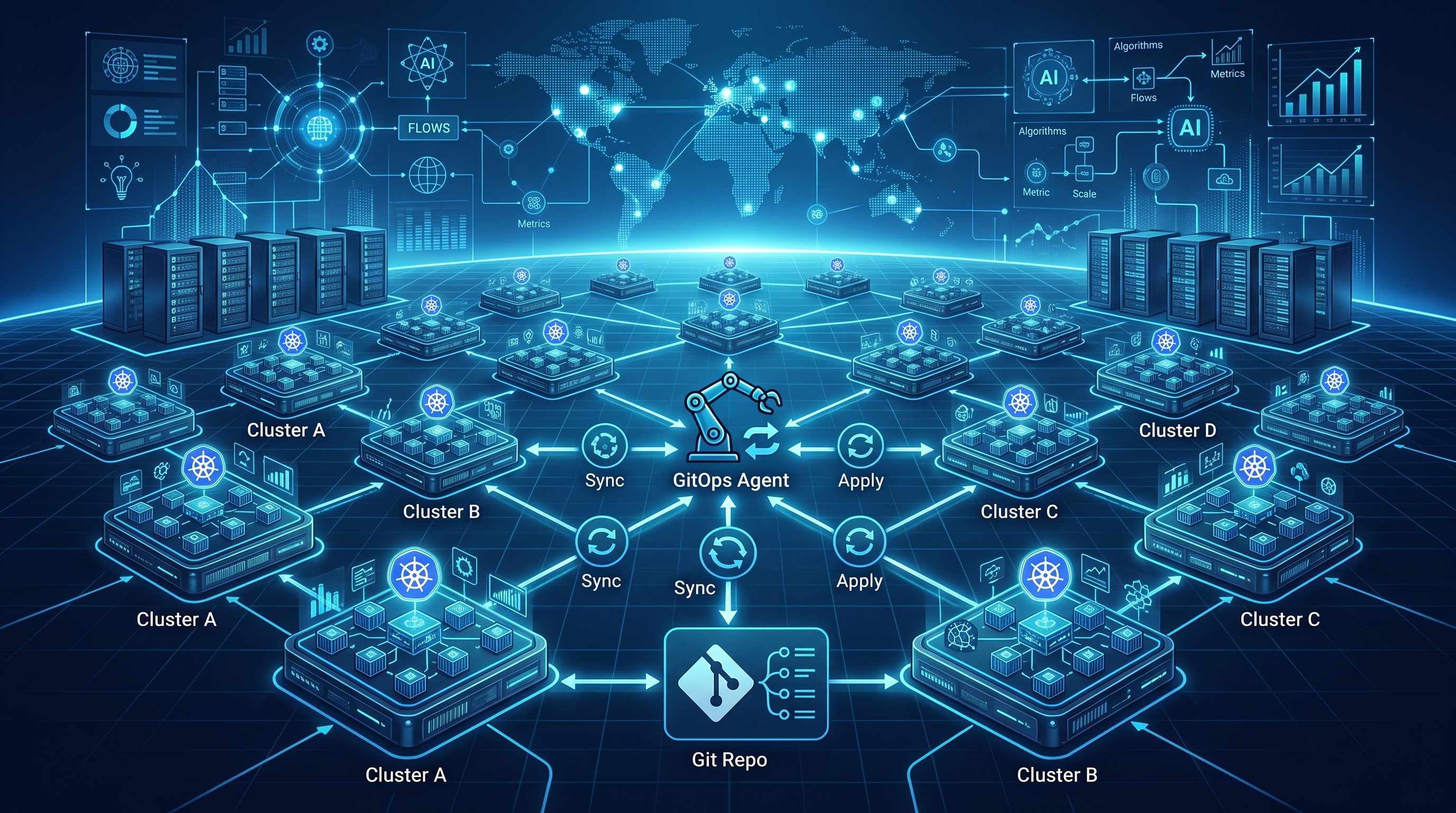
The Myth of the Single Control Plane
After twenty-five years in enterprise banking, from JPMorgan Chase to Deutsche Bank, I’ve seen the "single source of truth" evolve. In 2026, that truth isn't just a Git repository; it's a federated hierarchy. When we manage ten or fifty clusters across AWS, Azure, and on-premise data centers, treating each as an island is a recipe for configuration drift and security nightmares. The industry has moved past simple replication. We are now dealing with heterogeneous environments where network latency, data sovereignty, and regulatory compliance dictate topology.
The challenge isn't just pushing YAML files. It's managing state consistency when the network between your primary GitOps controller and a secondary cluster in Frankfurt experiences latency spikes. If you are still manually syncing Helm charts or using shell scripts to propagate changes, you are already behind. The modern stack relies on declarative state reconciliation, but the architecture must support hierarchical delegation.
Architecture: Hub-and-Spoke vs. Mesh
For most enterprises, a hub-and-spoke model remains the most defensible pattern for gitops multi-cluster kubernetes 2026 operations. You run a central "Hub" cluster that holds the global configuration—policy definitions, base manifests, and identity bindings. The "Spoke" clusters, which might be regional edge nodes or tenant-specific namespaces, pull their desired state from the Hub.
Why not a mesh? A fully meshed GitOps topology creates a consensus problem. If Cluster A updates a service account and Cluster B updates the same service account simultaneously, you introduce race conditions that are nearly impossible to debug. In a hub-and-spoke model, the Hub is the single writer. The Spokes are read-only consumers of the desired state. This simplifies conflict resolution significantly.
However, pure hub-and-spoke introduces a single point of failure. If the Hub goes down, no new changes can be propagated. To mitigate this, we implement a "local override" capability. Spokes can maintain a local Git repository for emergency fixes or low-latency adjustments, but these changes are periodically reconciled against the central truth. This hybrid approach allows for operational resilience without sacrificing architectural purity.
Tooling Wars: ArgoCD vs. Flux in 2026
Let’s be clear: ArgoCD and Flux are the two dominant players, and the choice depends on your team's DNA. ArgoCD is declarative and UI-first. It excels in visualization. If your SRE team needs to see the drift visually before approving it, ArgoCD’s native dashboard is superior. It handles complex sync waves well, allowing you to sequence dependencies—deploying the database before the application layer.
Flux, built by WeaveWorks (now part of VMware/Broadcom), is CLI-first and tightly integrated with the Git-native workflow. It feels more like a Kubernetes operator than a dashboard. For teams that prefer to manage everything via `kubectl` and Git commits, Flux offers a cleaner, less resource-heavy footprint.
In my recent deployments, I’ve seen a trend where teams use ArgoCD for the primary application workloads due to its robust application set features, while using Flux for infrastructure-level resources like CNI plugins or monitoring agents. This polyglot approach is viable but increases cognitive load. If you can standardize, pick one. For multi-cluster scenarios, ArgoCD’s ApplicationSet controller provides a more mature mechanism for generating resources across hundreds of clusters based on labels.
Implementing Hierarchical Sync and Policy
The core difficulty in multi-cluster management is ensuring that a change to a base image version propagates correctly to all regions without breaking a specific local deployment. We solve this using a layered Git structure.
Consider this directory structure in your configuration repository:
/base: Common libraries, shared ConfigMaps, and CRDs./env/global: Policies that apply to all clusters (e.g., OPA Gatekeeper policies)./env/us-east: Region-specific overrides for US East./env/eu-west: Region-specific overrides for EU West./apps: The actual application definitions referencing the base and env layers.
By using Kustomize or Helm charts that overlay these directories, you ensure that the "base" is immutable. Changes to the base require a new version, which triggers a cascade update. This prevents the "works on my machine" syndrome across clusters.
Furthermore, policy-as-code is non-negotiable. Use OPA Gatekeeper or Kyverno to enforce that no cluster can deploy a container from an untrusted registry. If a developer tries to push a direct image tag in a spoke cluster, the GitOps controller rejects the sync. This is how you maintain compliance at scale. For more on securing these agents, see my post on Agentic AI Security in Kubernetes Sandboxing.
Observability and Failure Modes
When you have 50 clusters, traditional logging fails. You cannot SSH into each node. You need a centralized observability layer that understands the GitOps state. Tools like Grafana Alloy or Prometheus must be deployed as a base layer, managed by the GitOps tool itself.
I recommend implementing a "health check" endpoint in your GitOps controllers. If the sync status is `OutOfSync` for more than five minutes, trigger an alert. But don't just alert on sync status. Alert on the *drift* between the Git state and the Kubernetes API server. This catches manual interventions. If a human manually changes a replica count via `kubectl scale`, the GitOps controller will revert it, but you should be notified that the manual change occurred.
For deeper insights into self-healing mechanisms, review Self-Healing Kubernetes Patterns for 2026. The combination of GitOps and self-healing controllers creates a system that corrects itself faster than humans can react.
Security and Identity Federation
Identity is the new perimeter. In a multi-cluster setup, you cannot rely on local Kubernetes service accounts. You must federate identities. Use OIDC to link your Git provider (GitHub, GitLab) to your Kubernetes clusters. When a developer pushes to the `main` branch, the GitOps controller authenticates via OIDC, not via static tokens stored in a secret.
This reduces the blast radius of a compromised token. If a token is leaked, it has a short TTL and limited scope. Additionally, implement least-privilege RBAC at the cluster level. The GitOps service account should only have permission to modify resources in its designated namespaces. It should never have cluster-admin rights. This is a common mistake I see in enterprise migrations. Start with restrictive policies and expand only as needed.
Frequently Asked Questions
What is the recommended tool for multi-cluster GitOps in 2026?
For most enterprises, ArgoCD is preferred due to its mature ApplicationSet feature and visual dashboard. However, Flux is a strong alternative for teams that prefer a CLI-native, Git-first workflow. The choice depends on your team's existing skill set and preference for UI vs. command line.
How do I handle configuration drift in a multi-cluster environment?
Configuration drift is handled by enforcing a "desired state" model. Use Kustomize overlays or Helm charts to separate base configurations from environment-specific overrides. Any manual changes made directly to the cluster will be reverted by the GitOps controller during the next sync cycle. Implement OPA Gatekeeper to prevent unauthorized manual changes.
Can I use GitOps for hybrid cloud setups?
Yes, but you must account for network latency and data residency. Use a hub-and-spoke architecture where the Hub is located in a region with low latency to all Spokes. For data residency requirements, ensure that the Git repository and the GitOps controller are hosted in compliance with local regulations. Consider using private Git mirrors for regions with restricted internet access.
How does GitOps integrate with AI agents?
AI agents can act as observers or operators within a GitOps workflow. For example, an AI agent can monitor cluster metrics and suggest configuration changes, which are then implemented as a pull request. The human-in-the-loop review process remains critical for security. See our analysis on Enterprise MCP vs CLI in DevOps for more on this integration.