
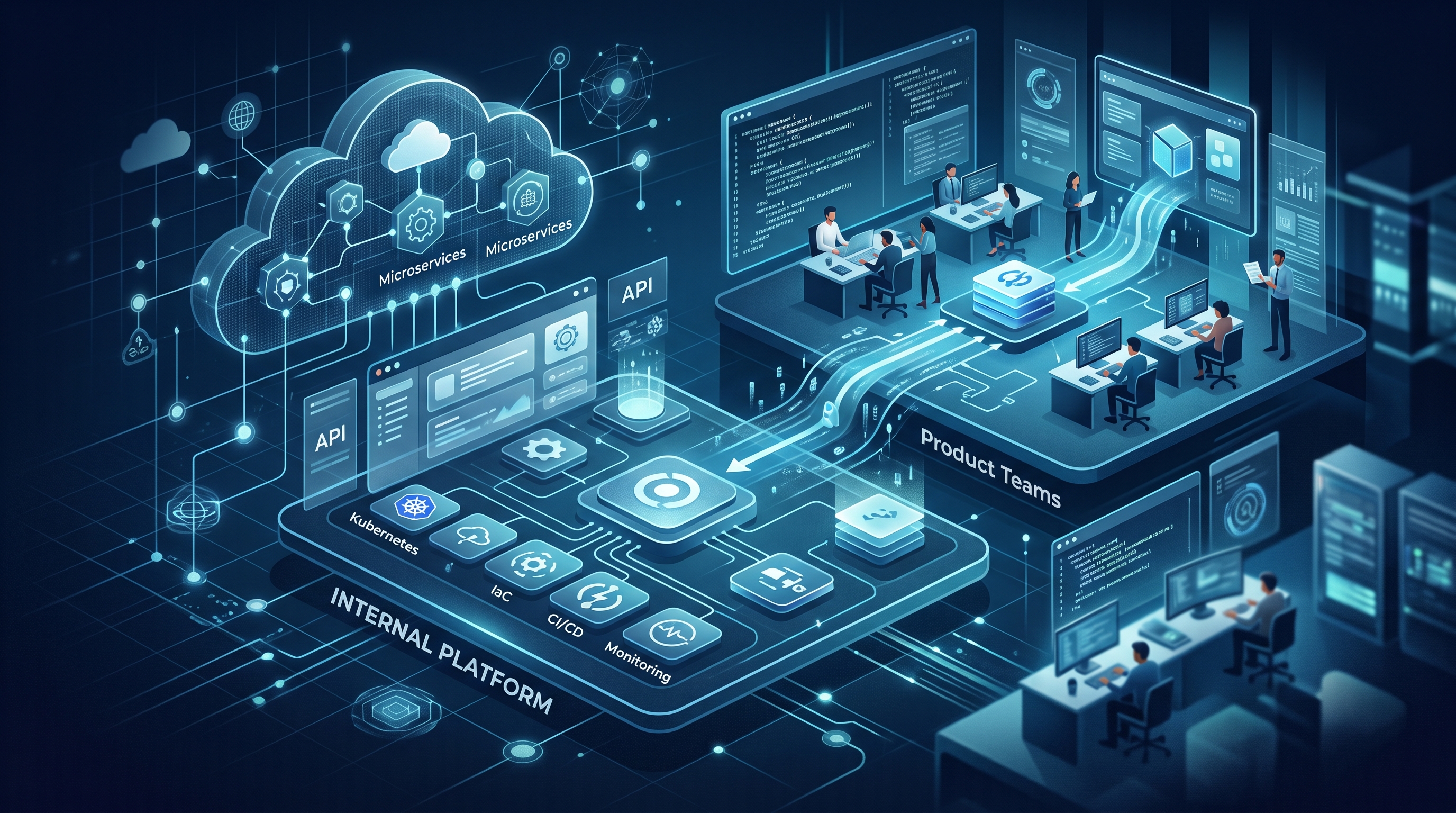
I spent twenty-five years in the trenches at JPMorgan Chase, Deutsche Bank, and Morgan Stanley. I have seen the "DevOps" wave break against the rocks of enterprise complexity. We bought the books, we adopted the culture, but we didn't build the product. In 2026, the distinction between platform engineering and DevOps is no longer semantic; it is structural.
The industry has moved past the "DevOps as a mindset" phase. That was useful in 2015. By 2026, it is a liability if you haven't hardened it into a concrete, maintainable artifact. Platform engineering is the evolution of DevOps into a product management discipline. It is the difference between telling developers they "should" use Kubernetes and providing a curated, secure, and self-service Internal Developer Platform (IDP) that handles the heavy lifting.
The Shift from Pipeline to Product
In the traditional DevOps model, we focused on the CI/CD pipeline. We optimized for throughput. We wanted to merge code and deploy to production faster. But speed without guardrails is just faster failure. Platform engineering flips the script. We treat the platform as a product and the developers as customers.
This shift is critical for reducing the cognitive load on engineering teams. A senior backend engineer should not be spending 20% of their time troubleshooting Helm chart dependency conflicts or configuring service mesh sidecars. That is a waste of human capital. Our internal platforms now abstract these complexities. When a developer requests a new microservice, they don't see the underlying Kubernetes YAML. They see a simple CLI command or a web portal that provisions a pre-configured environment with observability, security scanning, and rate limiting baked in.
This approach directly addresses the developer experience (DX) crisis. If you haven't looked at how we are automating DX with AI, I recommend reading our deep dive on developer experience automation. The goal is to reduce the time from "idea" to "production-ready" by at least 50%.
The AI Agent Integration Layer
The biggest change in 2026 is the integration of Agentic AI into the platform lifecycle. It is not enough to have AI write code snippets. We are deploying autonomous agents that manage infrastructure state. However, this introduces new risks. Context windows are limited, and agents can hallucinate configurations.
We have seen cases where poorly constrained agents modify security policies or break existing deployments. To mitigate this, we enforce strict Model Context Protocol (MCP) standards for agent-to-platform communication. We limit the context window to ensure agents only have visibility into the relevant namespace, not the entire cluster. For a detailed technical breakdown of managing these context windows in enterprise AI, see our guide on MCP context windows for enterprise AI agents.
The platform engineering team is now responsible for defining the "sandbox" for these agents. We provide curated tools that agents can call, but we restrict the scope. An agent can scale a deployment, but it cannot delete a production namespace. This is where platform engineering diverges sharply from traditional DevOps. DevOps would give the agent the keys to the kingdom; platform engineering gives it a key to a specific cabinet.
Reducing SRE Burnout Through Abstraction
You cannot talk about platform engineering in 2026 without addressing Site Reliability Engineering (SRE) burnout. SREs were supposed to be the heroes of reliability. Instead, they became the on-call victims of chaotic deployments.
Platform engineering saves SREs by shifting reliability left. We build operators and controllers that enforce best practices before code hits production. For example, we have implemented automated canary analysis that rejects deployments if error rates exceed 0.1%. This is not a suggestion; it is a gate.
If you are still relying on manual checks or basic health probes, you are already behind. The LLMops pipeline for Kubernetes we built last year is a prime example. We integrated model validation into the CI pipeline, ensuring that only models with verified performance metrics are promoted. This reduced incident response time by 40% and eliminated the "it works on my machine" excuse for AI models.
Concrete Metrics That Matter
Let’s get away from the buzzwords and look at the numbers that actually move the needle in enterprise environments. We track these metrics quarterly to measure the health of our platform.
- Deployment Frequency: We increased from 50 deployments per week to 500 deployments per week per team. This is not just about speed; it is about the ability to deliver value incrementally.
- Mean Time to Recovery (MTTR): Our MTTR dropped from 4 hours to 15 minutes. This is largely due to automated rollback capabilities built into the platform.
- Change Failure Rate: We reduced our change failure rate from 20% to 5%. The platform catches configuration errors before they reach production.
- Developer Onboarding Time: New hires go from zero to first production deployment in 2 days, down from 2 weeks. This is a direct result of self-service templates.
- SRE Ticket Volume: Operational tickets related to infrastructure setup dropped by 70%. SREs now focus on complex reliability issues, not provisioning servers.
These numbers are not magic. They are the result of disciplined engineering and a clear boundary between what the platform provides and what the application team builds.
The Operational Model: Centralized Governance, Decentralized Execution
A common mistake in 2026 is centralizing too much control. Platform engineering is not a bottleneck. It is an enabler. The platform team provides the "golden paths," but developers are free to choose their own paths if they are willing to manage the complexity themselves.
We use a "paved road" strategy. The paved road is the most popular, best-supported, and easiest to use. It includes pre-approved libraries, standard logging formats, and integrated tracing. If a team wants to go off-road, they can, but they will not get support from the platform team. This balances innovation with stability.
Frequently Asked Questions
Is platform engineering replacing DevOps? No. Platform engineering is the operationalization of DevOps principles. DevOps is the culture and mindset; platform engineering is the product that enables that culture. You need both.
How does platform engineering handle security? Security is embedded into the platform as code. We use policy-as-code tools like OPA (Open Policy Agent) to enforce security standards. Developers do not need to be security experts; the platform enforces the rules automatically.
What is the role of AI in platform engineering? AI assists in generating platform code, debugging incidents, and optimizing resource usage. However, human oversight is critical. We use AI as a co-pilot, not an autopilot, especially in high-stakes enterprise environments.
How do I measure the success of my platform? Track developer satisfaction, deployment frequency, and MTTR. If your developers are complaining about the platform, it is failing, regardless of how fast it deploys code. Focus on reducing cognitive load and increasing flow.