
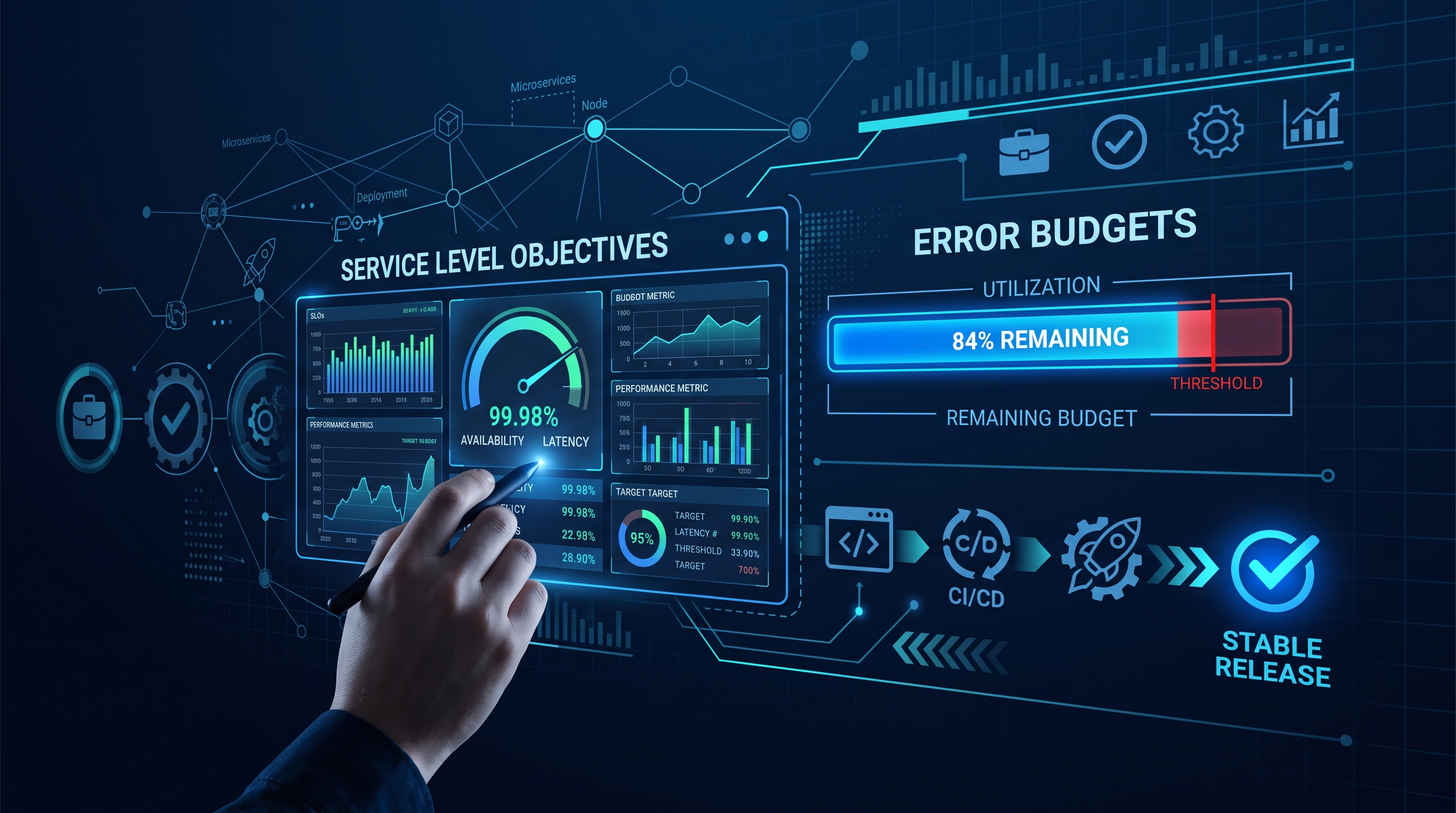
We spent two decades building "unbreakable" systems. At JPMorgan Chase and Deutsche Bank, we treated downtime as a sin. Today, that mindset is obsolete. In 2026, reliability is not about zero errors; it is about managing the acceptable rate of failure to maximize user value. If you are still defining Service Level Indicators (SLIs) based on CPU utilization or network packet loss, you are optimizing for the wrong thing. You are optimizing for infrastructure, not the user.
The shift to SLOs (Service Level Objectives) and Error Budgets is not just an operational tweak. It is a fundamental restructuring of how we prioritize work. When we treat reliability as a product decision, we stop asking "Is the system up?" and start asking "Is the system good enough to support the business goals right now?"
The Death of Uptime and the Rise of User-Centric SLOs
The era of "five nines" (99.999%) availability is largely dead for most enterprise applications, unless you are running core banking transaction ledgers. For most web applications, the cost of achieving that fifth nine exceeds the business value of the remaining 0.001% uptime. Instead, we define SLOs based on latency percentiles and error rates that matter to the end-user.
Consider a typical e-commerce checkout flow. If the page loads in 200ms 95% of the time, that is a solid SLO. If it takes 2 seconds 95% of the time, users abandon the cart. The internal health of the Kubernetes pod might be green, but the business is red.
To build effective SLOs, we must look at the request lifecycle:
- Latency SLOs: Define the percentage of requests that must complete within a threshold (e.g., 99% of requests under 500ms).
- Error Rate SLOs: Define the maximum percentage of failed requests (5xx errors) allowed (e.g., less than 0.1%).
- Correctness SLOs: For complex workflows, define the percentage of requests that return the correct data, not just a 200 OK status.
These metrics must be aggregated at the service level, not the individual component level. A microservice might be healthy, but if the API gateway is throttling, the user experience is broken. The SLO reflects the user's reality, not the engineer's dashboard.
Error Budgets: The Currency of Velocity
Once you have an SLO, you calculate the Error Budget. This is the allowable amount of error within a specific time window (usually 28 days). If your SLO is 99.9% availability, your error budget is 0.1% of the total requests.
In 2026, with the proliferation of Agentic AI and complex microservices, these budgets are consumed faster than ever. A single misconfigured agent tool call can trigger cascading failures, draining your budget in minutes. We discussed the specifics of agent reliability failures in our post on agent tool calling reliability failure 2026. When agents hallucinate or fail to parse responses, they generate errors that count against your budget.
The error budget is not a punishment. It is a governance mechanism. It answers the question: "How much instability can we tolerate to ship this new feature?"
When the error budget is green (plenty of room), engineering teams can move fast. They can deploy risky changes, experiment with new architectures, and prioritize velocity. When the budget is red (exhausted), the focus shifts immediately to stability. Feature development pauses. Engineers must fix bugs, improve testing, and harden the system before new features are merged.
This binary switch prevents the "boiling frog" scenario where slow degradation becomes the norm. It forces a conscious trade-off between speed and stability.
Automating the Enforcement of Reliability
Manual enforcement of error budgets is a relic of the past. In 2026, we use GitOps and CI/CD pipelines to automate the enforcement of SLOs. If a pull request introduces code that degrades the SLO below the threshold, the pipeline fails.
We implement this through several concrete steps:
- SLO Monitoring: Use Prometheus or OpenTelemetry to track SLIs in real-time.
- Budget Tracking: Implement a budget tracker that calculates remaining budget based on current error rates.
- Gatekeeping: Integrate budget checks into the CI/CD pipeline. If the budget is exhausted, block deployments.
- Alerting: Set up alerts for budget consumption rate, not just absolute error counts. A sudden spike in budget consumption is more actionable than a static error rate.
This automation ensures that reliability is not an afterthought. It is baked into the development process. Engineers cannot bypass the budget. They must address the root cause of the errors before they can continue shipping features.
Cost and Reliability: The Agentic AI Challenge
The introduction of Agentic AI adds a new dimension to reliability: cost. Agents can make multiple tool calls, leading to high token usage and potential financial waste. We explored the intricacies of agent cost attribution token budget 2026 in a previous article. Just as we manage error budgets, we must manage cost budgets.
In 2026, a reliable system is not just one that works correctly, but one that does so within acceptable cost constraints. If an agent completes a task but uses 10x the expected tokens, it is unreliable from a business perspective. We must define SLOs that include cost metrics, ensuring that reliability and cost efficiency go hand in hand.
Frequently Asked Questions
How do I choose the right SLO target for my service?
Start with user impact. Conduct surveys or analyze user behavior to determine at what latency or error rate users notice a problem. Set your SLO slightly below that threshold to provide a buffer. Avoid setting targets based on industry standards without context; a 99% SLO for a critical payment service is different from a 99% SLO for a marketing blog.
What happens when the error budget is exhausted?
When the budget is exhausted, the focus shifts from feature development to stability. Engineers must prioritize bug fixes, performance improvements, and testing. Deployments of new features are typically blocked until the budget is replenished, which usually takes 28 days or until error rates drop significantly.
Can I use error budgets for third-party services?
Yes, but with caution. You can define SLOs for third-party dependencies, but you have less control over their reliability. It is often better to set internal SLOs that account for third-party failures, rather than blaming the vendor when the budget is consumed. Focus on how you handle failures, not just the failure itself.
How often should I review and update my SLOs?
Review SLOs quarterly. As your product evolves and user expectations change, your SLOs should too. If you find that your SLOs are always met, they may be too easy. If they are always missed, they may be too ambitious. Regular reviews ensure that your reliability targets remain aligned with business goals.