
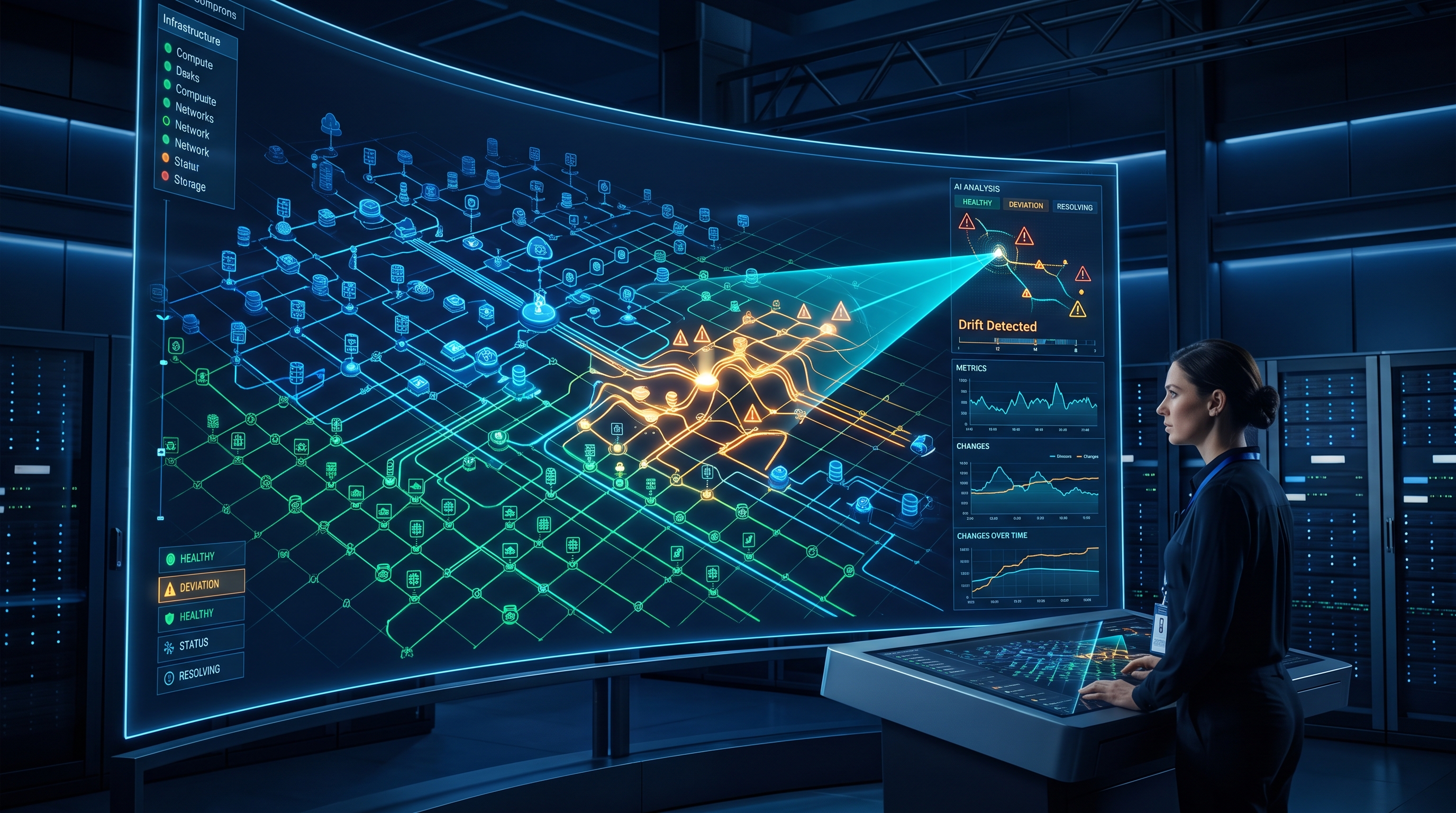
The Reality of Drift in Enterprise Environments
I have spent the last 25 years watching infrastructure evolve from manual SSH sessions to declarative state files. The promise of Infrastructure as Code (IaC) is that the state file is the source of truth. In practice, it rarely is. Drift occurs when the actual state of your cloud resources diverges from your Terraform configuration. This isn’t just a minor inconsistency; it is a security liability and an operational time bomb.
In 2026, the scale of enterprise infrastructure—multi-cloud, hybrid, and heavily regulated—makes manual drift detection impossible. You cannot expect engineers to audit thousands of resources weekly. The drift is often subtle: a security group rule added by a senior admin to "fix" a production issue, or a minor version change in a managed service that bypasses your CI pipeline. These small deviations accumulate, creating a shadow infrastructure that your code no longer controls.
The goal is not to prevent all changes, but to detect and govern them. We need a system that identifies drift, assesses its risk, and either auto-remediates or flags it for review. This requires a shift from passive state management to active governance.
Architecting the Detection Pipeline
Effective drift detection requires a pipeline that runs independently of the primary deployment workflow. Relying on `terraform plan` during a PR merge is insufficient because it only shows the delta between your current code and the remote state at that moment. It does not show what has happened in the wild since the last successful apply.
My recommended architecture involves a dedicated "Drift Watcher" service. This service runs on a scheduled basis (e.g., every 4 hours) or triggers on specific cloud events. It performs the following steps:
- State Refresh: It runs `terraform refresh` to pull the latest state from the cloud provider, ensuring the local state file matches reality.
- Plan Generation: It executes `terraform plan -detailed-exitcode` to generate a plan against the refreshed state.
- Diff Analysis: It parses the plan output to identify changes not present in the current code repository.
- Risk Scoring: It applies policy checks to determine if the drift is critical (e.g., open security groups) or benign (e.g., tag updates).
This pipeline must be idempotent and non-destructive. The first pass should never apply changes; it should only report. If the drift is confirmed, the system should create an issue or ticket in your project management tool, linking the specific resource ID and the deviation details.
Integrating Policy-as-Code for Governance
Drift detection is useless without context. Knowing that a resource changed is less valuable than knowing if that change violates compliance. This is where Policy-as-Code (PaC) becomes critical. Tools like Open Policy Agent (OPA) or HashiCorp Sentinel allow you to define rules that govern what changes are acceptable.
For example, you can write a policy that states: "No S3 bucket can have public read access enabled." If drift detection finds that a bucket has become public, the PaC engine flags it as a violation. This integration creates a feedback loop where governance is enforced automatically.
In my experience, integrating these checks into your CI/CD pipeline reduces the mean time to detect (MTTD) drift from weeks to minutes. Furthermore, by leveraging AI-driven governance frameworks, you can begin to correlate drift events with deployment logs, identifying the root cause of unauthorized changes.
Consider the following policy logic for a critical compliance check:
- Load the Terraform plan output.
- Identify all resources of type `aws_security_group`.
- Check if any ingress rules allow `0.0.0.0/0` on port 22 or 3389.
- If detected, return a `deny` decision and attach the specific resource ID to the alert.
This level of granularity ensures that governance is not a blunt instrument but a precise surgical tool.
Automated Remediation and Human-in-the-Loop
Once drift is detected and assessed, the next step is remediation. There are three approaches: manual, semi-automated, and fully automated. In enterprise environments, fully automated remediation is risky. A rogue script or a misconfigured policy could roll back a necessary manual change.
I advocate for a semi-automated approach. The system generates a "Remediation Pull Request." This PR contains the updated Terraform code that aligns the configuration with the desired state. It also includes a summary of the drift and the risk assessment. The engineering team then reviews and merges this PR.
This process ensures that:
- The codebase is updated to reflect reality, preventing future drift.
- There is an audit trail of who approved the reconciliation.
- The team remains aware of the state of their infrastructure.
For high-risk environments, you can implement a "Governance Gate" where the merge requires approval from a security officer or a lead architect. This adds a layer of accountability that is essential for regulated industries like finance.
Frequently Asked Questions
How often should drift detection run?
For most enterprise environments, running drift detection every 4 to 6 hours is sufficient. This balances the need for timely detection with the cost of API calls to cloud providers. For critical, high-risk resources, you might consider event-driven detection using cloud watch events or service mesh sidecars.
Can AI automate the remediation process?
AI can assist significantly by analyzing the drift and suggesting the correct Terraform code changes. However, I recommend keeping a human-in-the-loop for the final approval. AI agents, as discussed in our agentic AI governance frameworks, can handle the heavy lifting of code generation, but human oversight ensures that the changes align with business intent and compliance requirements.
What if the drift is caused by a necessary manual change?
If a manual change is necessary and compliant, it should be codified. The drift detection system should flag the change, and the engineering team should update the Terraform configuration to include this change. This ensures that the state file remains the source of truth. Ignoring drift because it is "necessary" is a technical debt that will eventually cause outages.
How do I handle multi-cloud drift?
Multi-cloud environments require a unified governance layer. Use a tool that can abstract the underlying cloud provider APIs and provide a consistent policy language. This allows you to apply the same governance rules across AWS, Azure, and GCP, simplifying compliance and reducing the cognitive load on your team.