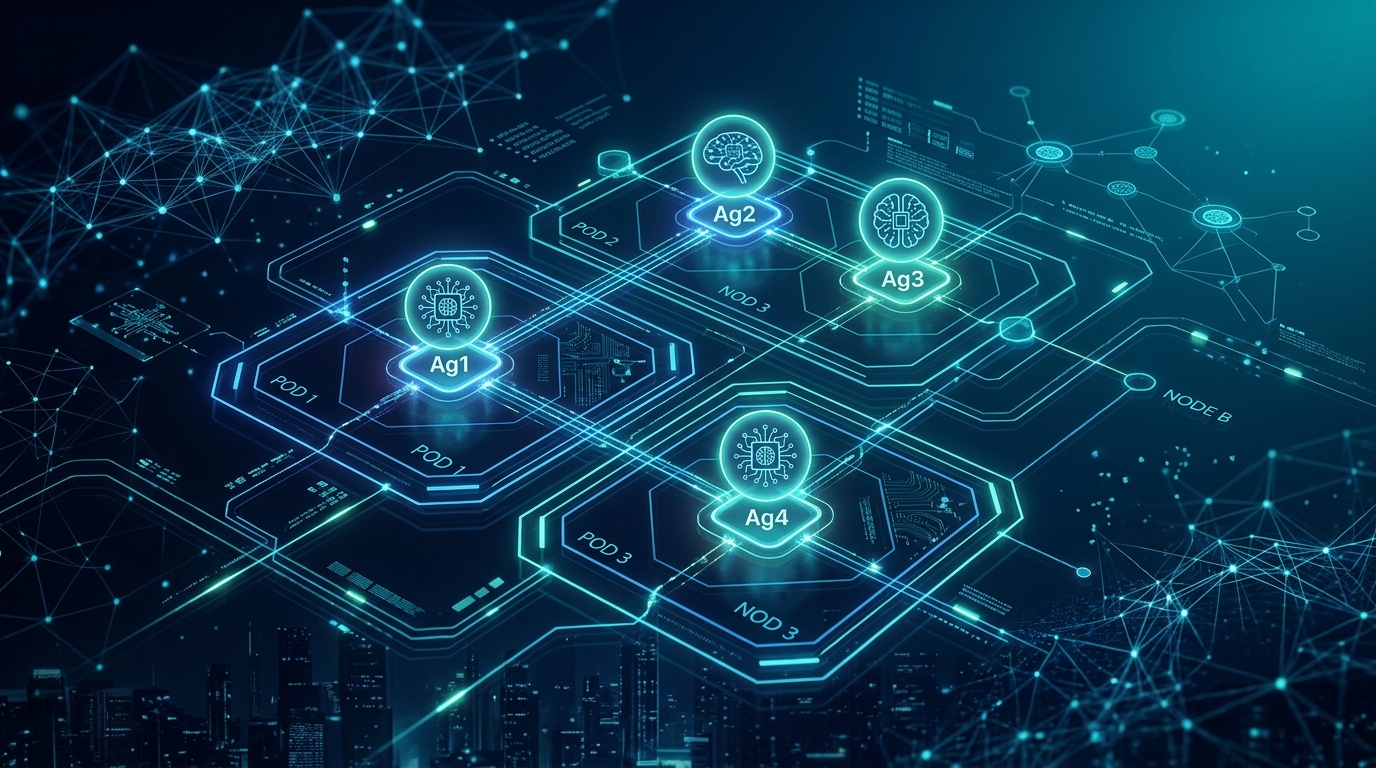
At 2 AM Tuesday, an AI agent running inside a Kubernetes cluster at a Fortune 500 bank noticed an anomaly in the payment processing pipeline. Within 30 seconds, it diagnosed the issue, rolled back the problematic deployment, and notified the on-call engineer with a complete incident summary.
This is not science fiction. In Rajesh Gheware's 25 years architecting systems at JPMorgan Chase, Deutsche Bank, and Morgan Stanley, this pattern represents the most significant shift in production operations since cloud-native architectures. AI agents are no longer experimental—they are mission-critical infrastructure requiring enterprise-grade deployment patterns.
In this guide, gheWARE shares production deployment patterns engineers must understand. Drawing from the 5-Day Agentic AI Workshop that earned a 4.91/5.0 rating at Oracle, this post covers architecture decisions, security guardrails, and scaling strategies that work in real enterprise environments.
⚡ Key Takeaways
- →AI agents require fundamentally different deployment patterns than traditional microservices
- →Kubernetes 1.32+ introduces native Agent Sandbox for strong isolation of untrusted code
- →Multi-agent orchestration frameworks demand specialized resource allocation and inter-agent communication patterns
- →Observability for AI agents requires LLM-specific tooling—traditional APM cannot trace agent decision chains
- →Cost optimization focuses on GPU sharing via DRA (Dynamic Resource Allocation) and intelligent autoscaling via KEDA
Why AI Agents Break Traditional Kubernetes Patterns
Traditional Kubernetes workloads follow predictable patterns: an HTTP request arrives, the container processes it, returns a response, and yields. AI agents violate every assumption in this model.
❌ Traditional Microservices
- Deterministic execution paths
- Stateless request-response cycles
- Fixed CPU/memory resource profiles
- No external tool invocation
- Idempotent operations
✅ AI Agent Workloads
- Non-deterministic LLM outputs
- Stateful conversation memory
- Variable resource spikes (GPU/CPU)
- Dynamic tool calling (APIs, databases)
- Autonomous decision-making
An AI agent handling customer support might run for 30 minutes, maintaining context across multiple interactions, calling CRM APIs, invoking knowledge base searches, and escalating to humans via Slack. This is not an HTTP request—this is long-running, stateful, potentially expensive work demanding new architectural patterns.
Production Pattern #1: Agent Sandbox for Security Isolation
The gravest risk in agentic AI is not prompt injection—it is code execution. When an AI agent invokes a tool executing arbitrary Python, SQL, or shell commands, it becomes a remote code execution vector. The Kubernetes community responded with the Agent Sandbox project in Kubernetes 1.32.
Rajesh observed a production incident where an autonomous code-review agent executed a malicious dependency that exfiltrated source code. AI agents must run in sandboxed environments where capabilities are explicitly provisioned.
apiVersion: v1
kind: Pod
metadata:
  name: ai-agent-sandboxed
  namespace: agent-runtime
spec:
  runtimeClassName: agent-sandbox
  containers:
  - name: agent-runtime
    image: gheware/agentic-ai-runtime:1.5.0
    resources:
      requests:
        memory: "2Gi"
        cpu: "1000m"
      limits:
        memory: "4Gi"
        cpu: "2000m"
    securityContext:
      allowPrivilegeEscalation: false
      readOnlyRootFilesystem: true
      runAsNonRoot: true
    env:
    - name: AGENT_TOOL_ALLOWLIST
      value: "api-call,database-query,file-read"
    - name: AGENT_MAX_EXECUTION_TIME
      value: "300"
    - name: AGENT_MEMORY_CONTEXT_LIMIT
      value: "50"
  automountServiceAccountToken: false
Key configuration elements:
- runtimeClassName: agent-sandbox — Spins up a micro-VM using Kata Containers or gVisor for true isolation from the host
- AGENT_TOOL_ALLOWLIST — Agent can only invoke explicitly allowed tools; attempts to spawn shells fail immediately
- Execution and memory limits — Hard boundaries prevent runaway agents from consuming cluster resources
- automountServiceAccountToken: false — Agents cannot impersonate Kubernetes service accounts
Production Pattern #2: Multi-Agent Orchestration at Scale
Enterprise deployments rarely involve a single agent. Production systems in 2026 run agent teams—specialized agents collaborating on complex workflows. A financial analysis platform might deploy:
- Data Ingestion Agent — Pulls market feeds and normalizes data
- Analysis Agent — Runs quantitative models on ingested data
- Report Generation Agent — Produces executive summaries
- Review Agent — Validates outputs for compliance
Orchestrating these agents requires patterns from distributed systems. After evaluating CrewAI, AutoGen, and LangGraph, gheWARE recommends LangGraph 2.0 for enterprise compliance thanks to persistence, checkpointing, and human-in-the-loop capabilities.
from langgraph.graph import StateGraph
from langgraph.checkpoint.memory import MemorySaver
from typing import TypedDict, List

class AgentState(TypedDict):
    messages: List[dict]
    team_lead: str
    current_task: str
    tools_invoked: List[str]

workflow = StateGraph(AgentState)
workflow.add_node("data_ingestion", data_ingestion_agent)
workflow.add_node("analysis", analysis_agent)
workflow.add_node("reporting", report_generation_agent)

checkpointer = MemorySaver()
app = workflow.compile(checkpointer=checkpointer)
# PVC mount: /app/checkpoints for agent state recovery
The critical insight from JPMorgan's production experience: agent workflows must be resumable. When a cluster node fails, state must persist. This requires:
- StatefulSets with PVCs — Not Deployments—agents hold conversation state
- Distributed checkpoint storage — Redis or PostgreSQL for LangGraph state
- Idempotent tool execution — Replayed operations must not duplicate side effects
Production Pattern #3: GPU Optimization and Cost Control
GPU costs are the silent killer of agent initiatives. A single AI agent running GPT-4-class models 24x7 can consume $15,000/month in A100 GPU time—multiply by hundreds of agents and budgets implode.
Dynamic Resource Allocation (DRA) for GPU Sharing
Kubernetes 1.32's DRA feature enables multiple inference workloads to share a single GPU slice. For agents that spend 70% of their time idle between user interactions, this is transformative.
apiVersion: resource.k8s.io/v1alpha3
kind: ResourceClaim
metadata:
  name: agent-gpu-claim
spec:
  resourceClassName: nvidia-mig-4g.20gb
  allocationMode: WaitForFirstConsumer
---
apiVersion: apps/v1
kind: StatefulSet
metadata:
  name: ai-agents-pool
spec:
  serviceName: agents
  replicas: 5
  template:
    spec:
      containers:
      - name: agent
        image: gheware/agentic-ai-runtime:1.5.0
        resources:
          claims:
          - name: gpu
        env:
        - name: NVIDIA_MIG_CONFIG
          value: "4g.20gb"
        - name: LLM_FALLBACK_MODE
          value: "cpu-quantized"
Intelligent Autoscaling with KEDA
Traditional HPA based on CPU usage fails for agent workloads. KEDA enables event-driven scaling based on message queue depth or custom metrics.
apiVersion: keda.sh/v1alpha1
kind: ScaledObject
metadata:
  name: agent-pool-scaler
spec:
  scaleTargetRef:
    name: ai-agents-pool
  pollingInterval: 5
  minReplicaCount: 2
  maxReplicaCount: 50
  triggers:
  - type: redis
    metadata:
      address: redis.agents.svc:6379
      listName: agent-tasks-pending
      listLength: "10"
Production Pattern #4: LLM-Native Observability
Standard APM tools—Datadog, New Relic, Dynatrace—cannot observe AI agents effectively. They see HTTP requests and database calls, but miss critical details: which model was invoked, what prompts were sent, how tokens were consumed.
Enterprises require LLM observability platforms. After benchmarking, Langfuse leads for open-source flexibility, LangSmith for LangChain integration, and Arize Phoenix for ML-centric tracing.
Required Observability Dimensions
Trace-Level Metrics
- Latency per LLM call
- Token consumption per agent
- Cost per conversation
- Tool invocation frequency
Decision Audit Trail
- Full prompt/response logging
- Agent reasoning chains
- Human review checkpoints
- Compliance redaction rules
In regulated industries—banking, healthcare, government—regulators want proof that AI agents made explainable decisions. This mandates integration with observability tools capturing the full agent reasoning graph.
Production Deployment Checklist
Security ✅
- ☐ Agent Sandbox runtime enabled
- ☐ Tool allowlist configured
- ☐ Network policies restrict egress
- ☐ No service account automount
- ☐ Admission controller validates configs
Operations ✅
- ☐ StatefulSets with PVC for state
- ☐ KEDA autoscaling configured
- ☐ Langfuse/LangSmith integrated
- ☐ Resource quotas per namespace
- ☐ Cost alerts at $100/day threshold
The Path From POC to Production
Deploying AI agents on Kubernetes in 2026 requires unlearning microservices assumptions. The playbook Rajesh developed across 5,000+ training hours with 119 hands-on labs emphasizes three principles:
- Sandbox First: Never run an agent without isolation. Agent Sandbox is the minimum viable security control.
- State Management: Treat agents as stateful workloads. Checkpoint everything.
- Cost Discipline: GPU budgets spiral quickly. Implement DRA, KEDA, and strict autoscaling.
The engineers gheWARE has trained report faster time-to-production. The Agentic AI Workshop rated 4.91/5.0 by Oracle's engineering team.
The AI agent revolution is here. Teams that master production deployment patterns now will lead their industries by 2027.
Ready to Deploy Production-Ready AI Agents?
gheWARE's 5-Day Agentic AI Workshop teaches these patterns through 119 hands-on labs—from LangGraph agents to multi-agent Kubernetes deployments with full observability. Oracle rated it 4.91/5.0.
Frequently Asked Questions
What's the difference between AI agents and standard Kubernetes workloads?▼
AI agents are autonomous, non-deterministic, and stateful. Unlike traditional microservices with predictable HTTP request-response cycles, agents make decisions, invoke external tools, maintain conversation context, and modify their own behavior.
How do you secure AI agents running in Kubernetes?▼
Securing AI agents requires Agent Sandbox for isolation, zero-trust network policies, resource quotas, admission controllers, and LLM observability tools like Langfuse for tracing agent decisions.
Which multi-agent framework should enterprises choose?▼
For enterprise Kubernetes deployments, LangGraph 2.0 is recommended for stateful agent workflows, production-grade observability, checkpointing, and human-in-the-loop capabilities required for compliance.