
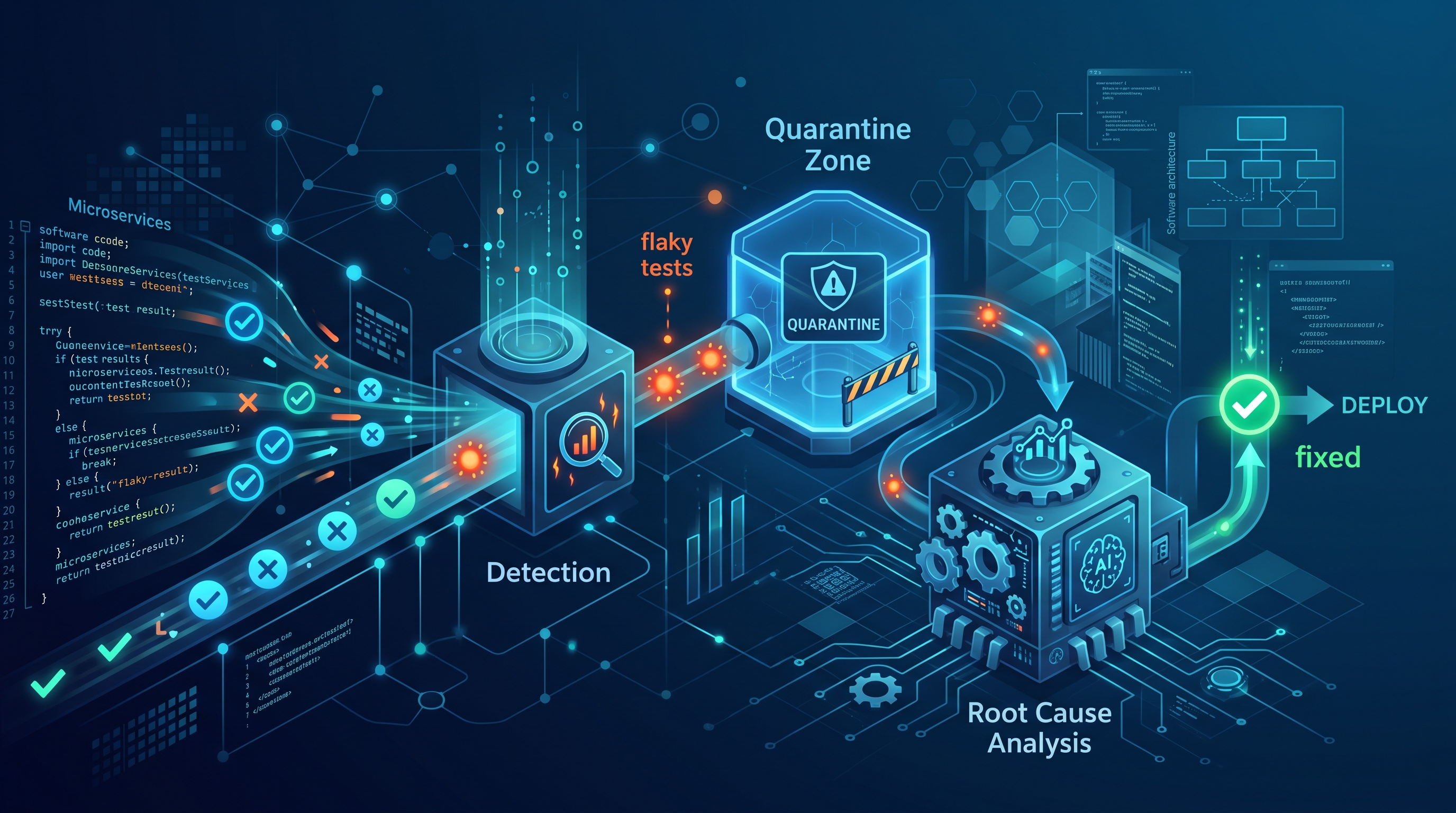
After twenty-five years in the trenches at firms like JPMorgan Chase and Deutsche Bank, I have learned that a CI pipeline is only as strong as its weakest test. We often obsess over build times and caching strategies, as detailed in our guide on monorepo CI caching remote build 2026, but we ignore the insidious rot of non-deterministic failures. A flaky test does not just delay a deployment; it erodes trust. When developers see red lights that turn green on a retry, they stop reading the logs. They start ignoring the pipeline. This is the beginning of technical debt accumulation that no amount of refactoring can easily repay.
The challenge in 2026 is not just finding flaky tests; it is engineering a system that isolates them before they block the merge queue. We need a strategy that moves from reactive debugging to proactive quarantine. This requires a shift in mindset: treat flakiness as a security vulnerability.
The Anatomy of Modern Flakiness
Before we can quarantine, we must define what we are fighting. In enterprise environments, flakiness rarely stems from simple logic errors. It is almost always environmental. Race conditions in distributed systems, timing dependencies in integration tests, and state leakage between parallel execution shards are the primary culprits.
I see teams wasting hundreds of engineer-hours per month chasing ghosts. A test fails because a database connection pool was exhausted at exactly 2:00 PM, or because a third-party API rate-limited the test runner. These are not code defects; they are infrastructure instability. If you are not monitoring your CI runner’s resource utilization alongside your test results, you are flying blind. You need to correlate test failure timestamps with infrastructure metrics. If a test fails only when the runner CPU utilization exceeds 80%, you do not have a test problem; you have a capacity problem.
Detection: Statistical Significance Over Grep
Many teams attempt to detect flakiness by running tests twice and comparing outputs. This is naive. True detection requires statistical rigor. You need to track the pass/fail history of each test case over a rolling window, typically the last 100 executions.
A test should be flagged as "flaky" if it fails more than a specific threshold, say 5% of the time, but only after ruling out known infrastructure outages. I recommend implementing a flaky test detector that runs as a background job, analyzing the CI logs. This detector should look for patterns, not just binary outcomes.
Here is what you need to track for every test case:
- Pass/Fail Ratio: The percentage of successful runs over the last N executions.
- Time-to-Fail: The average duration before failure occurs, which can indicate timeouts.
- Context Hash: A unique identifier for the environment, code branch, and dependencies used in the run.
- Retry Count: How many automatic retries were required to pass, indicating marginal stability.
If a test crosses the 5% failure threshold, it moves to quarantine. This is not a punishment; it is a protective measure.
Quarantine: The Circuit Breaker Pattern
Once a test is identified as flaky, it must be quarantined immediately. Do not let it sit in the main test suite. The goal of quarantine is to prevent it from blocking the merge queue while we investigate.
In practice, this means moving the test to a separate execution pool. In Kubernetes-based CI runners, this can be achieved by labeling specific pods or nodes that are dedicated to "flaky" or "integration" tests. This separation ensures that a flaky test does not consume resources from the critical path unit tests.
You should also implement a "circuit breaker" logic in your CI configuration. If a test is marked as flaky, the pipeline should skip it during the initial merge check but run it in a nightly "health check" job. This allows you to maintain visibility into the test without blocking progress.
Consider this workflow for handling a flagged test:
- Detect: The statistical analyzer flags the test after 3 failures in the last 10 runs.
- Quarantine: The CI system automatically moves the test to the
quarantinesuite. - Notify: A Slack or Teams alert is sent to the owning team with the failure logs and context.
- Investigate: The team has 48 hours to fix the root cause or disable the test with a justification.
This process reduces the noise in your pipeline significantly. By isolating the bad actors, you restore confidence in the green lights that remain.
Root Cause Analysis: Beyond the Stack Trace
Quarantine buys you time, but it does not solve the problem. You must perform root cause analysis (RCA) on every flaky test. I have found that most flaky tests can be categorized into one of three buckets:
- State Leakage: The test assumes a clean environment but shares state with previous tests. Fix this by enforcing strict isolation, such as creating fresh database schemas for each test or using transactional rollback strategies.
- Timing Dependencies: The test relies on specific sleep durations or assumes network latency. Replace sleeps with event-driven waits or polling mechanisms. Use tools like
wait-for-itor custom retry loops with exponential backoff. - Infrastructure Instability: The test fails due to external dependencies. Mock these dependencies or use service virtualization. If you cannot mock them, you must stabilize the environment. This is where our work on terraform drift detection governance 2026 becomes critical. If your CI environment drifts from its desired state, tests will fail unpredictably.
When analyzing logs, do not just look at the error message. Look at the environment variables, the network traces, and the system load. Use distributed tracing to understand the full lifecycle of the test execution. If you are running tests in Kubernetes, ensure that your logs are aggregated and searchable. A failed test is a data point; a failed test with no context is a dead end.
Frequently Asked Questions
How do I prioritize which flaky tests to fix first? Focus on the tests that fail most frequently and are part of the critical path. A test that fails 10% of the time and blocks a production deployment is more urgent than one that fails 1% of the time and is part of a nightly integration suite. Use a risk matrix that combines failure frequency with business impact.
Can I just disable flaky tests permanently? No. Disabling tests is a temporary workaround that increases technical debt. If you disable a test, you lose coverage. You should only disable a test if it is obsolete or if the underlying feature is deprecated. Otherwise, you are flying blind and risking regression in production.
How long should the quarantine period last? There is no fixed time limit. Quarantine lasts until the root cause is identified and fixed. However, you should enforce a review cadence. If a test has been quarantined for more than two weeks, it should be reviewed by a lead engineer to determine if it should be fixed, refactored, or removed.
What metrics should I track to measure improvement? Track the "Flaky Test Rate" (number of flaky tests divided by total tests) and the "Pipeline Stability Score" (percentage of builds that pass on the first attempt). Aim to reduce the flaky test rate by 20% each quarter. Monitor the mean time to detection (MTTD) for flaky tests to ensure your detection system is effective.
Conclusion
Killing flaky tests is not a one-time project; it is a continuous discipline. It requires a combination of statistical detection, automated quarantine, and rigorous root cause analysis. By treating flakiness as a critical defect, you can stabilize your CI pipelines and restore trust in your deployment process. Start by identifying your top 20% of flaky tests. Fix those. Then move to the next 20%. Within a few months, you will see a dramatic improvement in your pipeline’s reliability. The goal is not perfection; the goal is predictability. In 2026, predictability is the ultimate competitive advantage.