
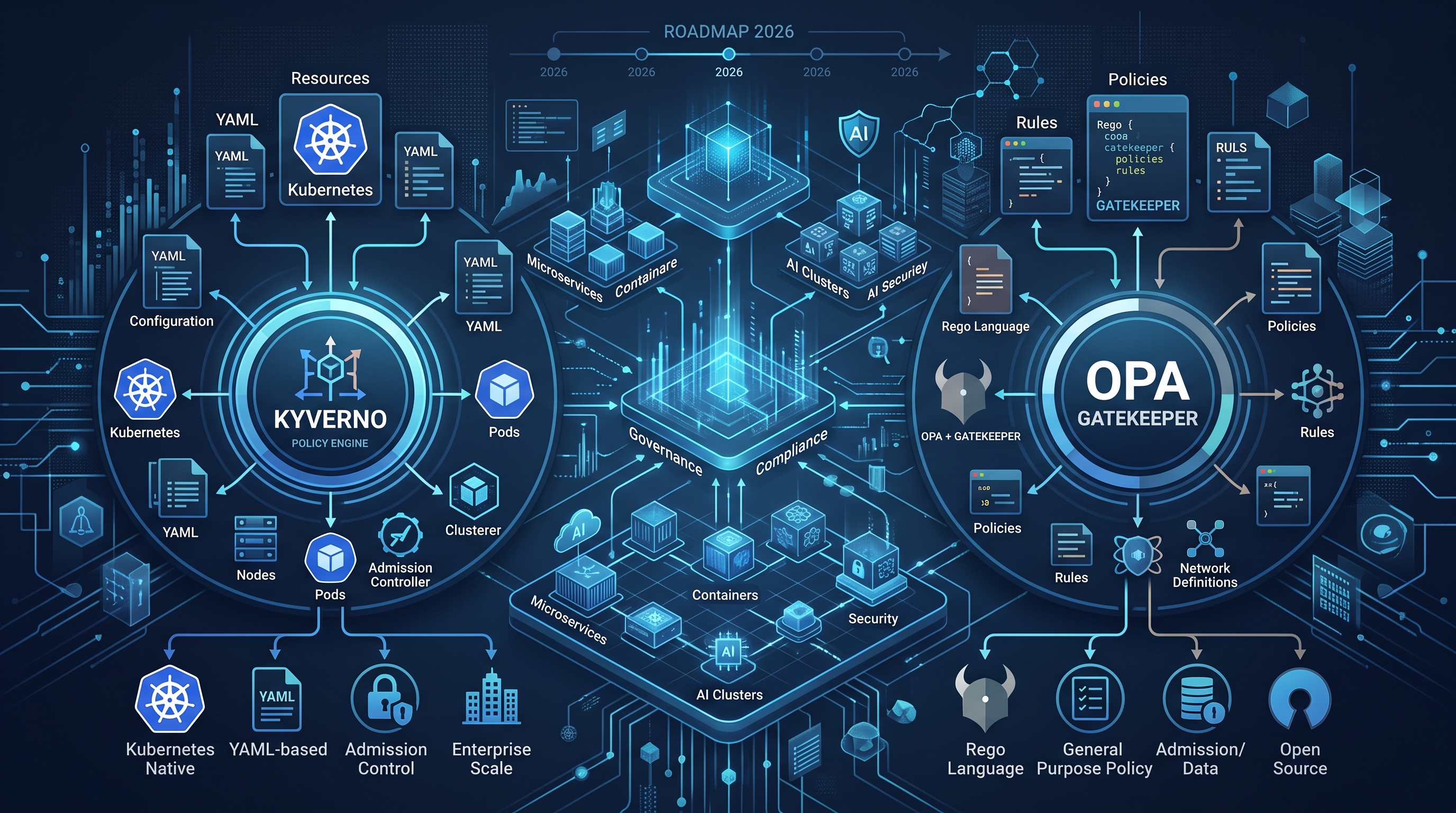
In my 25 years at institutions like JPMorgan Chase and Deutsche Bank, I have seen the Kubernetes security landscape shift from ad-hoc iptables rules to sophisticated, declarative policy engines. By 2026, the debate is no longer *whether* to use a policy engine, but *which* one fits your specific architectural gravity. The two titans, OPA Gatekeeper and Kyverno, dominate the conversation. I have managed clusters where both were deployed, often in the same enterprise, for different reasons.
Choosing between them is not a matter of finding the "better" tool, but the right tool for the specific constraint you are solving. My experience suggests that most enterprises fail not because of the engine choice, but because they treat policy as an afterthought rather than a core component of the CI/CD pipeline.
The OPA Gatekeeper Standard
Open Policy Agent (OPA) with its Kubernetes Gatekeeper webhook is the enterprise standard for a reason. It is battle-tested, language-agnostic (via Rego), and deeply integrated into the broader CNCF ecosystem. If you are dealing with complex, cross-resource compliance checks that span multiple namespaces or even clusters, OPA is your anchor.
Rego is a declarative language that allows for incredibly sophisticated logic. For example, if your compliance requirement states that "no database pod can run without a corresponding network policy and a resource quota defined in the same namespace," OPA can evaluate this state holistically. It does not just look at the incoming request; it looks at the cluster state.
However, this power comes with a cost. Rego has a steep learning curve. Writing a simple "deny if label missing" rule is straightforward, but debugging complex logic errors in Rego can be a nightmare for junior engineers. Furthermore, OPA is primarily a *validation* engine. While it can do some mutation, it is not its primary strength. In high-throughput environments, the latency introduced by the OPA webhook can become a bottleneck if not tuned correctly. I have seen clusters where the admission controller added 200-300ms of latency to every deployment, which is unacceptable for rapid iteration cycles.
Kyverno: Simplicity and Mutation
Kyverno, on the other hand, was built by engineers who wanted to make policy writing as intuitive as writing Kubernetes YAML. It uses native Kubernetes resources for policy definitions. If you can read a Pod spec, you can read a Kyverno policy. This lowers the barrier to entry significantly.
The real differentiator for Kyverno in 2026 is its mutation capability. Kyverno excels at *patching* resources on the fly. Need to inject a sidecar container, add a default security context, or tag a deployment with a specific label for tracing? Kyverno handles this with ease. In my experience, teams that spend 40% of their time managing policies are better served by Kyverno’s mutation features, which reduce the need for external operators or init containers.
Performance-wise, Kyverno is generally faster for simple, single-resource validations because it does not need to query the entire cluster state for every request. It is more lightweight. However, this simplicity can be a trap. If you try to force complex, cross-cluster logic into Kyverno, you will find yourself writing convoluted YAML that defeats the purpose of its simplicity.
The Hybrid Reality
In a large enterprise, you will rarely see a binary choice. The most robust architectures I have implemented use a hybrid approach. OPA Gatekeeper sits at the edge, enforcing global, compliance-heavy rules that require cluster-wide context. Kyverno operates closer to the nodes or in specific namespaces, handling high-throughput mutation and simpler validations.
This creates a "policy sprawl" challenge. Managing policies across two different engines, two different YAML formats, and two different debugging tools is a maintenance nightmare. This is where the concept of an Agentic AI Control Plane becomes relevant. As discussed in my previous post on agentic-ai-control-plane-enterprise-2026.html, using AI agents to abstract the underlying policy engine can provide a unified interface for developers, hiding the complexity of whether a policy is enforced by OPA or Kyverno.
Decision Framework: When to Choose Which
- Choose OPA Gatekeeper if:
- You have complex, cross-resource compliance requirements.
- Your team has strong Rego skills or access to dedicated policy engineers.
- You need to enforce policies that depend on the state of other resources in the cluster.
- You are integrating with other OPA-based tools in the CNCF ecosystem.
- Choose Kyverno if:
- You need to mutate or patch resources automatically (e.g., adding labels, sidecars).
- Your team is already comfortable with Kubernetes YAML and wants a low learning curve.
- You are focused on high-throughput, namespace-level policies.
- You want to reduce the cognitive load on developers by making policies readable as standard K8s resources.
The Cost of Agent Sprawl
As you integrate more policy engines, you also increase the attack surface for your agentic workflows. If an AI agent is tasked with applying a policy change, it must interact with the policy engine. If the tool calling reliability is poor, as detailed in agent-tool-calling-reliability-failure-2026.html, you risk deploying non-compliant resources. Therefore, your policy engine choice must also consider the reliability of the APIs it exposes to automation tools.
Conclusion
There is no single winner. OPA Gatekeeper is the heavy artillery for compliance. Kyverno is the agile scout for mutation and simplicity. In 2026, the most successful teams are those that treat their policy engine as a critical part of their infrastructure, not an afterthought. They choose the tool that matches their team’s skills and their architectural complexity, and they invest in automation to manage the resulting sprawl.
Frequently Asked Questions
Is OPA Gatekeeper slower than Kyverno? Not necessarily. OPA’s performance depends heavily on the complexity of the Rego policies and the size of the cluster state being evaluated. For simple deny rules, the difference is negligible. However, for complex, stateful checks, OPA’s overhead is higher. Kyverno is generally faster for simple, single-resource mutations because it does not query the cluster state.
Can I use Kyverno for compliance? Yes, Kyverno can handle compliance validation, but it is less suited for complex, cross-resource checks compared to OPA. If your compliance rules are simple (e.g., "must have label X"), Kyverno is sufficient. If they are complex, you may need to combine it with OPA.
What is the best way to manage policy sprawl? The best practice is to adopt a unified policy-as-code framework. Use GitOps to manage all policies, regardless of the engine. Implement automated testing for policies in your CI/CD pipeline. Consider using an agentic layer to abstract the policy engine, as mentioned in my guide on agent-cost-attribution-token-budget-2026.html, to ensure consistent enforcement and reduce manual overhead.