
The Illusion of Static Evaluation
I spent 25 years building robust CI/CD pipelines for transactional systems at JPMorgan Chase and Morgan Stanley. In those systems, a regression test was simple: input A must always produce output B. If it didn’t, the build failed. Today, in 2026, the AI engineering landscape has shifted. We are no longer just coding logic; we are curating probabilistic outcomes. The biggest mistake I see teams make is treating LLM evaluation as a one-time checkpoint. It is not. It is a continuous, high-velocity pipeline requirement.
If you are still running manual evaluation scripts or relying on static benchmarks from 2023, you are already behind. The model landscape changes monthly. Prompts drift. Context windows expand. The LLM gateway patterns we discussed last year are now standard infrastructure, but the evaluation layer remains an afterthought for most enterprises. You cannot ship LLM code without the same rigor you apply to your Java or Go microservices. This post details how to construct an eval harness that functions as a true regression gate.
Designing the Eval Harness Architecture
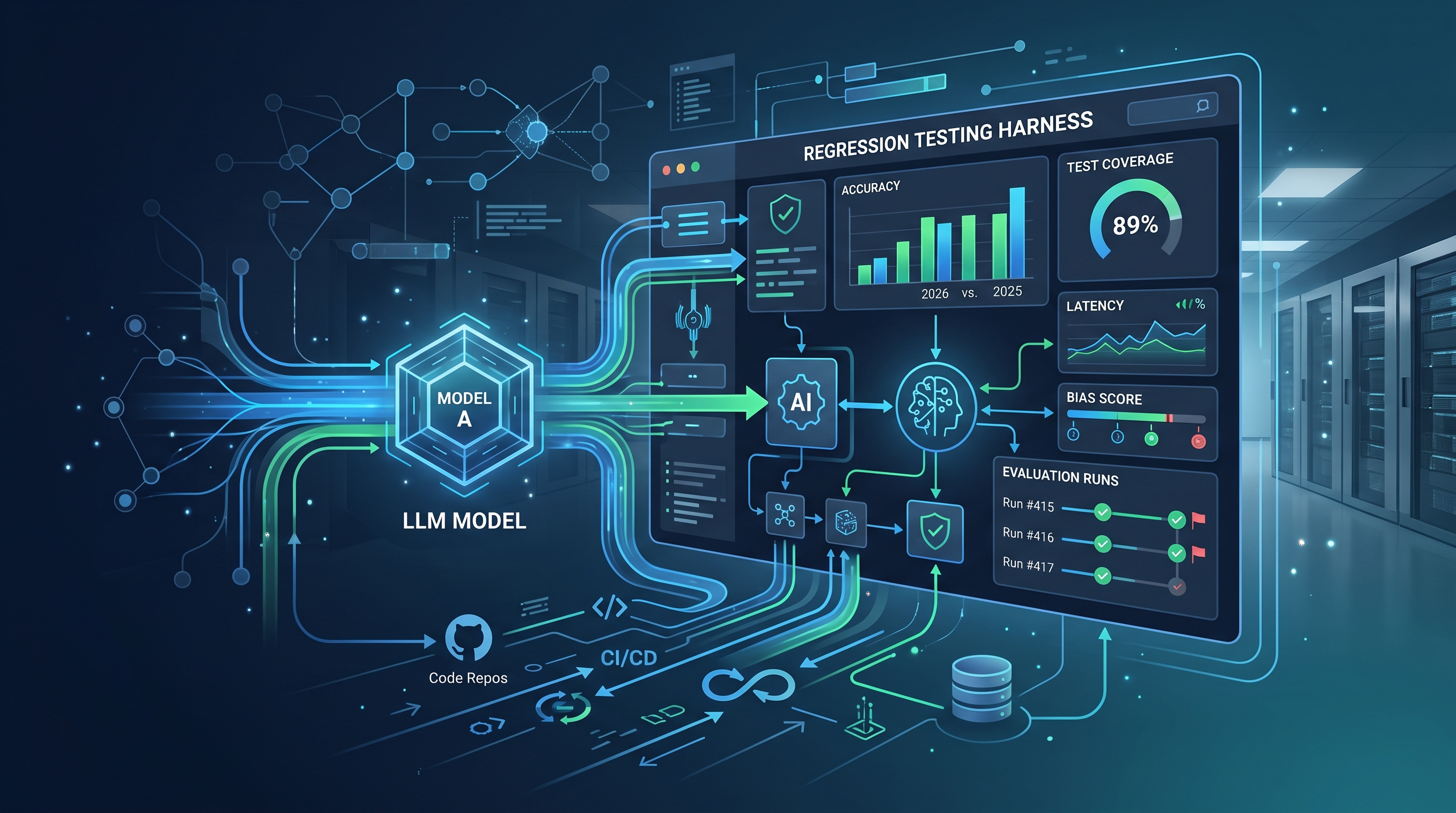
An eval harness is not a dashboard. It is an executable test suite. In 2026, the most effective harnesses are integrated directly into the CI/CD pipeline, running in parallel with unit and integration tests. The architecture must handle three distinct layers: input generation, model inference, and metric aggregation.
First, your test dataset must be versioned. Just as you version your Docker images, you must version your evaluation sets. I recommend maintaining a "Golden Set" of at least 500 high-value, representative queries. These are not random questions; they are edge cases, boundary conditions, and known failure modes identified from production logs. When you update a prompt or switch a base model, the harness runs these 500 queries against the new configuration.
Second, the inference layer must be decoupled. Do not hardcode your model calls. Use a standardized interface that allows you to swap between GPT-4o, Claude Opus, or your internal fine-tuned models without changing the test logic. This is crucial for cost optimization strategies. By abstracting the model, you can run the same eval harness against a cheaper, smaller model to see if it meets your accuracy threshold before committing to the expensive primary model.
Third, the metric aggregation layer must be automated. Human review is too slow for regression testing. You need programmatic metrics. For classification tasks, use exact match or F1 scores. For generative tasks, use LLM-as-a-judge frameworks with strict rubrics, but always back them up with deterministic checks like keyword presence or JSON schema validation. If your output is a structured JSON object, validate the schema. If it is natural language, check for hallucination indicators like "I don't know" or contradictory statements.
Implementing Regression Gates in CI/CD
Integrating this harness into your pipeline requires strict thresholds. A single point of failure is unacceptable. You need a multi-dimensional scoring system. Here are the key metrics I enforce in production environments:
- Accuracy Score: The percentage of outputs that meet the strict correctness criteria. This should not drop below 95% for critical paths.
- Latency P95: The 95th percentile response time. If a new prompt configuration increases latency by more than 10%, it fails the gate unless the accuracy gain is significant.
- Cost Per Token: Monitor the cost impact. A 5% improvement in accuracy is not worth a 50% increase in inference cost.
- Drift Detection: Compare the distribution of outputs against the baseline. If the semantic distribution shifts significantly, flag it for manual review.
These gates must be non-blocking for minor experiments but blocking for production releases. Use tools like Argo Workflows or GitHub Actions to parallelize these tests. Running 500 queries sequentially is inefficient. Distribute them across Kubernetes pods. This brings us to the infrastructure layer.
Kubernetes-Optimized Evaluation
Your eval harness should run on the same Kubernetes cluster that serves your inference traffic. This ensures that the network latency, GPU availability, and resource constraints are identical to production. I have seen teams test on local laptops and then fail in production because the GPU memory limits caused OOM kills under load. By running your eval harness in the cluster, you catch these issues early.
Furthermore, leverage GPU-optimized Kubernetes configurations to ensure your evaluation pods have access to the same hardware profiles as your serving pods. If you are using vLLM or TGI for inference, configure your harness to send concurrent requests that mimic production traffic patterns. This reveals concurrency issues that static, sequential testing misses.
Also, consider LLM quantization as part of your regression testing. When you optimize models for size, you often trade off precision. Your eval harness must detect this trade-off. Run the same test suite against the FP16 and INT8 versions of your model. If the INT8 version drops accuracy by more than 2%, you have a regression, even if the model is faster.
Managing Prompt Drift and Version Control
Prompt engineering is not coding; it is experimental. Prompts change frequently. Without rigorous version control, you lose the ability to reproduce results. Treat your prompts as code. Store them in a Git repository. When you modify a prompt, commit the change with a clear message. Your eval harness should automatically pick up the new prompt version and run the regression tests.
If the tests pass, you can merge. If they fail, you revert. This simple process prevents the "it worked yesterday" problem. I also recommend maintaining a "Prompt Changelog" that logs the reason for each change. This provides context for future developers and helps identify which types of changes typically cause regressions.
Frequently Asked Questions
How do I handle non-deterministic outputs in regression testing?
LLMs are inherently non-deterministic. To handle this, you must use a large enough sample size (at least 50-100 runs per query) to establish statistical significance. Use confidence intervals for your accuracy scores. If the mean accuracy drops below a certain threshold, fail the test. Additionally, use deterministic post-processing steps, such as JSON schema validation, to ensure structural consistency even if the content varies slightly.
Can I use open-source models for my eval harness?
Yes, and you should. Open-source models like Llama 3 or Mistral are excellent for baseline testing. They are faster and cheaper to run. Use them for initial regression checks. Only escalate to expensive proprietary models if the open-source model fails to meet your accuracy threshold. This approach reduces your evaluation costs by up to 80% while maintaining rigorous testing standards.
What is the best tool for LLM evaluation in 2026?
There is no single "best" tool. The trend is towards composable frameworks. I recommend building your harness using Python or Go, leveraging libraries like LangChain or LlamaIndex for orchestration, but writing custom evaluation logic for your specific domain. Off-the-shelf tools often lack the specificity required for enterprise-grade regression testing. You need to define your own rubrics and metrics.
How often should I run regression tests?
You should run them on every commit that touches the prompt, the model configuration, or the inference code. For production models, run a full regression suite every night. This ensures that any drift in the underlying model APIs or provider changes is caught immediately. Do not wait for a scheduled monthly review. AI moves too fast for that.