
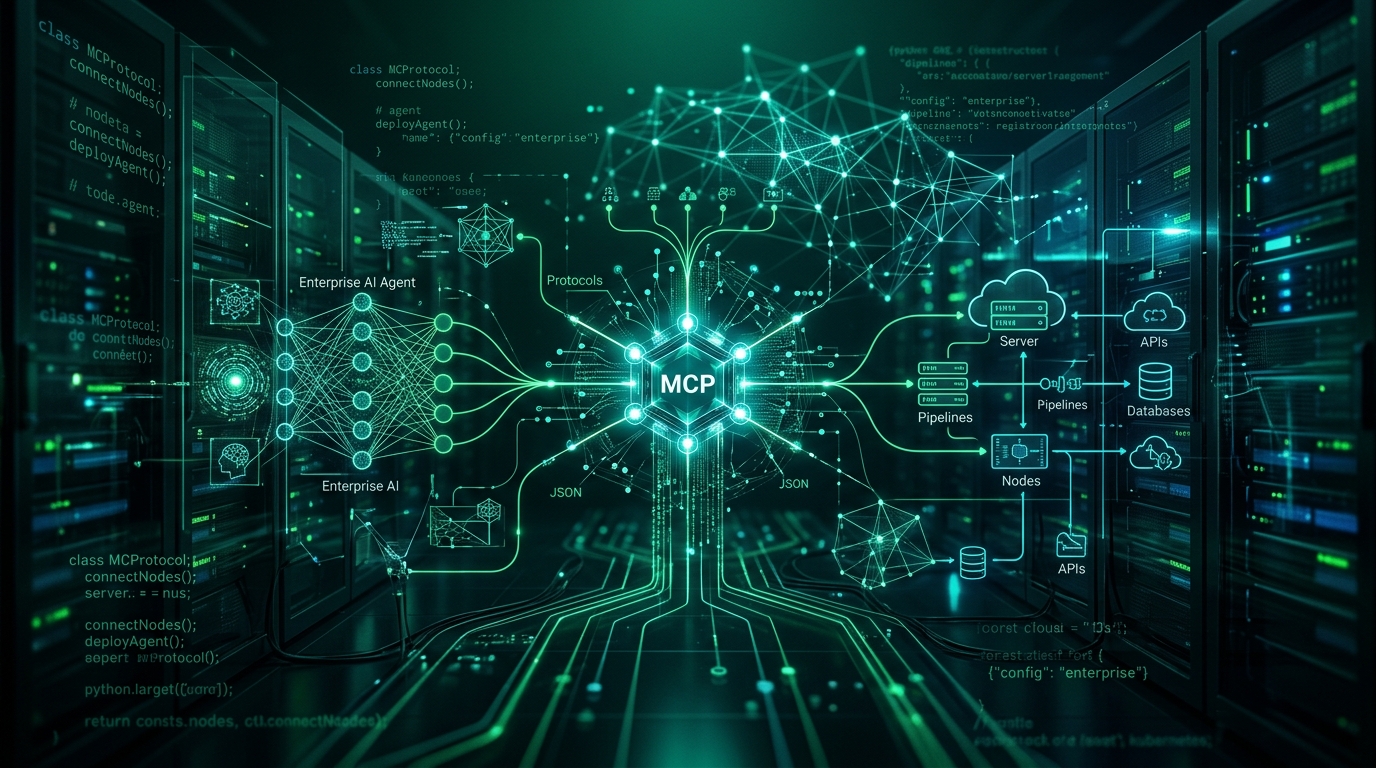
MCP Is the USB-C of AI: Why Every Enterprise Needs It in 2026
If your AI agents are still talking to tools with custom wrappers, you are building technical debt at the exact moment the industry standardized the problem away.
Model Context Protocol (MCP), introduced by Anthropic in November 2024, is doing for AI integration what USB-C did for device connectivity. One standard. Infinite compatibility. No more dongles.
By April 2026, 78% of enterprise AI teams already use at least one MCP-backed agent in production. The remaining 22% are maintaining brittle wrapper code — and rewriting it every time a vendor updates their API.
I teach this in our Agentic AI Workshop (rated 4.91/5.0 at Oracle). In 119 hands-on labs, every team builds their first MCP server in under 30 minutes. Here is why your enterprise needs it today — and how to deploy it correctly.
What MCP Actually Does (In Plain English)
Think of an AI agent as a person walking into an office and needing to use a computer, a printer, a phone, and a filing cabinet. Without MCP, the agent says: "I need to learn the unique interface for each device." With MCP, each device exposes a common interface, and the agent plugs in once.
MCP is a standardized protocol for how AI agents discover, authenticate, and invoke tools. It defines:
- Tool schemas — What capabilities are available (name, description, parameters, return type)
- Authentication — OAuth 2.1, API keys, token-based auth, all standardized
- Context exchange — Rich metadata (table definitions, dimensions, entitlements) flows naturally
- Error handling — Structured failures the agent can reason about (not just HTTP 500)
This is not a toy protocol. OpenAI, Anthropic, Google Gemini, Microsoft, LangChain, and Hugging Face all support it. The same MCP server works with any of them.
The Four Patterns Every Enterprise MCP Deployment Needs
At JPMorgan and Deutsche Bank, we learned that integration protocols live or die on four dimensions: identity, security, observability, and governance. MCP handles all four — if you design it right.
Pattern 1: Identity and Role-Based Access Control
In our payment gateway systems at JPMorgan, the principle was always: every tool call must carry identity. MCP servers natively support OAuth 2.1 with fine-grained permissions.
# MCP server tool definition with RBAC
{
  "name": "get_customer_balance",
  "description": "Retrieve customer account balance",
  "parameters": {
    "customer_id": {"type": "string", "required": true},
    "account_type": {"type": "string", "enum": ["checking", "savings"]}
  },
  "required_roles": ["account_viewer", "financial_analyst"],
  "rate_limit": "100/min"
}
The agent passes the user's identity token through. The MCP server enforces permissions at the edge. No agent can accidentally escalate privileges because the tool definition itself declares what is required.
Pattern 2: Context Engineering Through Metadata
This is where MCP truly differentiates from API wrappers. MCP servers provide rich metadata about the data they expose — not just raw endpoints.
For example, a PostgreSQL MCP server does not just expose "SELECT * FROM users." It provides:
- Schema definitions (columns, types, constraints)
- Column descriptions ("revenue — last 30 days, in USD")
- Row-level security rules ("user sees only their region")
- Audit metadata (last update, data lineage)
This contextual awareness slashes hallucinations. The agent reasons about what the data means, not just what columns it has.
Pattern 3: Observability by Design
Every MCP tool call leaves a structured trace. When we deploy LangGraph with MCP clients, every invocation is:
- Logged — tool name, parameters, latency, result status
- Cost-tracked — token usage per tool call, aggregated per session
- Auditable — who triggered the agent, what tool was called, when, and what was returned
- Versioned — MCP server schema versions, so breaking changes are detected before deployment
We mandate this in training: if you cannot trace an MCP call's identity and cost, it does not ship.
Pattern 4: Governance as Code
The EU AI Act goes into full effect in August 2026. Enterprises will need verifiable evidence of:
- What tools an agent accessed
- Who authorized each access
- What data was processed and for how long
- How decisions were made
MCP provides this natively through structured audit trails and schema versioning. Every tool call is a structured event that feeds into your SIEM or compliance dashboard.
How to Build Your First MCP Server (Production-Ready)
In our workshop, teams build a production-grade MCP server in three files:
- server.py — The FastMCP server with tool definitions
- tools.py — The actual tool implementations (database queries, API calls)
- Dockerfile — The container image with health checks and deployment spec
# server.py — Production MCP Server
from mcp.server.fastmcp import FastMCP
from tools import get_customer_data, update_order_status

mcp = FastMCP("enterprise-tools")

@mcp.tool()
def customer_lookup(customer_id: str, include_history: bool = False):
    """
    Look up customer by ID. Returns full profile.
    Requires 'customer_viewer' role.
    Rate limit: 100/min.
    """
    return get_customer_data(customer_id, include_history)

@mcp.tool()
def update_order(order_id: str, status: str, reason: str):
    """
    Update order status. Requires 'order_admin' role.
    All changes are logged and versioned.
    """
    return update_order_status(order_id, status, reason)

if __name__ == "__main__":
    mcp.run(port=8000, transport="http")
Thirty minutes. Two tools. Zero custom wrapper code. And this server works with OpenAI, Anthropic, Gemini, LangGraph — anything that speaks MCP.
The DevOps Playbook: MCP on Kubernetes
Deploying MCP servers on Kubernetes follows the same patterns we used for microservices at JPMorgan:
- Separate MCP servers per domain — Payment MCP, CRM MCP, Inventory MCP. Version them independently.
- Service mesh for auth — mTLS between agent and MCP server, with Istio or Cilium handling identity.
- Sidecar for observability — OpenTelemetry sidecar capturing every MCP call, feeding into Prometheus + Grafana.
- Circuit breakers — If an MCP server fails three times in 60 seconds, the agent routes to a fallback or pauses.
This is infrastructure, not a science project. The same rigor we apply to payment gateways applies here.
The Bottom Line
By 2027, custom API wrappers for AI agents will look as archaic as USB-A dongles. MCP is not optional — it is the foundation.
The teams winning in 2026 are the ones who:
- Standardize on MCP for all agent-tool integration
- Deploy MCP servers on Kubernetes with service mesh + observability
- Enforce identity, governance, and audit trails from day one
Want to build production MCP servers with your team? We teach this in 119 hands-on labs, zero PowerPoint, with a zero-risk guarantee:
- Agentic AI Workshop (5 days) — LangGraph, MCP, RAG, Langfuse, production patterns
- AI-Powered DevOps (3 days) — Self-healing K8s infrastructure with AI agents
Rated 4.91/5.0 at Oracle. Schedule a call →