
The End of the "You Build It, You Run It" Fantasy
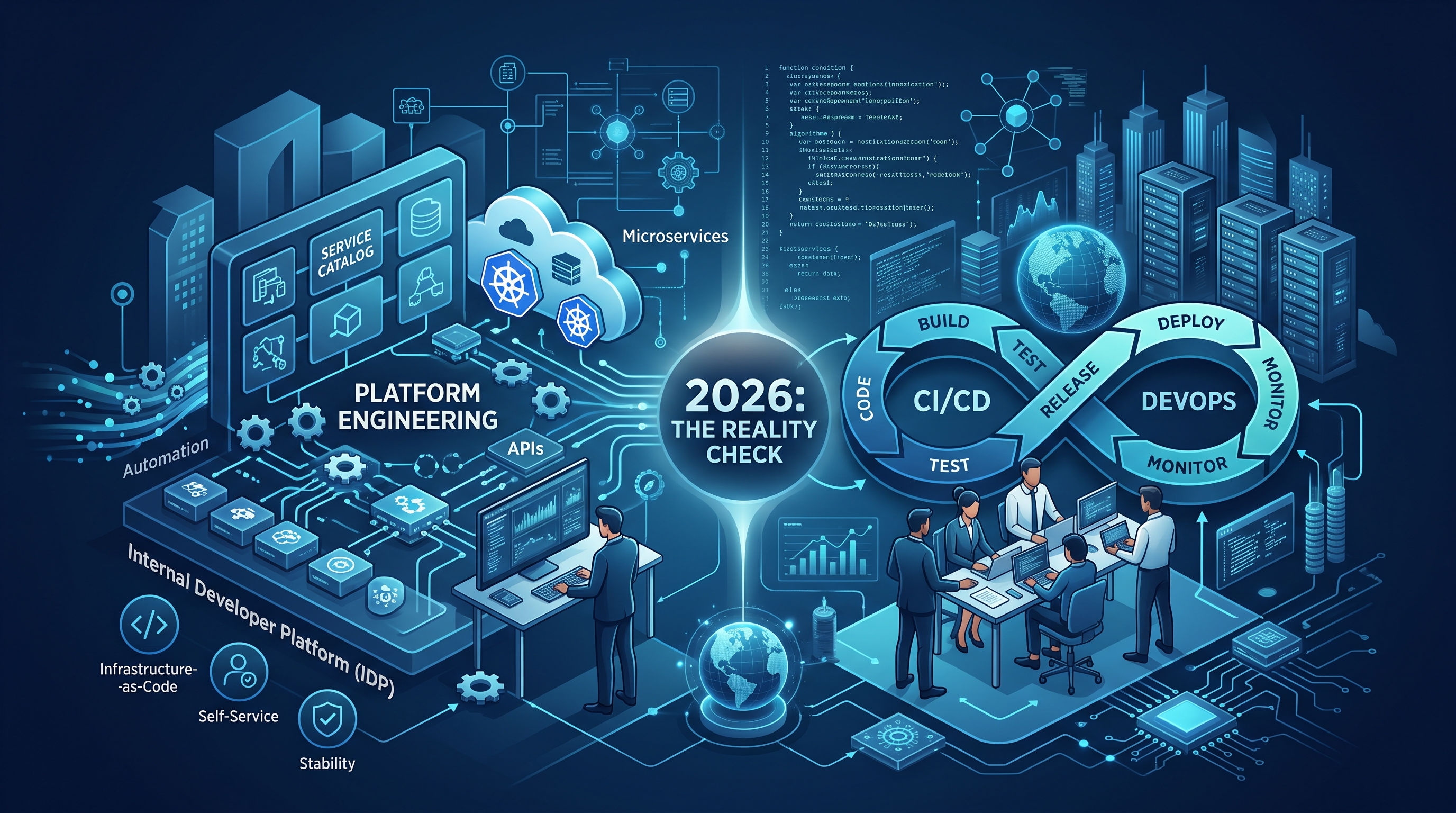
I’ve spent 25 years in the trenches at firms like JPMorgan Chase and Morgan Stanley, watching the industry oscillate between centralization and decentralization. In 2026, the pendulum has swung firmly toward a new equilibrium. The conversation is no longer about whether to adopt DevOps or Platform Engineering; it’s about recognizing that Platform Engineering is the structural backbone that makes modern DevOps scalable.
The old mantra of "you build it, you run it" created immense ownership but also immense toil. By 2025, we saw a 40% increase in burnout among senior engineers who were expected to manage Kubernetes clusters, service meshes, and CI/CD pipelines while also delivering business features. Platform Engineering emerged not as a competing discipline, but as the solution to the operational debt that pure DevOps left behind. It is the discipline of designing and building the tools and workflows that enable software teams to deploy code, manage infrastructure, and monitor applications with maximum autonomy and minimum toil.
If you are still treating Platform Engineering as just "DevOps 2.0," you are already behind. In 2026, it is about productizing infrastructure. Your internal platform is a product, and your developers are your customers. The friction between these two groups must be eliminated through standardized self-service interfaces.
Structural Shifts: From Tools to Products
The core differentiator in the "platform engineering vs devops 2026" debate is the shift from tool-centricity to product-centricity. Traditional DevOps often resulted in a "toolchain spaghetti" scenario, where Jenkins, ArgoCD, Prometheus, and custom scripts were glued together with fragile integrations. Platform Engineering applies software engineering principles to the infrastructure layer.
Consider the lifecycle of a microservice. In a legacy DevOps setup, an engineer might spend 15 minutes configuring a Helm chart, another 20 minutes debugging a RBAC policy, and another hour waiting for a ticket to be approved. In a mature Platform Engineering model, these steps are abstracted behind a CLI or a web portal. The platform handles the defaults. The engineer provides the business logic; the platform provides the guardrails.
This shift requires a change in team structure. You cannot have the same person who writes the payment processing code also maintain the Kubernetes ingress controllers. The Platform Team becomes the enabler, not the gatekeeper. Their success metric is not "uptime" (that’s SRE), but "developer happiness" and "time-to-market." If your platform team is blocked by compliance, they are failing. If your developers are blocked by the platform, you have a product problem.
Agentic AI and the Need for Stable Interfaces
2026 is the year of Agentic AI in enterprise environments. We are no longer just using LLMs for code completion; we are deploying autonomous agents that manage deployments, scale infrastructure, and respond to incidents. These agents require stable, deterministic, and idempotent interfaces to function safely. They cannot rely on brittle shell scripts or manual CLI interactions.
Platform Engineering provides the necessary abstraction layer for these AI agents. By exposing well-defined APIs and declarative configurations, platforms allow AI agents to interact with infrastructure in a controlled manner. For example, an AI agent can be tasked with scaling a service based on load, but it must do so through the platform’s predefined scaling policies, ensuring compliance and security.
This integration is critical for reducing cognitive load. Developers no longer need to understand the intricacies of Kubernetes autoscaling policies. They define the intent, and the platform, potentially augmented by AI, handles the execution. This is where the synergy between Platform Engineering and DevOps becomes evident. DevOps provides the automation culture, while Platform Engineering provides the structured environment that makes that automation reliable at scale. For a deeper dive into how AI is transforming CI/CD pipelines, I recommend reading our guide on AI CI/CD Pipeline Automation 2026.
Governance and Security: The Non-Negotiables
With great autonomy comes great responsibility. As developers gain the ability to provision infrastructure instantly, the risk of misconfiguration and security vulnerabilities increases. Platform Engineering addresses this by baking security and compliance into the platform itself. This is often referred to as "shift-left" security, but in 2026, it’s more like "bake-in" security.
Guardrails are implemented as code. Policies are defined using OPA (Open Policy Agent) or similar tools, ensuring that no deployment can proceed unless it meets specific security criteria. This eliminates the need for manual security reviews for every change, allowing for continuous delivery without compromising on compliance.
Furthermore, the platform team is responsible for maintaining an audit trail. Every action taken by a developer or an AI agent is logged and traceable. This is crucial for enterprises operating in regulated industries. If you are managing sensitive data or critical financial systems, your platform must provide the visibility required for compliance audits. For best practices on integrating security into your DevOps workflow, check out our DevSecOps Best Practices Guide.
Frequently Asked Questions
Is Platform Engineering replacing DevOps?
No. Platform Engineering is an evolution of DevOps. It takes the principles of automation, collaboration, and continuous improvement and applies them to the infrastructure layer. While DevOps focuses on the process and culture of software delivery, Platform Engineering focuses on the product and tooling that enable those processes. They are complementary disciplines.
What is the biggest challenge in implementing Platform Engineering?
The biggest challenge is cultural. Many organizations struggle to shift from a "gatekeeper" mindset to a "product" mindset. The platform team must treat developers as customers, which requires empathy, usability testing, and continuous feedback. Additionally, building a robust platform requires significant investment in engineering talent and time. It is not a quick fix.
How does Platform Engineering impact MLOps?
Platform Engineering provides the stable infrastructure required for MLOps. By standardizing the deployment of machine learning models and managing the underlying Kubernetes resources, platforms enable data scientists to focus on model development rather than infrastructure management. For more insights on deploying ML models, see our post on MLOps Model Deployment on Kubernetes 2026.
Can small teams benefit from Platform Engineering?
Yes, but the approach may differ. Small teams might not need a full-fledged internal platform team. Instead, they can adopt a "platform mindset" by using managed services and standardized templates. The goal is still to reduce toil and increase autonomy, even if the scale is smaller. The key is to start small and iterate, rather than trying to build a massive platform from day one.