
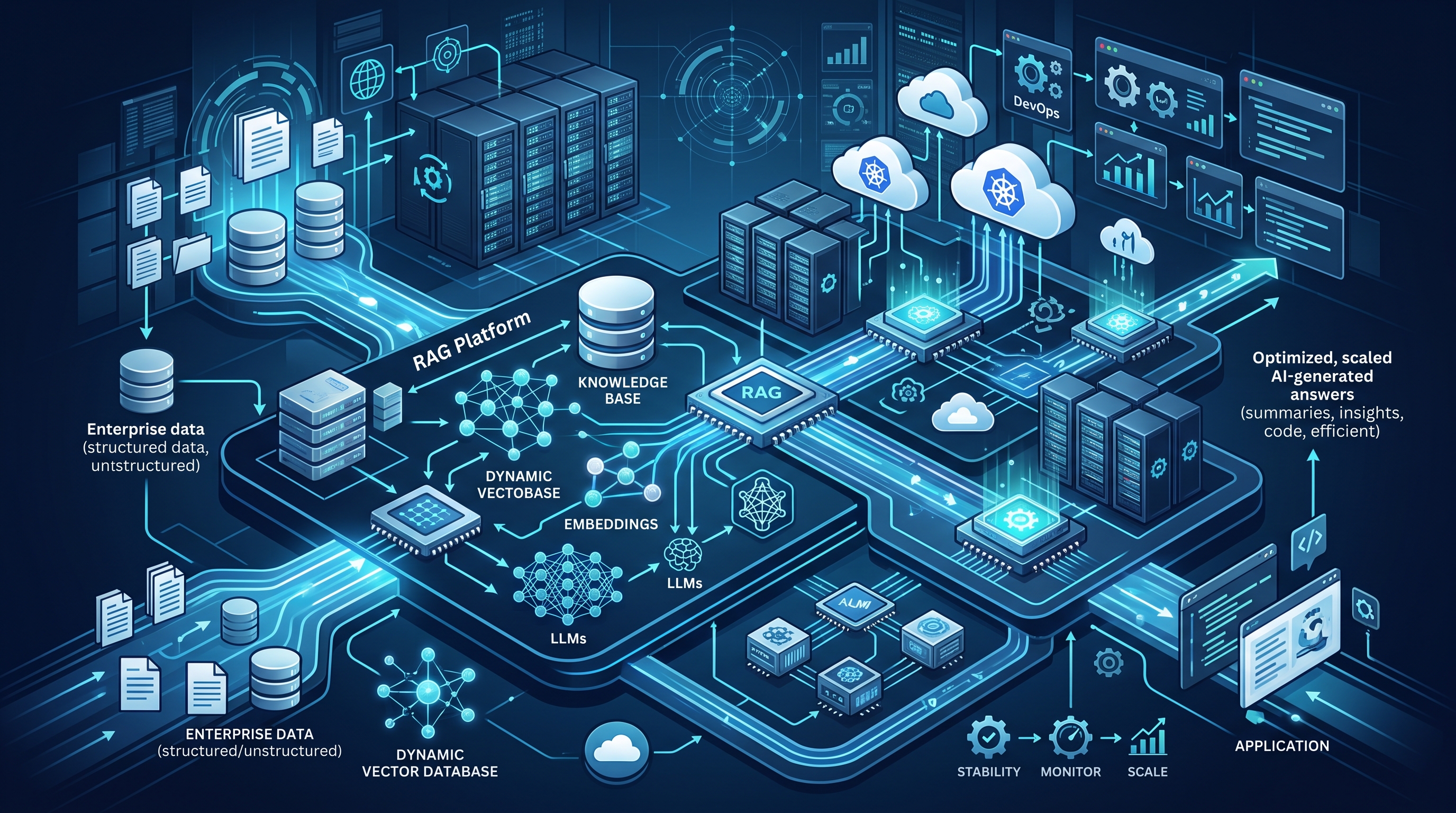
The Prototype Trap: Why Your POC Won't Scale
I’ve spent the last 25 years watching enterprise AI projects die in the "valley of death" between proof-of-concept and production. In 2026, the gap is wider than ever. You can spin up a RAG pipeline in a weekend using LangChain or LlamaIndex. You can get it to answer questions about your internal wiki with 80% accuracy on a small test set. But when you push that to production, facing 10,000 concurrent users and petabytes of unstructured data, the architecture collapses.
The failure isn't usually the model. It's the pipeline. At Deutsche Bank, we learned the hard way that a naive vector search doesn't scale. It doesn't scale because vector databases are computationally expensive, and LLM inference is slow and costly. If you treat RAG as a simple API call, you will burn through your budget and your SLAs within weeks. We moved away from "build it and hope" to "build it with constraints." The key is treating the retrieval component as a critical infrastructure service, not an afterthought.
Start by decoupling your retrieval logic from your generation logic. In production, you need to be able to scale your vector index independently of your LLM inference engines. This means adopting a microservices architecture where your retrieval service is stateless and horizontally scalable. Don't embed your vector search logic inside your LLM gateway. Let them breathe separately.
Hybrid Search: The Non-Negotiable for 2026
In 2024, everyone was chasing pure vector similarity. It was sexy. It was also wrong for enterprise data. By 2026, any production RAG pipeline that relies solely on dense vector embeddings is obsolete. Why? Because vector search struggles with exact keyword matches, proper nouns, and structured data lookups. If a user asks for "Q3 2025 revenue for Division B," a pure vector search might hallucinate a similar-sounding answer from Q2. It misses the precision.
The solution is Hybrid Search. You must combine dense vector embeddings with sparse keyword search (BM25) and, increasingly, metadata filtering. This isn't just a nice-to-have; it's a requirement for accuracy. We saw a 15% improvement in answer relevance when we implemented a weighted fusion of vector and keyword scores. The formula is simple: $Score = \alpha \cdot VectorScore + (1-\alpha) \cdot KeywordScore$. Tune $\alpha$ based on your data distribution. For technical documentation, lean towards keywords. For creative or abstract content, lean towards vectors.
Furthermore, leverage metadata filtering aggressively. Your vector store should support efficient pre-filtering. If you have 10 million documents, don't search them all. Filter by department, date, or access level first, then search within that subset. This reduces latency by orders of magnitude and improves security by ensuring users only see what they're allowed to see. This ties directly into our earlier discussion on Zero Trust DevOps, where identity and access control are paramount.
Caching and Caching Strategies: The Cost Killer
Let's talk money. LLM tokens are expensive. In a production environment, users don't ask unique questions. They ask the same questions, phrased slightly differently. If you send every query to the LLM, you're burning cash. A robust production RAG pipeline must implement multi-level caching.
Here’s the hierarchy we use at Gheware Technologies:
- Exact Match Cache: Store the raw query hash and the final answer. If the query matches exactly, return the cached answer. This handles 30-40% of traffic in stable environments.
- Fuzzy Match Cache: Use a vector index of previous queries. If a new query is 95% similar to a past one, retrieve the cached answer. This handles another 20-30% of traffic.
- Intermediate Result Cache: Cache the retrieved chunks and the LLM's intermediate reasoning steps. This is useful for debugging and for re-ranking.
This isn't just about cost; it's about latency. An exact match cache response is measured in milliseconds, while an LLM call takes seconds. Your SLA will thank you. Also, ensure your cache is distributed. If you scale your RAG API to 100 instances, they all need to see the same cache. Use Redis or Memcached, but be mindful of eviction policies. LRU (Least Recently Used) is usually a safe bet, but consider TTLs based on data freshness. If your source data changes, your cache must invalidate.
Observability: You Can't Improve What You Can't Measure
In the early days of LLMs, we relied on simple latency and cost metrics. That's no longer enough. In 2026, you need granular observability into the RAG pipeline. You need to know not just if the LLM responded, but if the retrieved chunks were relevant, and if the generated answer was faithful to those chunks.
We implemented a three-layer observability stack:
- Trace Level: Every request gets a unique trace ID that flows from the API gateway through the retrieval service, the LLM, and back. Tools like OpenTelemetry are essential here.
- Metric Level: Track retrieval accuracy (e.g., using embedding similarity scores against ground truth), hallucination rates (using a secondary LLM as a judge), and token usage.
- Log Level: Log the raw queries, retrieved chunks, and generated responses. This is critical for debugging and for retraining your models. Never lose the data. It's your most valuable asset.
Without this visibility, you're flying blind. You won't know if a drop in performance is due to a bad model update, a change in data, or a network issue. Integrate this with your existing DevOps practices. See how we bridge this gap in our guide to DevOps to AgentOps.
Scaling the Infrastructure: Kubernetes and Vector Stores
Finally, let's talk infrastructure. Scaling a RAG pipeline to handle millions of queries per day requires a robust Kubernetes orchestration strategy. Your vector database is the bottleneck. Most managed vector databases have limits on concurrent connections and query complexity. You need to design for connection pooling and query batching.
Consider using a dedicated vector database service that supports horizontal scaling. Don't roll your own vector index on top of Elasticsearch unless you have a massive team. Use managed solutions like Pinecone, Weaviate, or Qdrant, but ensure they are deployed in a way that allows for auto-scaling. Monitor their CPU and memory usage closely.
Your LLM inference layer should also be scaled independently. Use models like vLLM or TGI for high-throughput serving. Implement autoscaling policies based on queue length, not just CPU. If your queue is full, scale up. If it's empty, scale down. This is critical for cost optimization.
Remember, the goal is not just to scale the pipeline, but to scale the intelligence. As you add more data, your retrieval accuracy should improve, not degrade. This requires continuous evaluation and feedback loops. Use human-in-the-loop feedback to refine your retrieval and generation strategies. This is the only way to stay ahead in the 2026 landscape. For more on deploying agents at scale, check out our Fortune 500 Agentic AI Deployment Playbook.
Frequently Asked Questions
How do I handle data freshness in a RAG pipeline?
Data freshness is a critical challenge. Implement a incremental indexing strategy. Instead of re-indexing the entire dataset, update only the changed chunks. Use a message queue (like Kafka) to trigger re-indexing when source data changes. Also, implement a TTL (Time-To-Live) for cached answers to ensure users don't get stale information.
What is the best vector database for enterprise RAG in 2026?
There is no single best database. It depends on your scale and data type. For pure vector search, Pinecone and Weaviate are strong choices. For hybrid search with SQL capabilities, consider Milvus or Qdrant. The key is to choose a database that supports metadata filtering and hybrid search out of the box. Don't over-engineer it.
How can I reduce hallucinations in RAG?
Hallucinations are reduced by improving retrieval quality and adding guardrails. Use hybrid search to ensure accurate context retrieval. Implement a re-ranking step to sort retrieved chunks by relevance. Finally, use a secondary LLM to verify the generated answer against the retrieved context. If the verification fails, return a "I don't know" response instead of a hallucinated answer.
Is RAG still relevant in 2026?
Absolutely. RAG is the backbone of enterprise AI. While fine-tuning is useful for specific tasks, RAG provides the flexibility to update knowledge without retraining models. It also provides transparency and traceability, which are critical for compliance. RAG is not going away; it's evolving to become more robust and scalable.