
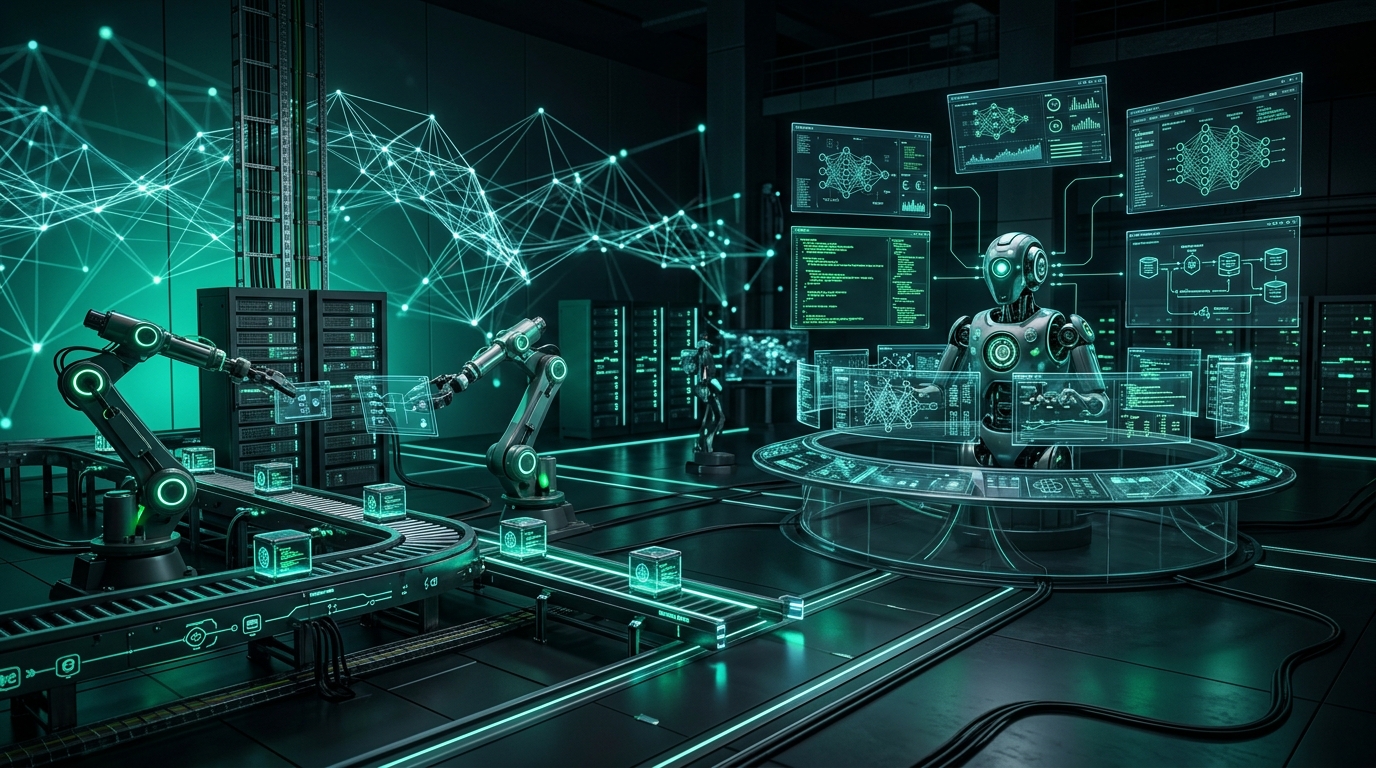
Self-Healing DevOps: How AI Agents Fix Your Infrastructure at 3 AM (And Why 2026 Is the Year)
At 3:17 AM on a Tuesday in 2017, I got the call every DevOps engineer dreads: the JPMorgan payment gateway was down. Three hours of war-room chaos later, we found the root cause — a misconfigured load balancer health check. It took a human to break it. It should have taken a machine to fix it.
Fast forward to 2026. That same incident would be resolved in under 90 seconds — by an AI agent that detected the anomaly, correlated it with the deployment that introduced it, rolled back the change, and verified service restoration. No pager. No war room. No 3 AM adrenaline.
This is not science fiction. Gartner named agentic AI the top strategic technology trend for 2025. The AIOps market is projected at $18.51 billion by 2029, growing at 37.2% CAGR. And 70% of new enterprise applications will use agentic AI by 2028.
In our AI-Powered DevOps Workshop (rated 4.91/5.0 at Oracle), we teach teams to build exactly these systems. Here is the architecture that actually works in production.
The Self-Healing Loop: Detect → Diagnose → Decide → Act
Every self-healing system follows a four-stage loop. The difference in 2026 is that LLM-powered agents handle the middle two stages — diagnosis and decision — with human-level reasoning at machine speed.
Stage 1: Detect (Observability Layer)
The foundation is always observability. At Morgan Stanley, we instrumented every service with:
- Metrics — Prometheus scraping 10K+ time series per service
- Logs — Structured JSON with trace IDs, flowing into Loki/Elasticsearch
- Traces — OpenTelemetry spans end-to-end, from user click to database query
- Profiles — Continuous profiling with Pyroscope to catch resource contention before it becomes an incident
The AI agent consumes these signals through Grafana dashboards, alertmanager webhooks, and direct API queries. It does not replace your observability stack — it amplifies it.
Stage 2: Diagnose (LLM-Powered Root Cause Analysis)
This is where traditional AIOps tools fail. Rule-based systems can tell you what is wrong ("CPU > 90%"). They cannot tell you why.
An LLM agent, armed with:
- The last 50 Git commits and their diffs
- The deployment that coincides with the anomaly
- Historical incident records ("last time this happened, it was...")
- Runbooks and SRE playbooks as context
...can reason: "The latency spike started 4 minutes after commit a3f7d2e, which added a N+1 query to the payment service. The pattern matches incident #2847 from March. Recommended action: rollback a3f7d2e and alert the payment team."
This is not retrieval. This is contextual reasoning — and it is the core of what we teach in lab 34.
Stage 3: Decide (Human-in-the-Loop for Critical Actions)
Not every action should be autonomous. At JPMorgan, we used a tiered approval model:
- Tier 1 (auto): Restart a pod, clear a cache, scale a deployment +1 replica
- Tier 2 (notify + auto): Rollback to previous version, fail over to secondary region
- Tier 3 (require approval): Database schema changes, security policy modifications, financial transaction reversals
LangGraph's interrupt mechanism creates natural breakpoints. The agent proposes, the human approves (or overrides), and the agent resumes. All decisions are logged in Langfuse for audit.
Stage 4: Act (Kubernetes-Native Remediation)
The agent executes through Kubernetes APIs and MCP servers. Examples from production deployments:
# Agent-generated remediation script (auto-approved Tier 1)
# Detected: Payment-service latency > 2s P95
# Diagnosed: Memory pressure causing GC thrashing
# Action: Scale deployment +2 replicas, trigger heap dump

kubectl scale deployment payment-service --replicas=5 -n production
kubectl exec -n production deploy/payment-service -- \
  jmap -dump:live,format=b,file=/tmp/heap.hprof 1
# Alert on-call for heap analysis tomorrow morning
The agent does not just run commands. It verifies that P95 latency drops below 500ms before considering the incident resolved. If not, it escalates to Tier 2.
The Kubernetes AI Stack for Self-Healing
The production stack we teach combines four technologies:
- KServe — Production model serving with canary rollbacks and A/B testing
- KEDA — Event-driven autoscaling for GPU and CPU workloads (scales to zero, scales from zero)
- DRA (Dynamic Resource Allocation) — Fine-grained GPU scheduling for multi-tenant AI clusters
- Quantized LLMs — Run 7B-parameter models on spare CPU nodes for inference, not just GPU
This is where Kubernetes becomes an AI supercomputer — not by adding more GPUs, but by using the ones you have intelligently.
Governance: The EU AI Act Is Coming
In August 2026, the EU AI Act goes into full effect. Self-healing systems that autonomously modify production infrastructure are classified as high-risk AI systems. Enterprises will need:
- Audit trails — Every agent decision, with rationale, timestamp, and outcome
- Human oversight — Meaningful human review for Tier 2+ actions, not just rubber-stamp
- Risk management — Documented risk assessments for autonomous capabilities
- Accuracy testing — Offline validation on historical incidents before deployment
MCP provides structured audit trails by design. Langfuse captures reasoning. LangGraph enforces human-in-the-loop. This is not checkbox compliance — it is production architecture that happens to be compliant.
The Bottom Line
2026 is the year self-healing infrastructure moves from elite tech companies to mainstream enterprise. The tools are mature. The patterns are proven. The only question is whether your team is ready.
The teams winning are not the ones with the biggest LLMs. They are the ones with:
- Observability first — You cannot heal what you cannot see
- Tiered autonomy — Smart about what to automate, smarter about what not to
- Governance built in — Audit trails, human approval, rollback capability from day one
- Kubernetes-native — KServe, KEDA, DRA for efficient AI workload management
Want to build self-healing systems that actually survive contact with reality? We teach this — with 119 hands-on labs, zero PowerPoint, and a zero-risk guarantee:
- AI-Powered DevOps Workshop (3 days) — Self-healing infrastructure, LLM-driven CI/CD, autonomous security remediation
- Agentic AI Workshop (5 days) — LangGraph, MCP, RAG, Langfuse, production agent patterns
Rated 4.91/5.0 at Oracle. Schedule a call →