
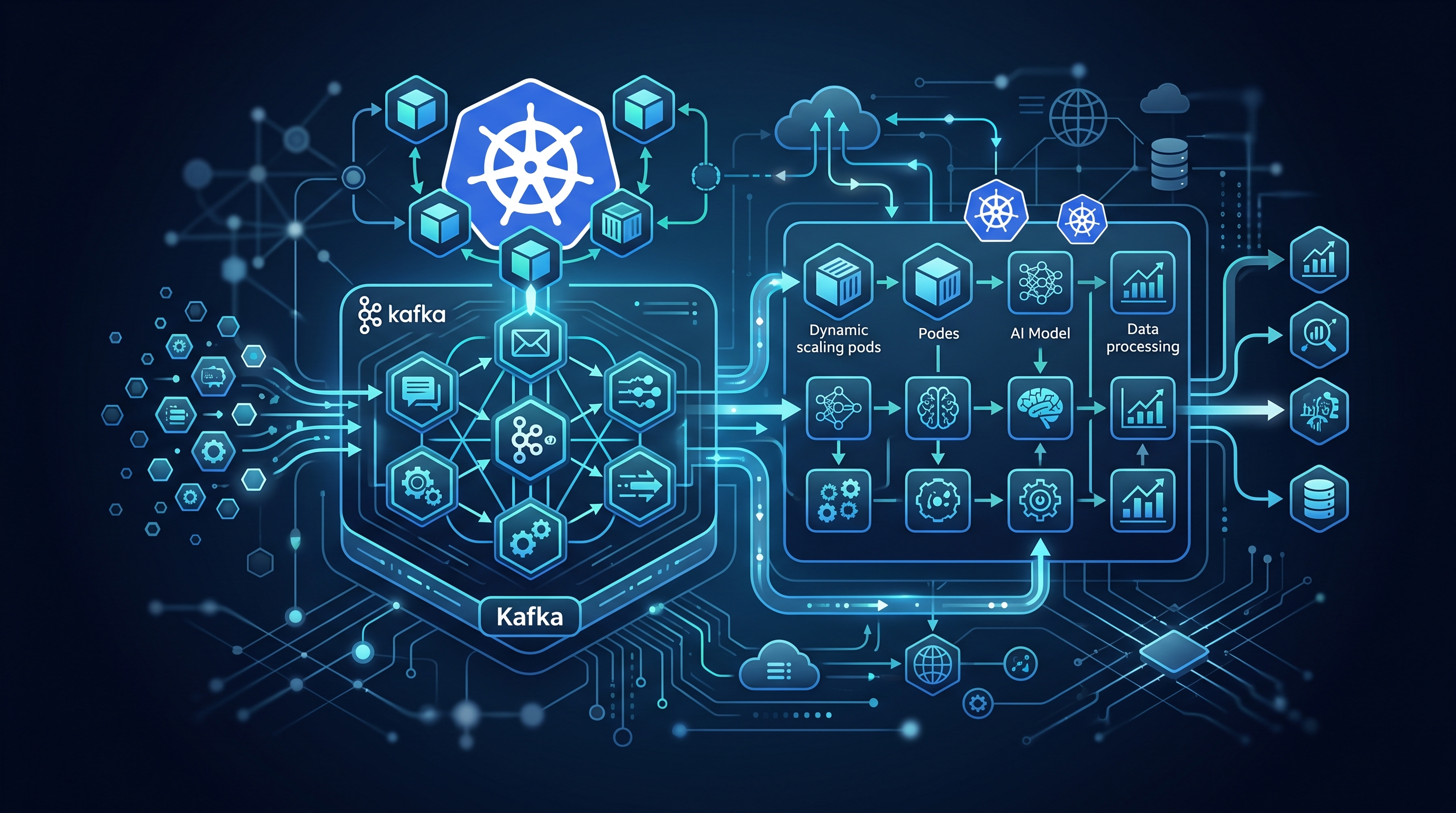
The Reality of Event-Driven Systems in 2026
Twenty-five years ago, I built monolithic applications where a database transaction was the only way to ensure consistency. Today, that model is broken. In enterprise environments handling millions of transactions per second, synchronous REST calls create latency bottlenecks that no amount of horizontal scaling can fix. The shift to event-driven architectures (EDA) is not a trend; it is an engineering necessity.
However, running Apache Kafka on Kubernetes is where many enterprises stumble. The complexity of managing Zookeeper (or KRaft), partition rebalancing, and cross-zone networking often leads to "Kafka on K8s" becoming a maintenance burden rather than a competitive advantage. My experience at JPMorgan Chase and Deutsche Bank taught me that the technology stack matters less than the operational discipline. You need an architecture that is resilient by design, not by accident.
This post outlines the concrete steps to building a robust, event-driven Kafka architecture on Kubernetes that scales horizontally and survives node failures without dropping messages. We will move beyond theoretical diagrams to the actual patterns that work in production.
Architectural Patterns for Resilience
The core tenet of an event-driven system is that producers and consumers are decoupled in time and space. In a Kubernetes environment, this decoupling must be reinforced by network policies and resource isolation. I recommend the following pattern for high-throughput financial or transactional systems:
- Producer Isolation: Run producers in separate deployments with strict resource limits. A memory leak in a producer should not starve the Kafka brokers.
- Broker Tiering: Deploy Kafka brokers with
statefulsetcontrollers to ensure stable network identities. Use persistent volumes (PV) withReadWriteManyaccess modes if your storage class supports it, or stick toReadWriteOncewith careful node affinity rules to avoid cross-AZ latency penalties. - Consumer Groups: Ensure consumer replicas match the number of partitions for maximum parallelism. Use the
StickyAssignorstrategy to minimize rebalancing overhead during deployments.
This separation prevents the "noisy neighbor" problem that plagues shared environments. If your consumer service spikes in CPU usage, it should not impact the broker's ability to commit offsets or replicate data.
Operationalizing Kafka with Operators
Managing Kafka manually is a recipe for disaster. The industry standard is to use an Operator. In 2026, I strongly advise against building custom controllers for Kafka lifecycle management unless you have a dedicated team of 5+ engineers. Instead, leverage established solutions like the Strimz Operator or Confluent Kubernetes Operator.
These operators handle the complex logic of cluster expansion, topic creation, and configuration propagation. They ensure that the desired state defined in your YAML manifests is always reconciled, even after unexpected node failures. When you update a broker's configuration, the operator orchestrates a rolling restart, ensuring that quorum is maintained throughout the process.
For observability, integrate Prometheus and Grafana directly into the operator pipeline. I have seen clients reduce mean time to recovery (MTTR) by 40% simply by exposing JMX metrics through a sidecar container. This allows you to track lag, request latency, and under-replicated partitions in real-time.
Integrating Agentic AI for Stream Processing
The true power of event-driven architecture emerges when you combine it with Agentic AI. In 2026, static rule-based alerting is insufficient for complex systems. You need agents that can consume event streams, analyze context, and take action.
Consider a scenario where a fraud detection agent consumes transaction events from a Kafka topic. Instead of just logging alerts, the agent can trigger a workflow in your orchestration layer. This is where you should look at AI Agents in Kubernetes for patterns on how to deploy these lightweight, stateful agents alongside your data pipelines.
Implementing this requires a robust message schema. Use Apache Avro or Protobuf to enforce schema evolution. Without schema validation, your AI agents will fail unpredictably when producers change the payload structure. I recommend integrating a Schema Registry as a critical component of your Kubernetes cluster, managed by the same operator that manages Kafka.
Security and Network Policies
Enterprise security cannot be an afterthought. In a Kubernetes cluster, network policies are your first line of defense. You must restrict traffic to Kafka brokers to only allow connections from authorized producer and consumer namespaces. Use mTLS for all inter-broker communication to prevent man-in-the-middle attacks.
Additionally, implement RBAC at the Kafka level. Do not rely on Kubernetes RBAC alone. The principle of least privilege applies here: a consumer service should only have read access to specific topics, while a producer should have write access only to the topics it owns. This granular control is essential for compliance in regulated industries.
For more insights on securing your AI workflows, read about Kubernetes GenAI Architecture Patterns, which covers how to secure LLM integrations in the same environment.
Frequently Asked Questions
How do I handle schema evolution in Kafka?
Always use a Schema Registry. When you update a topic, define a new version of the schema and ensure backward compatibility. Producers should validate messages against the schema before publishing. Consumers should be version-aware and able to handle multiple schema versions if necessary. This prevents breaking changes from cascading through your entire system.
What is the recommended replication factor?
For production systems, a replication factor of 3 is the industry standard. This allows you to tolerate the loss of one broker without data loss or service interruption. For critical financial data, some organizations use a factor of 5, but this increases storage costs and write latency. Balance your durability requirements with performance needs.
How do I monitor Kafka lag effectively?
Monitor consumer lag, which is the difference between the latest offset and the consumer's current offset. High lag indicates that consumers are falling behind. Use tools like Burrow or Prometheus exporters to track this metric. Set alerts for lag thresholds that indicate potential data loss or processing delays. In my experience, a lag of more than 10,000 messages per partition should trigger an immediate investigation.
Can I run Kafka on bare metal instead of Kubernetes?
Yes, and for some high-performance use cases, bare metal can offer lower latency. However, the operational overhead of managing bare metal clusters is significantly higher. Kubernetes provides the tooling for automated scaling, self-healing, and declarative configuration. For most enterprises, the benefits of Kubernetes outweigh the slight performance gain of bare metal, especially when combined with advanced scheduling and resource management.