
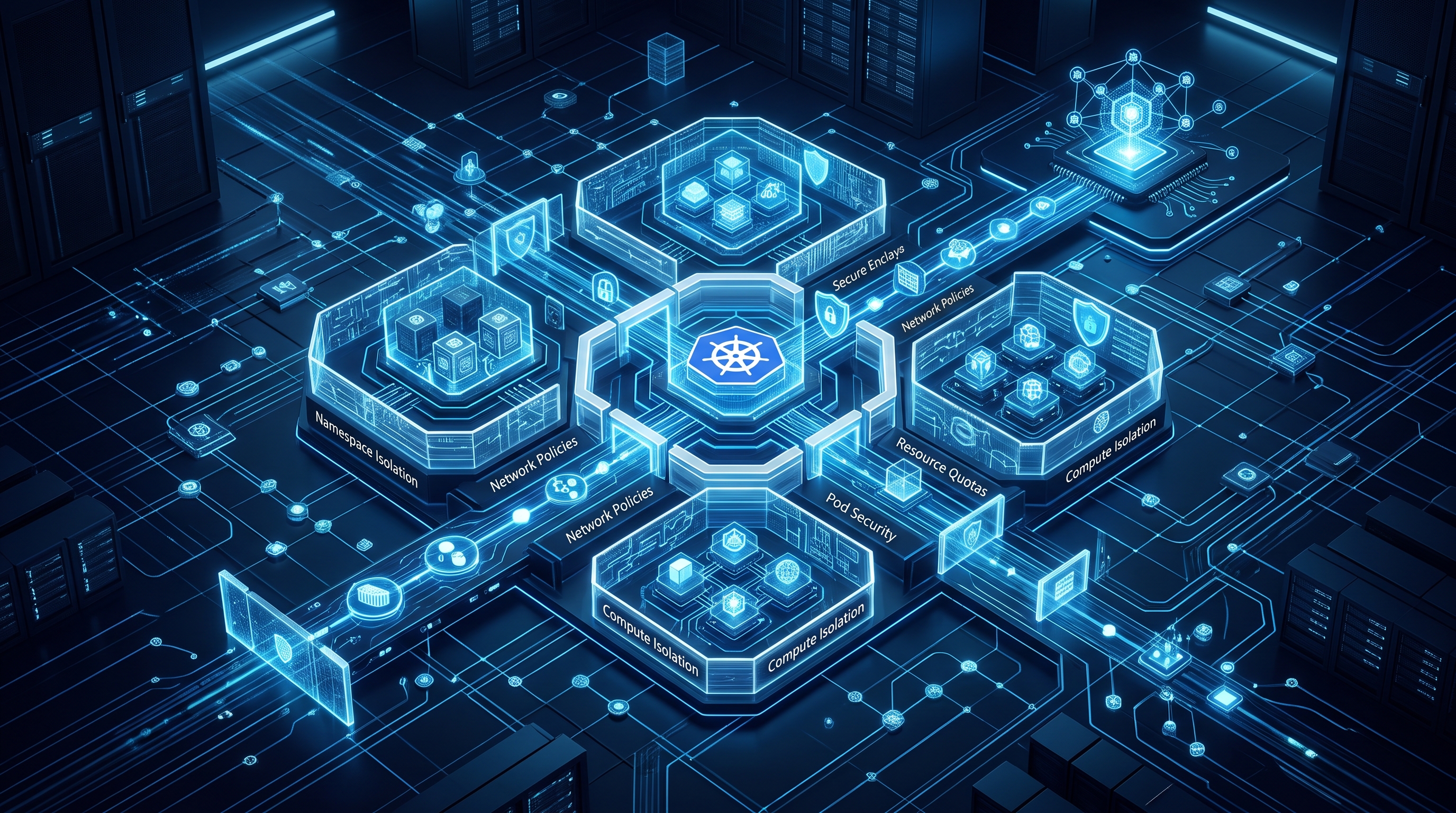
The Illusion of Isolation in Shared Clusters
After 25 years in enterprise banking infrastructure, I have seen enough "secure" multi-tenant environments crumble under a single misconfigured role-binding. In 2026, the era of "shared everything" clusters is dead. We are moving toward strict, policy-driven isolation where a tenant in one namespace cannot even see the existence of a pod in another, let alone access its resources. The keyword kubernetes multi-tenancy isolation patterns 2026 is not just about convenience; it is about security posture and compliance. If you are running a multi-tenant cluster without these controls, you are not running Kubernetes; you are running a distributed debugging nightmare.
Isolation is a layered defense. It is not a single toggle. It requires coordination across the identity layer, the network layer, and the compute layer. When I architect clusters for financial institutions, I treat every namespace as a trust boundary. A breach in one tenant’s application should not grant lateral movement to the core banking services running in a different namespace. This requires deliberate engineering, not hope.
Identity and Access: The First Line of Defense
Before we talk about network cables or CPU cycles, we must talk about who is speaking to the API server. The default Kubernetes RBAC model is too permissive for multi-tenancy. You cannot rely on `cluster-admin` roles. Instead, we implement strict Role-Based Access Control (RBAC) scoped to specific namespaces.
For each tenant, we create a dedicated namespace and a corresponding service account. We then bind a `Role` to that service account, granting only the permissions necessary for their workload. This is not just about security; it is about operational clarity. When a deployment fails, you know exactly which tenant’s permissions caused the issue. We often integrate this with external identity providers like LDAP or Active Directory, mapping groups to Kubernetes roles. This ensures that if an employee leaves the organization, their access is revoked at the identity provider, cascading immediately to the cluster.
We also leverage Service Accounts with projected tokens to avoid storing static secrets in pod specs. This reduces the blast radius of credential leakage. In a multi-tenant environment, every service account is a potential vector for attack. Minimizing privileges is the only way to mitigate this risk.
Network Isolation: Zero Trust Within the Pod
Even with strict RBAC, network isolation is critical. By default, Kubernetes allows all traffic between pods in the same cluster. This is a fatal flaw for multi-tenancy. We must implement Network Policies to enforce a zero-trust model.
A Network Policy is a declarative way to control traffic flow. It specifies which pods can communicate with each other and which ports are allowed. For example, a tenant’s frontend pods should only be able to talk to their own backend pods, not to the database pods of another tenant. We typically use CNI plugins like Calico or Cilium to enforce these policies at the kernel level, ensuring that traffic is dropped before it even reaches the application.
Here is a typical strategy for implementing network isolation:
- Define a default-deny policy for all namespaces. This ensures that no traffic is allowed unless explicitly permitted.
- Create ingress rules for each tenant, allowing traffic only from their authorized sources.
- Create egress rules to restrict outbound traffic, preventing data exfiltration or command-and-control communication.
- Regularly audit network policies to ensure they match the current application architecture.
This approach ensures that even if an attacker compromises a pod, they cannot move laterally to other parts of the cluster. It is a fundamental requirement for any serious multi-tenant deployment. For more on managing complex cluster configurations, see our guide on multi-cluster GitOps.
Resource Isolation: Preventing Noisy Neighbors
Resource isolation is often overlooked, but it is critical for performance and stability. Without proper controls, a single tenant can consume all available CPU and memory, causing outages for everyone else. This is the classic "noisy neighbor" problem.
We use Resource Quotas and LimitRanges to enforce boundaries. A Resource Quota sets the total amount of compute resources that can be consumed by a namespace. A LimitRange sets default limits and requests for containers and pods within that namespace. This ensures that no single tenant can monopolize cluster resources.
For example, we might set a Resource Quota of 100 CPU cores and 500GB of memory for a tenant namespace. If they try to deploy more pods than this, the API server will reject the request. This provides a hard ceiling on resource consumption. Additionally, we use LimitRanges to ensure that every container has a reasonable limit. This prevents accidental over-provisioning and ensures fair resource distribution.
We also leverage QoS (Quality of Service) classes to prioritize traffic. BestEffort pods are the first to be evicted under pressure, while Guaranteed pods are the last. This allows us to define critical services that must remain available, even during resource contention. In a multi-tenant environment, this is essential for maintaining SLAs.
Policy as Code: Enforcing Isolation at Scale
Manual configuration is not scalable. In a large enterprise, managing hundreds of namespaces and policies manually is impossible. We use Policy-as-Code tools like OPA Gatekeeper to enforce isolation rules automatically.
OPA Gatekeeper allows us to define policies in a declarative format and enforce them across the cluster. For example, we can create a policy that prevents any pod from running as root, or that requires all images to come from a trusted registry. This ensures that every new deployment adheres to our security standards, without requiring manual review.
We also use admission controllers to validate resources before they are created. This provides a real-time check against policy violations. If a tenant tries to deploy a pod that violates a network policy, the admission controller will reject it, preventing the deployment from proceeding. This shifts security left, catching issues before they reach production.
For deeper insights into managing complex AI workloads in this environment, check out our post on multi-agent AI systems.
Monitoring and Auditing: Visibility is Key
You cannot protect what you cannot see. In a multi-tenant environment, visibility is critical. We implement comprehensive monitoring and auditing to track resource usage, network traffic, and access events. Tools like Prometheus and Grafana provide real-time metrics, while ELK Stack or Splunk provides log aggregation and analysis.
We also enable Kubernetes audit logging to track all API server requests. This provides a detailed record of who did what, when, and where. In the event of a security incident, this data is invaluable for forensic analysis. We typically forward audit logs to a centralized logging platform for long-term retention and analysis.
Regular security scans are also essential. We use tools like Trivy or Clair to scan container images for vulnerabilities before they are deployed. This ensures that we are not introducing known risks into our multi-tenant environment. Combined with runtime security tools like Falco, we can detect and respond to anomalies in real-time.
Frequently Asked Questions
What is the difference between namespace isolation and network isolation?
Namespace isolation is a logical separation of resources and configurations, while network isolation controls traffic flow between pods. Both are necessary for effective multi-tenancy. Namespace isolation prevents unauthorized access to resources, while network isolation prevents unauthorized communication between pods.
How do I prevent noisy neighbor effects in a multi-tenant cluster?
You prevent noisy neighbor effects by implementing Resource Quotas and LimitRanges. These enforce hard limits on CPU and memory usage per namespace or per container. Additionally, using QoS classes ensures that critical services are prioritized during resource contention.
Is RBAC sufficient for multi-tenant security?
No, RBAC is necessary but not sufficient. RBAC controls access to resources, but it does not control network traffic or resource consumption. You must combine RBAC with Network Policies and Resource Quotas to achieve comprehensive isolation.
What tools are best for policy enforcement in 2026?
OPA Gatekeeper is the industry standard for policy-as-code enforcement. It integrates with admission controllers to validate resources in real-time. Other tools like Kyverno offer similar capabilities with a more user-friendly YAML-based approach.