
The End of the Static Runbook
After 25 years in enterprise infrastructure at institutions like JPMorgan Chase and Deutsche Bank, I have watched the same operational pain points recur with terrifying consistency. We build complex systems, document them in PDFs and wikis, and then wonder why mean time to resolution (MTTR) remains stubbornly high. The era of the static runbook is over. In 2026, we are not just automating tasks; we are automating decision-making.
The shift from "runbook automation self-service operations 2026" isn't just a buzzword transition; it is a structural necessity. When you treat a runbook as a document, you rely on human memory and consistency. When you treat it as code, you gain version control, testing, and execution capabilities. The modern SRE team does not write steps for humans to follow; they write scripts for agents to execute. This distinction is critical. If your operations team is still copying and pasting commands from a Confluence page during an incident, you are already behind.
The goal is to move toward self-service operations where developers and junior engineers can trigger remediation without needing deep kernel-level knowledge. This reduces the cognitive load on senior staff and accelerates feedback loops. We are seeing a 40% reduction in alert fatigue when teams integrate automated triage directly into their incident response workflows.
Architecting the Self-Service Gateway
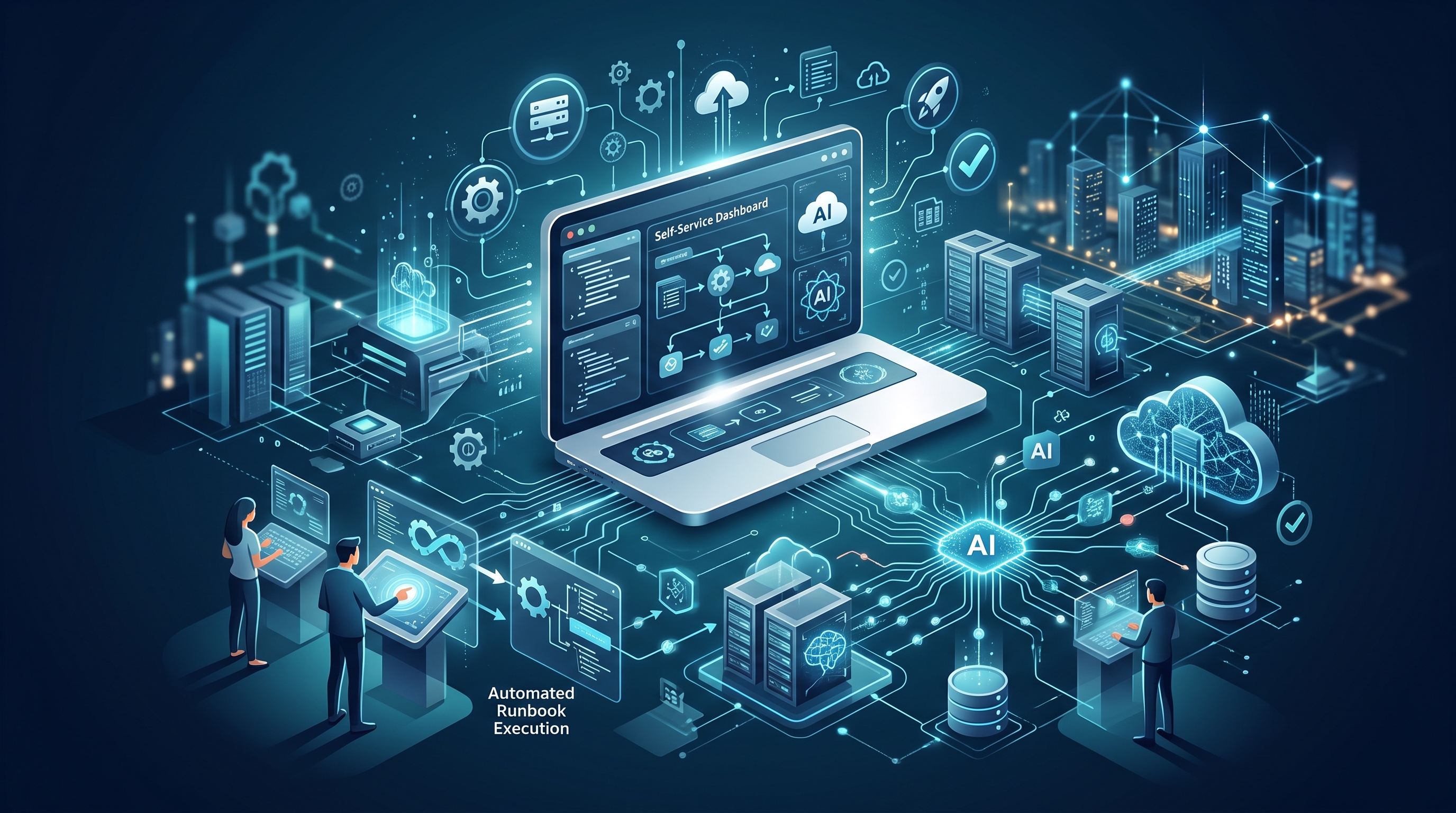
Building a self-service operation platform requires a clear separation of concerns. You need a frontend that abstracts complexity and a backend that executes with precision. The architecture typically involves an API gateway that authenticates users, validates permissions, and routes requests to appropriate automation engines.
Consider the following components essential for a robust implementation:
- Identity and Access Management (IAM): Strict RBAC policies ensure that only authorized personnel can trigger sensitive operations. This is non-negotiable in regulated environments.
- Orchestration Engine: Whether you use Kubernetes CronJobs, Argo Workflows, or custom Python scripts, the engine must handle state management and error retries.
- Observability Integration: Every action taken by the automation must be logged. If an agent restarts a pod, that event must appear in your tracing system alongside the original alert.
- Feedback Loop: The system must report success or failure back to the user and the monitoring stack. Silent failures are the enemy of trust.
We have found that integrating these components with AI-powered GitOps Kubernetes automation creates a seamless experience. When a developer triggers a self-service operation, the underlying changes are tracked in Git, ensuring full auditability. This approach aligns with the principles we discussed in our analysis of AI CI/CD pipeline automation 2026, where consistency and reproducibility are paramount.
The Role of Agentic AI in Remediation
The most significant leap in runbook automation self-service operations 2026 is the introduction of agentic AI. Traditional automation scripts are brittle; they fail if a variable changes or an unexpected error code appears. Agentic AI, however, can reason about context.
Imagine an alert for high CPU usage on a Kubernetes node. A static script might simply restart the container. An agentic system, however, can first check the logs, correlate the spike with recent deployments, and determine if the restart is the correct action or if the issue is a memory leak requiring a code fix. This level of nuance reduces false positives and prevents cascading failures.
We are seeing implementations where AI agents handle up to 60% of L1 and L2 support tickets autonomously. These agents do not replace SREs; they elevate them. SREs move from being "firefighters" to being "architects of reliability." They spend their time improving the underlying systems and refining the agents' decision trees rather than chasing down logs at 3 AM.
For a deeper dive into how these agents function, read our post on self-healing DevOps AI agents 2026. It details the specific architectures we use to ensure these agents operate within safe boundaries.
Security, Compliance, and the Human-in-the-Loop
In enterprise environments, autonomy cannot come at the cost of security. The "runbook automation self-service operations 2026" model must include robust guardrails. We implement policy-as-code using tools like OPA (Open Policy Agent) to ensure that no automation can bypass compliance requirements.
For high-risk operations, such as database schema changes or production deployments, we enforce a human-in-the-loop (HITL) workflow. The AI agent prepares the change, validates it against the policy, and presents it to a human approver for final confirmation. This hybrid approach maintains speed while ensuring accountability.
Furthermore, we treat the runbook automation itself as a product. This means it gets code reviews, unit tests, and integration tests. If the automation breaks, it is treated with the same severity as a production bug. This cultural shift is often harder to achieve than the technical implementation.
Measuring Success: Metrics That Matter
To justify the investment in runbook automation self-service operations 2026, you need to track the right metrics. Vanity metrics like "number of automated scripts" are meaningless. Instead, focus on:
- MTTR Reduction: Track the average time to resolve incidents before and after automation. A 50% reduction is a common target.
- Automation Coverage: What percentage of recurring alerts are handled without human intervention? Aim for 80% coverage for non-critical alerts.
- False Positive Rate: How often does the automation take incorrect action? This metric drives trust in the system.
- Developer Satisfaction: Survey your developers. Are they using the self-service portal? Is it saving them time?
We have observed that teams achieving these metrics see a significant decrease in burnout. When developers can solve their own operational problems, they feel more empowered and less dependent on the infrastructure team. This aligns with the broader trends in agentic AI vs RPA automation ROI 2026, where flexibility and adaptability outweigh rigid scripting.
Looking Ahead: Autonomous Operations
The trajectory is clear. We are moving from assisted operations to autonomous operations. The agentic AI vs RPA automation ROI 2026 analysis highlights that while RPA is good for repetitive, rule-based tasks, agentic AI is superior for complex, context-dependent operations.
In 2026, the best SRE teams are not just building runbooks; they are building ecosystems where AI agents continuously learn from incidents and improve their response strategies. This is not sci-fi; it is the current state of the art in high-performing financial and tech organizations.
The key is to start small. Pick one noisy alert. Write a script to handle it. Test it rigorously. Then, add an AI layer to handle edge cases. Iterate. The goal is not to eliminate humans from the loop but to elevate their role. By embracing runbook automation self-service operations 2026, we create systems that are more resilient, more secure, and more efficient.
Frequently Asked Questions
What is the difference between runbook automation and self-service operations?
Runbook automation refers to the technical execution of predefined steps. Self-service operations is the broader framework that allows users to trigger these automations through a user-friendly interface, often with embedded AI for decision support. Automation is the engine; self-service is the car.
How do I ensure security in an automated operational environment?
Security is ensured through strict identity management, policy-as-code validation, and audit logging. Every action must be traceable to a user or service account. High-risk actions should require human approval. We recommend using Open Policy Agent to enforce these rules consistently.
Is AI necessary for runbook automation in 2026?
While not strictly necessary for simple tasks, AI is becoming essential for complex, multi-step remediation. AI agents can handle context, correlate data, and make decisions that static scripts cannot. For high-volume environments, AI reduces the cognitive load on SREs significantly.
How long does it take to implement runbook automation self-service operations?
Implementation varies based on complexity. A basic self-service portal for a single service can be built in 2-3 months. However, achieving full enterprise-wide coverage with AI-driven decision-making is a 12-18 month journey. Start with a pilot program to demonstrate value and build momentum.