
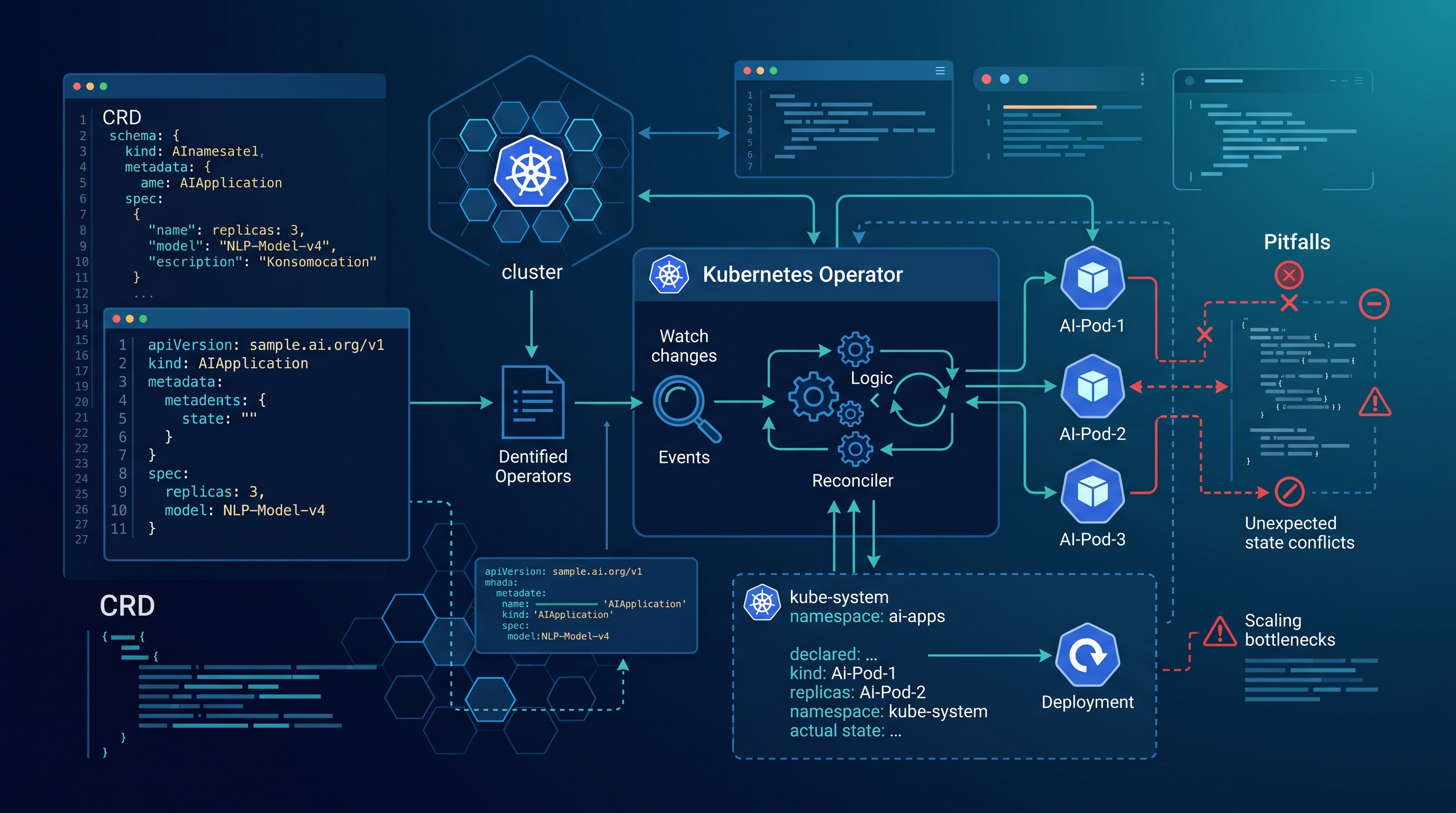
I’ve spent the last two decades at institutions like JPMorgan Chase and Morgan Stanley, watching the cloud-native landscape shift from fragile scripts to robust, declarative systems. In 2026, writing a Kubernetes operator is no longer a niche skill; it’s a core competency for anyone serious about enterprise infrastructure automation. But despite the maturity of the tooling, many operators fail in production because developers misunderstand the fundamental contract of the Kubernetes control loop.
Writing an operator is not about writing a script that runs once. It is about writing a state machine that runs forever. The goal is to ensure that the desired state defined in a Custom Resource Definition (CRD) is continuously reconciled against the actual state of the cluster. If you get the CRD design or the reconciler logic wrong, you will create systems that are difficult to debug, prone to race conditions, and eventually, a liability to your platform team.
CRD Design: The Foundation of Reliability
Before you write a single line of Go or Python, you must define your Custom Resource Definition (CRD) with surgical precision. The CRD is the API contract between your operator and the users of your platform. A poorly designed CRD leads to ambiguous states and difficult troubleshooting.
The most critical rule in CRD design is the separation of spec and status. The spec is what the user wants. The status is what the system currently has. Never allow the user to set the status field directly; that is the exclusive domain of your operator. This separation allows the Kubernetes API server to track drift and enables tools like GitOps to compare the desired state against the observed reality.
Consider the structure of your fields. Use x-kubernetes-preserve-unknown-fields sparingly and only when you have a specific reason to accept arbitrary JSON. For enterprise-grade operators, strict schema validation is preferable. It prevents users from submitting malformed configurations that might cause silent failures. I often see teams skip this step to save time, but the debugging overhead later is significant.
When defining your fields, think about the lifecycle. If a field is immutable after creation, mark it as such in the CRD schema. This prevents complex update logic that tries to modify resources that cannot be changed in place. For example, if you are managing a database instance, the initial configuration might be immutable, but the connection strings might need to be updated. Separate these concerns into different fields.
The Reconciler Loop: Idempotency and Error Handling
The reconciler is the heart of your operator. It reads the current state of the cluster and the desired state from the CRD, then applies the necessary changes. The most common mistake I see in new operators is the lack of idempotency. An idempotent reconciler produces the same result regardless of how many times it is called. This is non-negotiable.
Your reconciler must handle three types of outcomes: success, retry, and error.
- Success: The desired state is achieved. Return a clean result.
- Retry: A transient error occurred (e.g., network timeout, API rate limit). Return a result with a requeue duration. This allows the controller manager to retry the reconciliation after a delay, rather than failing immediately.
- Error: A permanent error occurred (e.g., invalid configuration, resource not found). Update the status condition to reflect the error and return an error object. This stops the reconciliation loop for that specific resource, preventing excessive logging and CPU usage.
In a production environment, you should aim for a reconciliation loop that is efficient. Polling the API server every second is wasteful. Instead, rely on the Kubernetes informers to trigger reconciliations only when relevant resources change. This event-driven approach reduces load on the API server and ensures that your operator reacts quickly to changes.
However, you must also handle the case where the informer cache is stale. When your operator starts up, the cache may not be fully synchronized. If you act on stale data, you might delete a resource that is actually needed. To mitigate this, implement a cache synchronization check at startup. Wait until the cache is synced before processing any events. This simple step prevents a significant class of startup bugs.
Managing State and Finalizers
State management in Kubernetes is tricky because resources can be deleted at any time. If your operator creates external resources (like a cloud instance or a database), you must ensure they are cleaned up when the Kubernetes resource is deleted. This is where finalizers come in.
A finalizer is a string added to the metadata.finalizers list of a resource. When a resource is deleted, Kubernetes prevents the deletion until all finalizers are removed. This gives your operator a chance to perform cleanup tasks.
Here is the pattern I recommend for implementing finalizers:
- Add the finalizer: When you create a resource, add a unique finalizer string to its
metadata.finalizerslist. - Handle deletion: In your reconciler, check if the resource has a deletion timestamp. If it does, it means the resource is being deleted.
- Perform cleanup: Execute your cleanup logic (e.g., delete the cloud instance, revoke permissions).
- Remove the finalizer: Once cleanup is complete, remove the finalizer string from the
metadata.finalizerslist.
This process ensures that external resources are not left orphaned. However, there is a pitfall: if your cleanup logic fails, the resource will remain in a "terminating" state indefinitely. To handle this, implement a timeout or a fallback mechanism. If cleanup fails, log a warning and continue, or escalate to an administrator. Do not let a failed cleanup block the entire cluster.
Common Pitfalls and Best Practices
After building dozens of operators for enterprise clients, I have identified several common pitfalls that lead to operational headaches. Avoiding these will save you significant time in the long run.
- Over-reconciliation: Do not reconcile everything on every event. Use field selectors to watch only the resources that matter. For example, if you are managing a database, you don’t need to reconcile when a ConfigMap changes unless it affects the database configuration.
- Ignoring Backpressure: If your operator creates too many resources too quickly, it can overwhelm the Kubernetes API server. Implement backpressure by limiting the number of concurrent reconciliations or by using a workqueue with a maximum depth.
- Lack of Observability: Your operator must expose metrics and logs. Expose metrics like
reconcile_total,reconcile_errors, andresource_age. Use structured logging to make debugging easier. Without observability, you are flying blind. - Testing in Production: Never test a new operator directly in production. Use a staging environment that mirrors production as closely as possible. Implement automated tests that verify the reconciler logic against various scenarios.
For more insights on integrating AI agents with Kubernetes, you might find my previous post on Agentic AI Security in Kubernetes Sandboxing useful. It covers how to secure AI workloads within the same ecosystem where your operators run.
Frequently Asked Questions
What is the difference between a controller and an operator? A controller is a generic term for any control loop that watches Kubernetes resources and reacts to changes. An operator is a specific type of controller that manages a custom resource (CRD) and encapsulates the operational knowledge for a specific application. All operators are controllers, but not all controllers are operators.
How do I handle retries in my reconciler? Use the reconcile.Result struct in Go. If you encounter a transient error, return reconcile.Result{Requeue: true, RequeueAfter: duration}. This tells the controller manager to retry the reconciliation after the specified duration. Avoid using time.Sleep in the reconciler function, as it blocks the entire controller loop.
Can I use non-Go languages to write Kubernetes operators? Yes, you can write operators in any language that can interact with the Kubernetes API. However, the Go ecosystem provides the most mature tooling, including client-go and controller-runtime. These libraries handle much of the boilerplate, such as cache synchronization and informer management. For enterprise-grade reliability, Go is the recommended choice.
How do I test my operator locally? Use tools like kind or minikube to create a local Kubernetes cluster. Deploy your operator in the cluster and create test CRs. Use kubectl to inspect the resources and logs to verify the behavior. Additionally, write unit tests for your reconciler logic using mock clients. This allows you to test edge cases without needing a full cluster.
For those interested in the broader context of AI automation in Kubernetes, check out AI-Powered GitOps for Kubernetes Automation. It explores how AI can enhance the GitOps workflows that often manage these operators.