
After 25 years in the trenches at institutions like JPMorgan Chase and Deutsche Bank, I’ve seen every paradigm shift from monolithic Java apps to microservices, and now to agentic AI. In 2026, the novelty has worn off. The question is no longer "Can we build an agent?" but "Can we run it reliably at scale without bankrupting the margin or violating compliance?"
The answer lies in AI agent observability production 2026. It is not merely logging. It is a fundamental shift in how we measure success, cost, and safety in stateful, multi-step AI workflows. If you are still treating LLM calls like simple HTTP endpoints, you are already behind.
The Failure of Traditional APM
Traditional Application Performance Monitoring (APM) tools were built for deterministic code. You trace a request, you see a latency spike, you find a slow database query. AI agents are non-deterministic. Two identical prompts can yield different reasoning paths, different tool calls, and different outcomes.
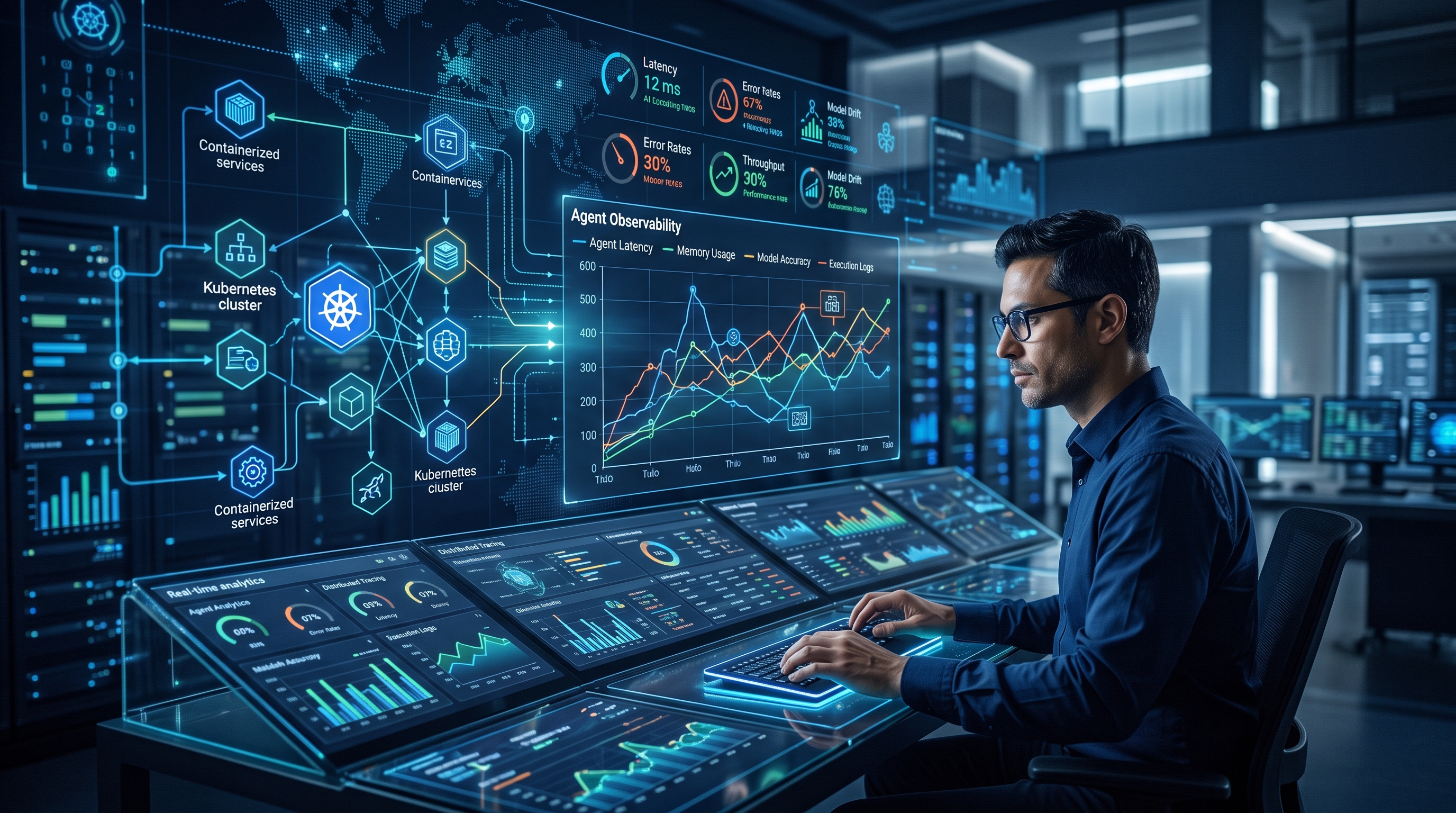
When you deploy an agent on Kubernetes, as detailed in my previous post on Kubernetes GenAI Architecture Patterns, you cannot rely on standard HTTP metrics alone. You need to observe the *reasoning* loop.
In my experience, teams that ignore this gap see error rates climb by 40% within the first quarter of production deployment. Why? Because they don't know *why* the agent failed. Did it hallucinate? Did it timeout on a tool? Did it hit a context window limit? Without granular observability, you are flying blind.
Instrumenting the Agent Lifecycle
To achieve true observability, we must instrument the three core components of any agentic system: the Planner, the Executor, and the Memory.
- Tracing the Reasoning Chain: Every step in an agent's thought process must be a span in your distributed trace. If an agent uses a ReAct loop, each "Thought -> Action -> Observation" cycle is a nested span. This allows you to visualize the decision tree.
- Context Window Metrics: You must monitor the size of the context window relative to the token budget. If your context exceeds 90% of the model's limit, latency will spike and costs will explode.
- Tool Execution Latency: External tool calls (APIs, databases) are often the bottleneck. Separate these from LLM inference latency.
I recommend using OpenTelemetry (OTel) for this. It is the de facto standard in enterprise DevOps. By wrapping your agent framework (LangChain, LlamaIndex, or custom) with OTel SDKs, you ensure that your traces are compatible with your existing Jaeger or Datadog infrastructure.
Cost and Performance Attribution
In enterprise finance, every dollar counts. In AI, every token counts. AI agent observability production 2026 demands that we attribute cost to specific business outcomes.
You need to track:
- Input Tokens: The cost of understanding the user's intent.
- Output Tokens: The cost of generating the response.
- Tool Call Tokens: The overhead of interacting with external systems.
If an agent takes 50 steps to answer a simple question, it is burning cash. My rule of thumb is to set a hard cap on step count. If an agent exceeds 10 steps for a simple query, it should trigger a fallback to a simpler model or a human-in-the-loop workflow.
Furthermore, you must monitor for drift. If the quality of responses degrades over time, it’s often due to data drift in the tools the agent interacts with, not the model itself. Implement automated evaluation suites that run against your production traffic, sampling 1% of requests to check for accuracy and safety.
Security and Governance in Production
Observability is not just about performance; it’s about safety. As discussed in Zero Trust AI Agents for Enterprise, every agent call must be authenticated and authorized.
Your observability platform must integrate with your identity provider. When an agent accesses a sensitive database, the trace must include the user ID, the role, and the justification for the access. This is critical for compliance in regulated industries.
Moreover, you need to monitor for prompt injection attacks. If a user input contains malicious instructions, your observability system should flag the anomaly in real-time. This requires a combination of static analysis and runtime monitoring.
The Developer Experience
Building observability into your agents is not an afterthought. It must be part of the developer experience. As we transition from DevOps to AgentOps, as outlined in my DevOps to AgentOps Enterprise Playbook, developers need tools that help them debug agent behavior.
Provide dashboards that show:
- Average step count per query.
- Tool call success rates.
- Latency percentiles (p50, p95, p99).
- Error rates by failure mode.
These metrics should be as visible as CPU and memory usage. If you can't see it, you can't improve it.
Frequently Asked Questions
Q: What is the biggest challenge in AI agent observability? A: The non-deterministic nature of LLM outputs makes it difficult to establish baselines. Traditional error detection doesn't work because "wrong" answers are subjective. You need semantic evaluation, not just string matching.
Q: How do I measure the ROI of an AI agent? A: Link agent actions to business KPIs. If an agent automates customer support, measure the reduction in human agent hours. If it aids developers, measure the time saved in code review. Observability provides the data, but you must define the metric.
Q: Is OpenTelemetry sufficient for AI observability? A: It is the foundation, but not the whole solution. OTel handles traces and metrics, but you need additional tools for semantic evaluation, prompt management, and guardrails. Integrate OTel with specialized AI observability platforms like Arize, Phoenix, or LangSmith for a complete view.
Q: How often should I retrain my agents? A: Continuously. Use production data to fine-tune your prompts and, if necessary, your models. Observability data should feed directly into your training pipelines. If you see a pattern of failures, update your few-shot examples or your system prompts immediately.
Conclusion
The era of "build and pray" is over. In 2026, enterprise success depends on rigorous, continuous observability of AI agents. It requires a blend of traditional DevOps practices and new AI-specific metrics. By instrumenting the reasoning chain, attributing costs, and enforcing governance, you can deploy agents that are not just smart, but reliable, safe, and profitable.
For those looking to implement this, start with your internal developer platform. As I've written about Internal Developer Platform with Backstage, standardizing the agent deployment process is the first step to standardizing its observability. Build the platform, instrument the agents, and watch your enterprise AI maturity soar.